Cellular Generation and Phenotyping Core Facility, Wellcome Sanger Institute, Cambridge, United Kingdom.
Department of Biology, Middle Tennessee State University, Murfreesboro, TN, United States.
Front Immunol. 2018 Dec 14;9:2962. doi: 10.3389/fimmu.2018.02962. eCollection 2018.
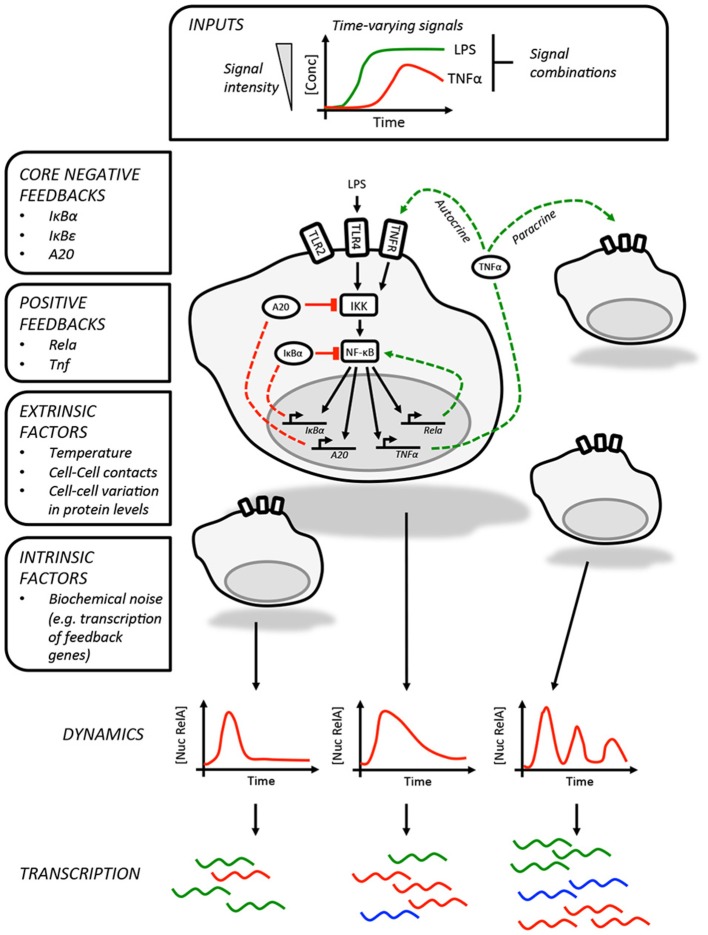
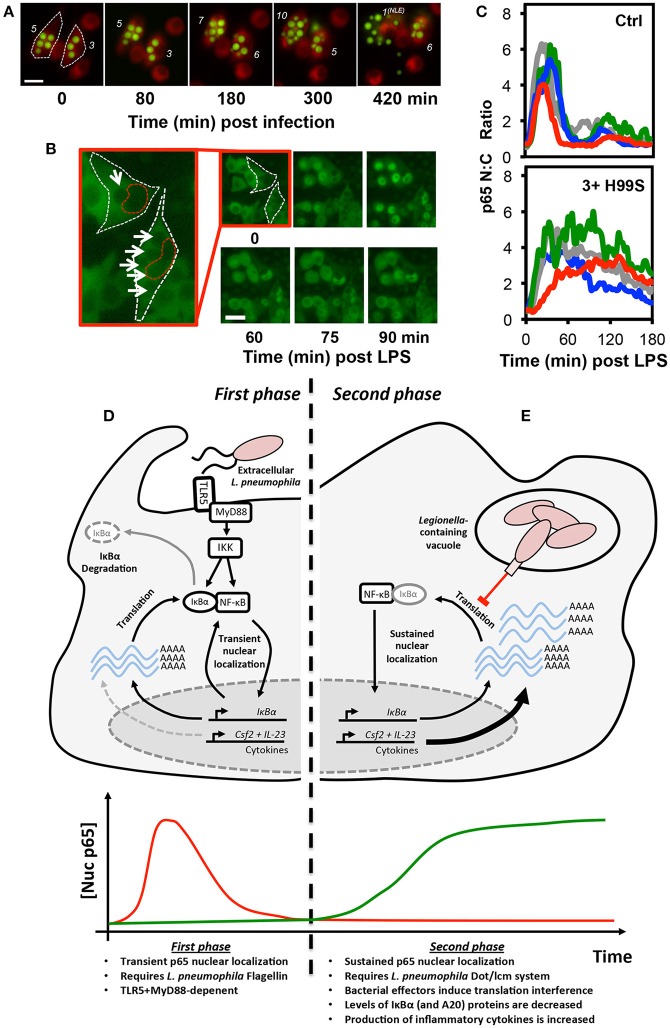
By uncovering complex dynamics in the expression or localization of transcriptional regulators in single cells that were otherwise hidden at the population level, live cell imaging has transformed our understanding of how cells sense and orchestrate appropriate responses to changes in their internal state or extracellular environment. This has proved particularly true for the nuclear factor-kappaB (NF-κB) family of transcription factors, key regulators of the inflammatory response and innate immune function, which are capable of encoding information about the mode and intensity of stimuli in the dynamics of NF-κB nuclear accumulation and loss. While live cell imaging continues to serve as a useful tool in ongoing efforts to characterize the feedbacks that shape these dynamics and to connect dynamics to downstream gene expression, it is also proving invaluable for recent studies that seek to determine how intracellular pathogens subvert NF-κB signaling to survive and replicate within host cells by providing quantitative information about the pathogen and changes in NF-κB activity during different stages of an infection. Here, we provide a brief overview of NF-κB signaling in innate immune cells and review recent literature that uses live imaging to investigate the mechanisms by which bacterial and yeast pathogens modulate NF-κB in a variety of different host cell types to evade destruction or maintain the viability of an intracellular growth niche.
通过揭示转录调控因子在单细胞中的表达或定位的复杂动态,而这些动态在群体水平上是隐藏的,活细胞成像改变了我们对细胞如何感知和协调对内部状态或细胞外环境变化的适当反应的理解。对于核因子-κB(NF-κB)转录因子家族来说尤其如此,NF-κB 是炎症反应和先天免疫功能的关键调节剂,能够在 NF-κB 核积累和损失的动力学中编码关于刺激模式和强度的信息。虽然活细胞成像继续作为一种有用的工具,用于描述这些动态的反馈,并将动态与下游基因表达联系起来,但它也为最近的研究提供了宝贵的支持,这些研究试图确定细胞内病原体如何通过提供关于病原体和 NF-κB 活性在感染不同阶段的变化的定量信息,来颠覆 NF-κB 信号转导,从而在宿主细胞中存活和复制。在这里,我们简要概述了先天免疫细胞中的 NF-κB 信号转导,并回顾了最近的文献,这些文献使用活细胞成像来研究细菌和酵母病原体在各种不同的宿主细胞类型中调节 NF-κB 的机制,以逃避破坏或维持细胞内生长小生境的活力。