Wahlberg Karin E, Guazzetti Stefano, Pineda Daniela, Larsson Susanna C, Fedrighi Chiara, Cagna Giuseppa, Zoni Silvia, Placidi Donatella, Wright Robert O, Smith Donald R, Lucchini Roberto G, Broberg Karin
Division of Occupational and Environmental Medicine, Lund University, Lund, Sweden.
Azienda USL-IRCCS di Reggio Emilia, Reggio Emilia, Italy.
Front Genet. 2018 Dec 20;9:664. doi: 10.3389/fgene.2018.00664. eCollection 2018.
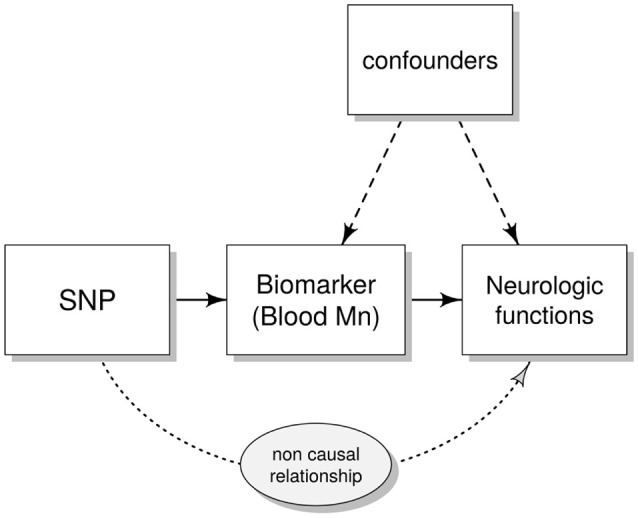
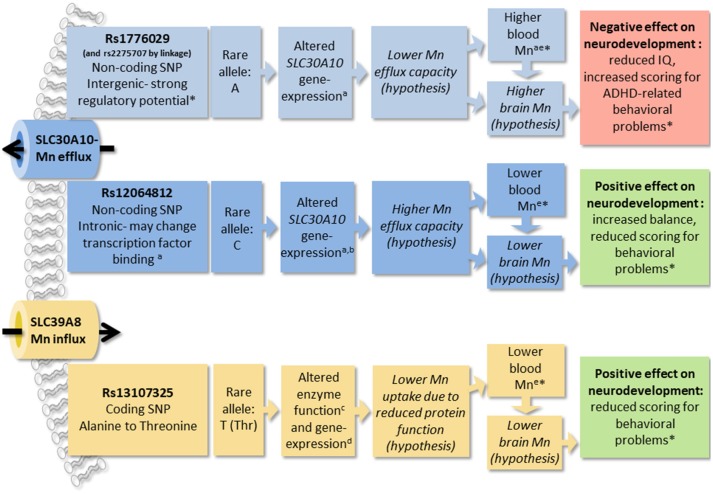
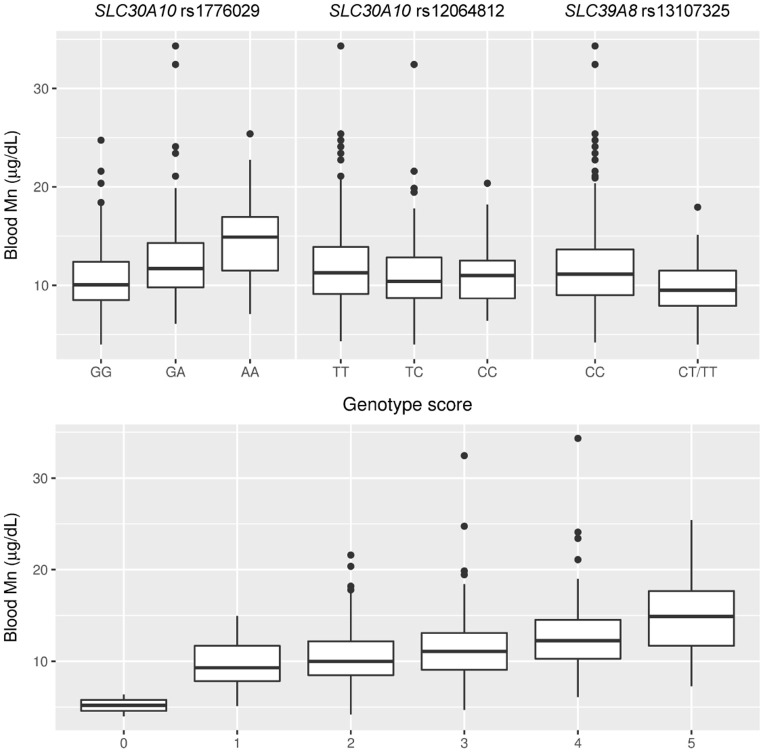
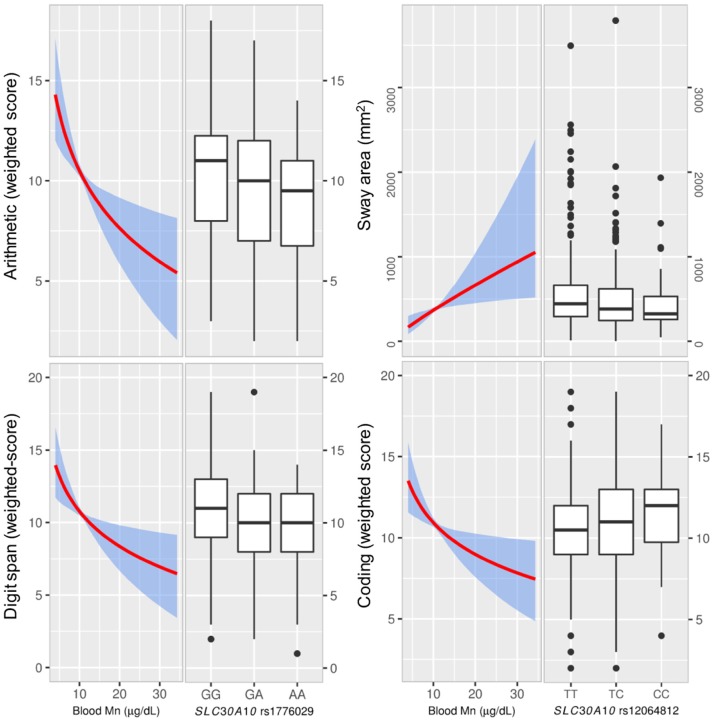
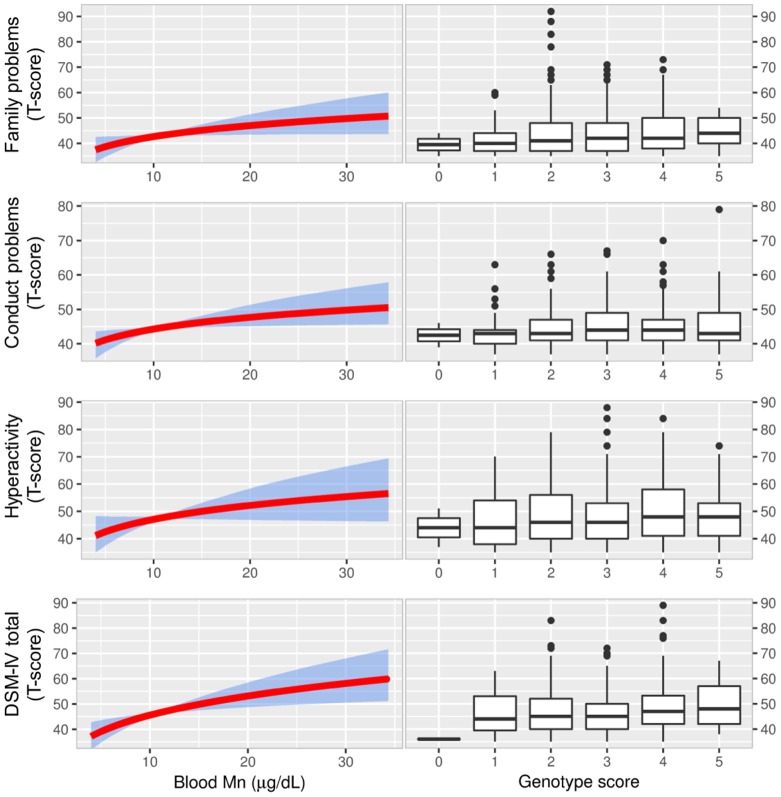
Manganese (Mn) is an essential element but at excessive levels, it is neurotoxic. Even a moderate increase in Mn has been suggested to interfere with neurodevelopment in children. Genetics influencing Mn concentrations and toxicity is unclear. We assessed, in a cross-sectional study, whether common single-nucleotide polymorphisms in the Mn transporters SLC39A8 (influx) and SLC30A10 (efflux) are associated with neurodevelopment in children. We genotyped (rs13107325 C/T) and (rs1776029 G/A and rs12064812 T/C) in Italian children ( = 686, ages 11-14). We then used linear regression models to analyze associations between genotype, blood Mn concentrations, and neurodevelopmental outcomes including intelligence, behavior, motor function, and sway. Inferred causal relationships were evaluated using instrumental variables (IV) analysis. For rs1776029, the minor allele (A) was associated with increased average blood Mn of 41% ( < 0.001), whereas minor alleles for rs12064812 (C) and rs13107325 (T) were associated with reduced blood Mn of 7% ( = 0.002) and 15% ( < 0.001), respectively. For children carrying genotypes associated with high blood Mn, we observed lower performance for certain IQ subtests, increased sway, and increased scores for behavioral problems. High Mn genotypes showed odds ratios of 2-4 ≤ 0.01) for high scores in tests assessing ADHD-related behavior. IV analyses suggested that several of the associations were mediated by blood Mn. Our results suggest that common polymorphisms in and influence neurodevelopmental outcomes in children via differences in Mn homeostasis.
锰(Mn)是一种必需元素,但过量时具有神经毒性。甚至有人提出,锰的适度增加也会干扰儿童的神经发育。影响锰浓度和毒性的遗传学尚不清楚。在一项横断面研究中,我们评估了锰转运蛋白SLC39A8(流入)和SLC30A10(流出)中的常见单核苷酸多态性是否与儿童神经发育有关。我们对意大利儿童(n = 686,年龄11 - 14岁)的rs13107325(C/T)以及rs1776029(G/A)和rs12064812(T/C)进行了基因分型。然后,我们使用线性回归模型分析基因型、血液锰浓度与神经发育结果(包括智力、行为、运动功能和摇摆)之间的关联。使用工具变量(IV)分析评估推断的因果关系。对于rs1776029,次要等位基因(A)与平均血液锰增加41%相关(P < 0.001),而rs12064812的次要等位基因(C)和rs13107325的次要等位基因(T)分别与血液锰降低7%(P = 0.002)和15%(P < 0.001)相关。对于携带与高血液锰相关基因型的儿童,我们观察到某些智商子测试成绩较低、摇摆增加以及行为问题得分增加。在评估多动症相关行为的测试中,高锰基因型的高分比值比为2 - 4(P ≤ 0.01)。IV分析表明,其中一些关联是由血液锰介导的。我们的结果表明,SLC39A8和SLC30A10中的常见多态性通过锰稳态的差异影响儿童的神经发育结果。