Alonso-Gómez Angel M, Tojal Sierra Lucas, Fortuny Frau Elena, Goicolea Güemez Leire, Aboitiz Uribarri Ane, Portillo María P, Toledo Estefanía, Schröder Helmut, Salas-Salvadó Jordi, Arós Borau Fernando
Department of Cardiology, Organización Sanitaria Integrada (OSI) ARABA, University Hospital Araba, Vitoria-Gasteiz, Spain.
Centro de Investigación Biomédica en Red de la Fisiopatología de la Obesidad y Nutrición (CIBEROBN), Instituto de Salud Carlos III (ISCIII), Madrid, Spain.
Int J Cardiol Heart Vasc. 2018 Dec 27;22:67-72. doi: 10.1016/j.ijcha.2018.12.010. eCollection 2019 Mar.
Left ventricle diastolic dysfunction (LVDD) is a common finding in high risk individuals, its presence being associated with reduced exercise capacity (EC). We assessed the prevalence of LVDD, applying the 2016 guidelines of the American Society of Echocardiography (ASE)/European Association of Cardiovascular Imaging (EACVI), in a population with overweight/obesity and metabolic syndrome and its association with EC.
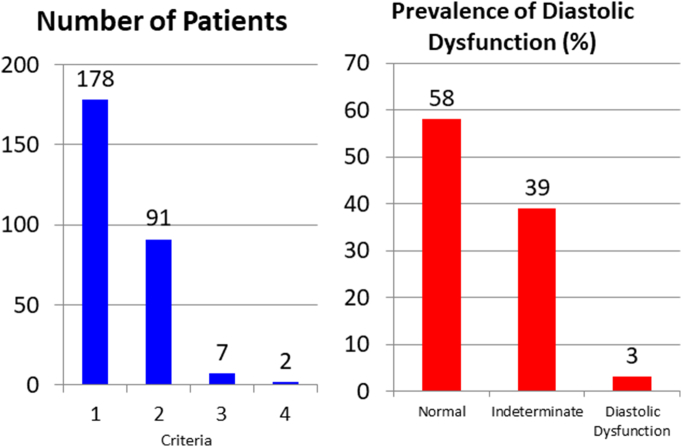
This was a prospective, cross-sectional study of a cohort of 235 patients (mean age of 65 ± 5 years old and 33% female) without heart disease and an ejection fraction >50% who underwent a complete echocardiographic assessment and cardiopulmonary exercise testing. Individuals meeting three or more criteria of the 2016 ASE/EACVI guidelines are considered to have LVDD, while tests are considered indeterminate in those meeting only two. Overall, 178 (76%) of our patients met one echocardiographic cutoff value for LVDD, 91 (39%) met two and 7 (3%) three or more. Patients meeting three cutoffs values showed a significant reduction in maximal oxygen uptake (16 ± 3 vs. 19.6 ± 5 ml/kg/min, p < .05), unlike those with indeterminate tests. In multiple regression analysis, meeting three cutoffs was associated with number of METS (ß = -2.2, p = .018). In exploratory analysis, using two criteria based on cutoffs different from those proposed in the guidelines, we identified groups with different EC.
The application of 2016 ASE/EACVI guidelines limited the prevalence of LVDD to 3%. This group showed a clear reduction of the EC. New echocardiographic cutoff values proposed in this study allow us to establish subgroups with different levels of EC.
左心室舒张功能障碍(LVDD)在高危个体中很常见,其存在与运动能力(EC)下降有关。我们应用美国超声心动图学会(ASE)/欧洲心血管影像协会(EACVI)2016年指南,评估超重/肥胖和代谢综合征人群中LVDD的患病率及其与EC的关系。
这是一项对235例患者(平均年龄65±5岁,33%为女性)进行的前瞻性横断面研究,这些患者无心脏病且射血分数>50%,接受了完整的超声心动图评估和心肺运动测试。符合2016年ASE/EACVI指南三项或更多标准的个体被认为患有LVDD,而仅符合两项标准的个体测试结果被认为不确定。总体而言,我们的患者中有178例(76%)符合LVDD的一项超声心动图临界值,91例(39%)符合两项,7例(3%)符合三项或更多。与测试结果不确定的患者不同,符合三项临界值的患者最大摄氧量显著降低(16±3 vs. 19.6±5 ml/kg/min,p<.05)。在多元回归分析中,符合三项临界值与代谢当量数量相关(β=-2.2,p=.018)。在探索性分析中,使用基于与指南中不同临界值的两个标准,我们确定了具有不同EC的组。
应用2016年ASE/EACVI指南将LVDD的患病率限制在3%。该组显示EC明显降低。本研究中提出的新的超声心动图临界值使我们能够建立具有不同EC水平的亚组。