Clancy David J, Scully Timothy, Slama Michel, Huang Stephen, McLean Anthony S, Orde Sam R
ICU, Nepean Hospital, Kingswood, NSW, 2747, Australia.
Medical ICU, Amiens University Hospital, Amiens, France.
Ann Intensive Care. 2017 Dec 19;7(1):121. doi: 10.1186/s13613-017-0342-x.
Left ventricular diastolic dysfunction is suggested to be associated with higher mortality in severe sepsis and septic shock, yet the methods of diagnosis described in the literature are often inconsistent. The recently published 2016 American Society of Echocardiography and European Association of Cardiovascular Imaging (ASE/EACVI) guidelines offer the opportunity to apply a simple pragmatic diagnostic algorithm for the detection of diastolic dysfunction; however, it has not been tested in this cohort.
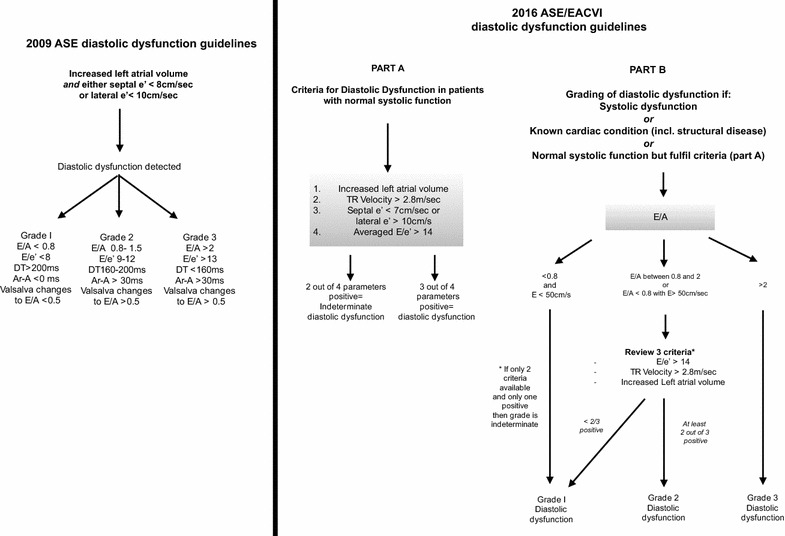
We sought to assess the applicability in septic patients of recently published 2016 ASE/EACVI guidelines on diastolic dysfunction compared with the 2009 ASE guidelines. Our hypothesis was that there would be poor agreement in classifying patients.
Prospective observational study includes patients identified as having severe sepsis and septic shock. Patients underwent transthoracic echocardiography on day 1 and day 3 of their ICU admission. Patients with normal and abnormal (ejection fraction < 52%) systolic function had their diastolic function stratified according to both the 2009 ASE and 2016 ASE/EACVI guidelines.
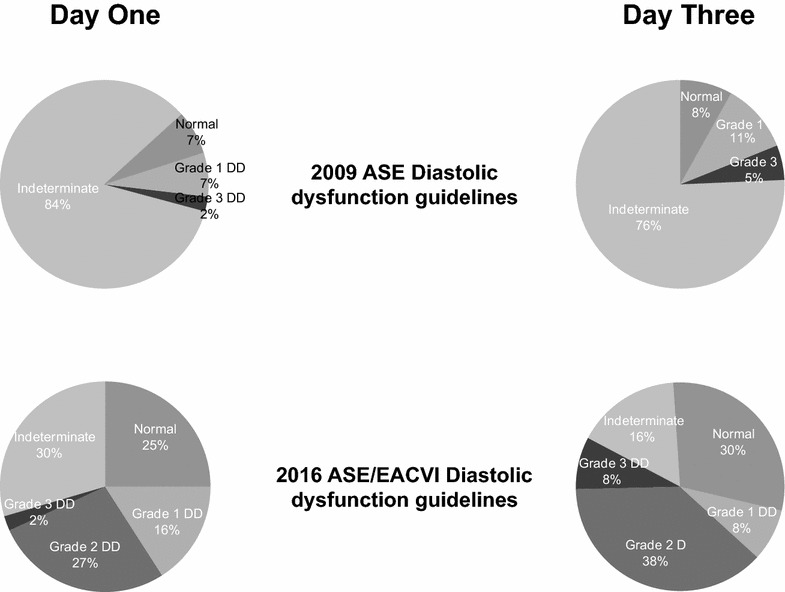
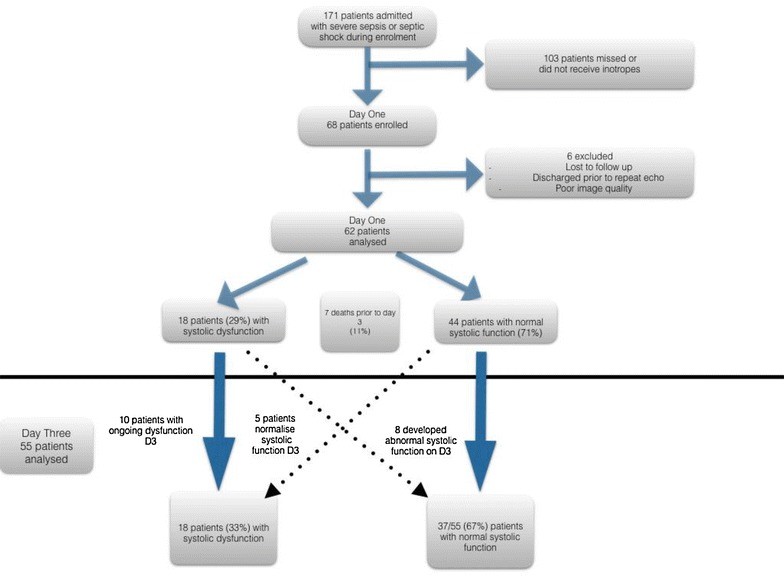
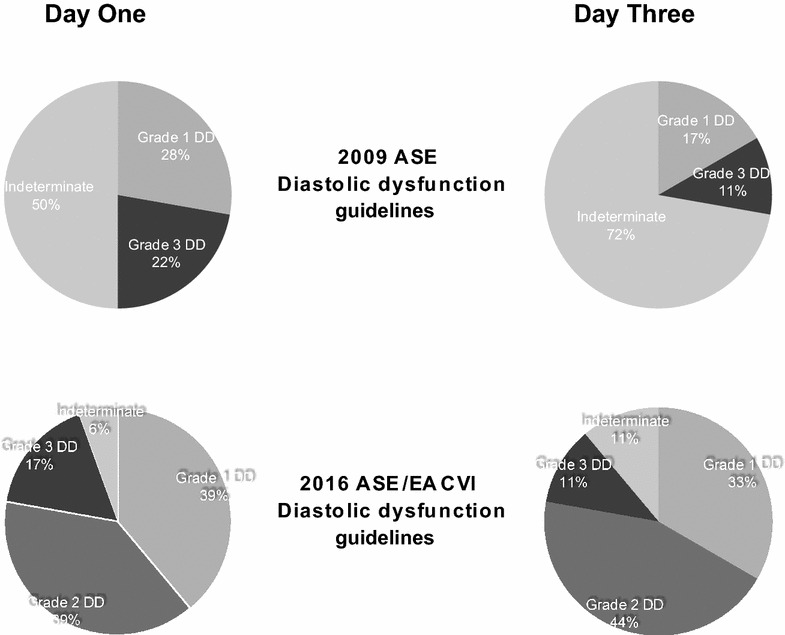
On day 1 echocardiography, of the 62 patients analysed, 37 (60%) had diastolic dysfunction according to the 2016 ASE/EACVI guideline with a further 23% having indeterminate diastolic function, compared to the 2009 ASE guidelines where only 13 (21%) had confirmed diastolic dysfunction with 46 (74%) having indeterminate diastolic dysfunction. On day 3, of the 55 patients studied, 22 patients (40%) were defined as having diastolic dysfunction, with 6 (11%) having indeterminate diastolic dysfunction according to the 2016 ASE/EACVI guidelines, compared to the 2009 guidelines where 11 (20%) were confirmed to have diastolic dysfunction and 41 (75%) had indeterminate diastolic function. Systolic dysfunction was identified in 18 of 62 patients (29%) on day 1 and 18 of 55 (33%) on day 3. These patients were classified as having abnormal diastolic function in 94 and 89% with the 2016 guidelines on day 1 and day 3, respectively, compared with 50 and 28% using the 2009 guidelines. The 2016 guidelines had less patients with indeterminate diastolic function on days 1 and 3 (11 and 6%) compared to the 2009 guidelines (50 and 72%). Normal systolic function was identified in 44 patients on day 1 and 37 on day 3. In this group, abnormal diastolic function was present in 45 and 54% on days 1 and 3 according to the 2016 ASE/EACVI guidelines, compared with 9 and 16% using the 2009 guidelines, respectively. In those with normal systolic function, the 2016 guidelines had less indeterminate patients with 30 and 16% on days 1 and 3, respectively, compared to 84 and 76% in the 2009 guidelines.
The 2016 ASE/EACVI diastolic function guidelines identify a significantly higher incidence of dysfunction in patients with severe sepsis and septic shock compared to the previous 2009 guidelines. Although the new guidelines seem to be an improvement, issues remain with the application of guidelines using traditional measures of diastolic dysfunction in this cohort.
左心室舒张功能障碍被认为与严重脓毒症和脓毒性休克的较高死亡率相关,但文献中描述的诊断方法往往不一致。最近发布的2016年美国超声心动图学会和欧洲心血管影像协会(ASE/EACVI)指南提供了应用一种简单实用的诊断算法来检测舒张功能障碍的机会;然而,尚未在该队列中进行测试。
我们试图评估与2009年ASE指南相比,2016年ASE/EACVI最近发布的舒张功能障碍指南在脓毒症患者中的适用性。我们的假设是在对患者进行分类时一致性较差。
前瞻性观察性研究纳入被确定为患有严重脓毒症和脓毒性休克的患者。患者在入住重症监护病房的第1天和第3天接受经胸超声心动图检查。收缩功能正常和异常(射血分数<52%)的患者,其舒张功能根据2009年ASE指南和2016年ASE/EACVI指南进行分层。
在第1天的超声心动图检查中,在分析的62例患者中,根据2016年ASE/EACVI指南,37例(60%)有舒张功能障碍,另有23%舒张功能不确定;相比之下,根据2009年ASE指南,只有13例(21%)确诊有舒张功能障碍,46例(74%)舒张功能不确定。在第3天,在研究的55例患者中,根据2016年ASE/EACVI指南,22例患者(40%)被定义为有舒张功能障碍,6例(11%)舒张功能不确定;相比之下,根据2009年指南,11例(20%)确诊有舒张功能障碍,41例(75%)舒张功能不确定。第1天62例患者中有18例(29%)被确定有收缩功能障碍,第3天55例中有18例(33%)。根据2016年指南,这些患者在第1天和第3天分别有94%和89%被归类为舒张功能异常,而使用2009年指南时分别为50%和28%。与2009年指南(50%和72%)相比,2016年指南在第1天和第3天舒张功能不确定的患者较少(11%和6%)。第1天确定44例患者收缩功能正常,第3天确定37例。在这组患者中,根据2016年ASE/EACVI指南,第1天和第3天分别有45%和54%存在舒张功能异常,而使用2009年指南时分别为9%和16%。在收缩功能正常的患者中,2016年指南在第1天和第3天舒张功能不确定的患者较少,分别为30%和16%,而2009年指南中为84%和76%。
与之前的2009年指南相比,2016年ASE/EACVI舒张功能指南确定严重脓毒症和脓毒性休克患者中舒张功能障碍的发生率显著更高。尽管新指南似乎有所改进,但在该队列中使用传统舒张功能障碍测量方法应用指南仍存在问题。