Department of Epidemiology and Preventive Medicine, School of Public Health and Preventive Medicine, Monash University, Melbourne, Australia.
Institute of Advanced Studies, University of São Paulo, São Paulo, Brazil.
Environ Health Perspect. 2019 Jan;127(1):17001. doi: 10.1289/EHP3889.
Limited evidence is available regarding the association between heat exposure and morbidity in Brazil and how the effect of heat exposure on health outcomes may change over time.
This study sought to quantify the geographic, demographic and temporal variations in the heat–hospitalization association in Brazil from 2000–2015.
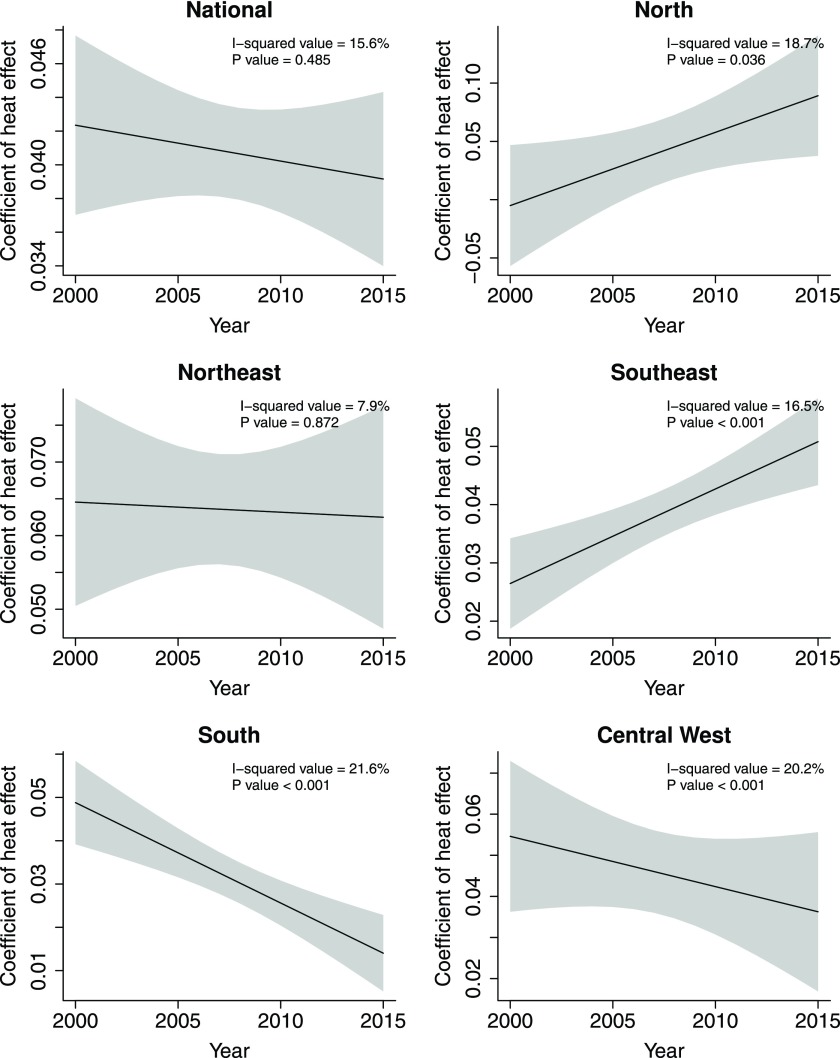
Data on hospitalization and meteorological conditions were collected from 1,814 cities during the 2000–2015 hot seasons. Quasi-Poisson regression with constrained lag model was applied to examine city-specific estimates, which were then pooled at the regional and national levels using random-effect meta-analyses. Stratified analyses were performed by sex, 10 age groups, and 11 cause categories. Meta-regression was used to examine the temporal change in estimates of heat effect from 2000 to 2015.
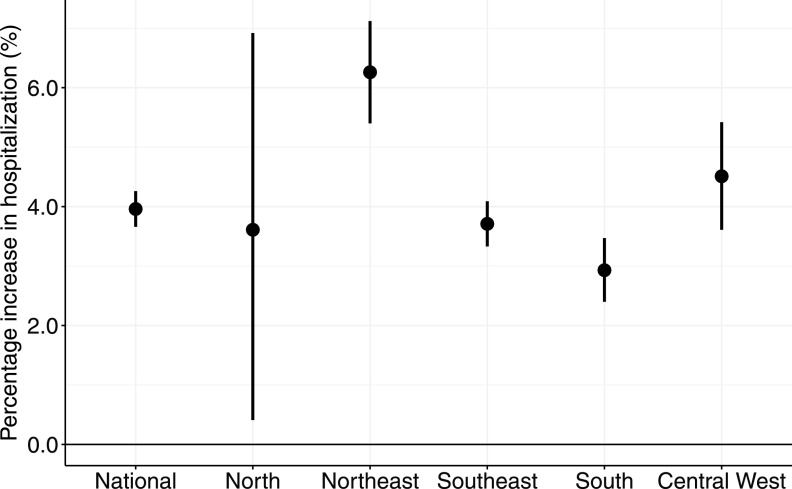
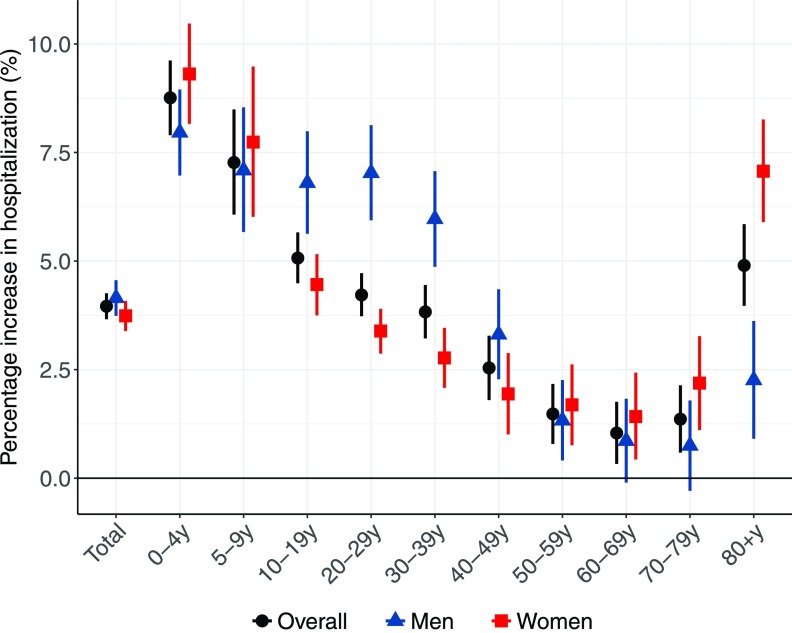
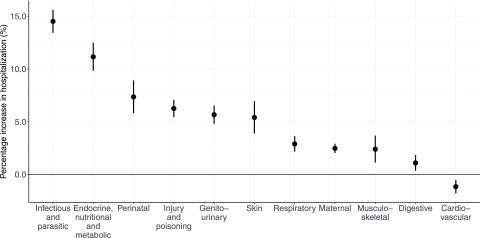
For every 5°C increase in daily mean temperature during the 2000–2015 hot seasons, the estimated risk of hospitalization over lag 0-7 d rose by 4.0% [95% confidence interval (CI): 3.7%, 4.3%] nationwide. Estimated 6.2% [95% empirical CI (eCI): 3.3%, 9.1%] of hospitalizations were attributable to heat exposure, equating to 132 cases (95% eCI: 69%, 192%) per 100,000 residents. The attributable rate was greatest in children [Formula: see text] and was highest for hospitalizations due to infectious and parasitic diseases. Women of reproductive age and those [Formula: see text] had higher heat burden than men. The attributable burden was greatest for cities in the central west and the inland of the northeast; lowest in the north and eastern coast. Over the 16-y period, the estimated heat effects declined insignificantly at the national level.
In Brazil's hot seasons, 6% of hospitalizations were estimated to be attributed to heat exposure. As there was no evidence indicating that thermal adaptation had occurred at the national level, the burden of hospitalization associated with heat exposure in Brazil is likely to increase in the context of global warming. https://doi.org/10.1289/EHP3889.
关于热暴露与巴西发病率之间的关系,以及热暴露对健康结果的影响随时间的变化,现有证据有限。
本研究旨在量化 2000-2015 年期间巴西热暴露与住院率关联的地理、人口统计学和时间变化。
收集了 2000-2015 年热季期间来自 1814 个城市的住院和气象条件数据。采用具有约束滞后模型的拟泊松回归来检验城市特定的估计值,然后使用随机效应荟萃分析在区域和国家层面进行汇总。按性别、10 个年龄组和 11 个病因类别进行分层分析。Meta 回归用于检验 2000 年至 2015 年期间热效应估计值的时间变化。
在 2000-2015 年热季期间,每日平均温度每升高 5°C,滞后 0-7d 的住院风险估计增加 4.0%[95%置信区间(CI):3.7%,4.3%],全国范围内均如此。估计有 6.2%[95%经验 CI(eCI):3.3%,9.1%]的住院可归因于热暴露,相当于每 10 万居民中有 132 例(95%eCI:69%,192%)。儿童的归因率最高[公式:见文本],因传染病和寄生虫病住院的归因率最高。生育年龄的妇女和[公式:见文本]的热负荷高于男性。内陆城市和中西部城市的归因负担最大;北部和东部沿海城市的归因负担最小。在 16 年期间,全国范围内的热效应估计值没有显著下降。
在巴西的热季,估计有 6%的住院可归因于热暴露。由于没有证据表明全国范围内已经发生了热适应,因此,在全球变暖的背景下,巴西与热暴露相关的住院负担可能会增加。https://doi.org/10.1289/EHP3889.