Department of Cardiology, Erasmus Medical Center, Rotterdam, the Netherlands.
Netherlands Heart Institute, Utrecht, the Netherlands.
PLoS One. 2019 Jan 8;14(1):e0210329. doi: 10.1371/journal.pone.0210329. eCollection 2019.
To provide a comprehensive overview of cardiovascular disease (CVD) risk prediction models for women and models that include female-specific predictors.
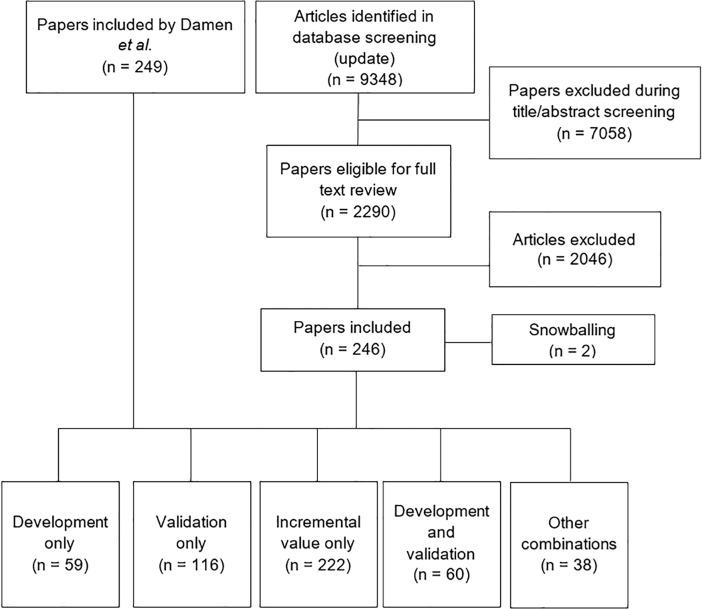
We performed a systematic review of CVD risk prediction models for women in the general population by updating a previous review. We searched Medline and Embase up to July 2017 and included studies in which; (a) a new model was developed, (b) an existing model was validated, or (c) a predictor was added to an existing model.
A total of 285 prediction models for women have been developed, of these 160 (56%) were female-specific models, in which a separate model was developed solely in women and 125 (44%) were sex-predictor models. Out of the 160 female-specific models, 2 (1.3%) included one or more female-specific predictors (mostly reproductive risk factors). A total of 591 validations of sex-predictor or female-specific models were identified in 206 papers. Of these, 333 (56%) validations concerned nine models (five versions of Framingham, SCORE, Pooled Cohort Equations and QRISK). The median and pooled C statistics were comparable for sex-predictor and female-specific models. In 260 articles the added value of new predictors to an existing model was described, however in only 3 of these female-specific predictors (reproductive risk factors) were added.
There is an abundance of models for women in the general population. Female-specific and sex-predictor models have similar predictors and performance. Female-specific predictors are rarely included. Further research is needed to assess the added value of female-specific predictors to CVD models for women and provide physicians with a well-performing prediction model for women.
提供一份关于女性心血管疾病(CVD)风险预测模型和包含女性特异性预测因子的模型的全面综述。
我们通过更新先前的综述,对一般人群中女性 CVD 风险预测模型进行了系统评价。我们检索了 Medline 和 Embase 数据库,检索时间截至 2017 年 7 月,纳入了以下研究:(a)开发了新模型;(b)验证了现有模型;或(c)在现有模型中添加了预测因子。
共开发了 285 个女性预测模型,其中 160 个(56%)为女性特异性模型,即专门在女性中开发的模型,125 个(44%)为性别预测模型。在 160 个女性特异性模型中,有 2 个(1.3%)包含一个或多个女性特异性预测因子(主要是生殖危险因素)。在 206 篇论文中确定了 591 次对性别预测或女性特异性模型的验证。其中,333 次验证(56%)涉及 9 个模型(Framingham、SCORE、Pooled Cohort Equations 和 QRISK 的五个版本)。性别预测模型和女性特异性模型的中位数和汇总 C 统计值相当。在 260 篇文章中描述了新预测因子对现有模型的增值作用,但只有 3 篇文章中添加了女性特异性预测因子(生殖危险因素)。
一般人群中存在大量的女性模型。女性特异性和性别预测模型具有相似的预测因子和性能。很少有研究添加女性特异性预测因子。需要进一步研究,以评估女性特异性预测因子对女性 CVD 模型的增值作用,并为医生提供性能良好的女性预测模型。