UCL Great Ormond Street Institute of Child Health, London, United Kingdom.
Health Protection Scotland, Glasgow, United Kingdom.
Euro Surveill. 2019 Jan;24(1). doi: 10.2807/1560-7917.ES.2019.24.1.1800046.
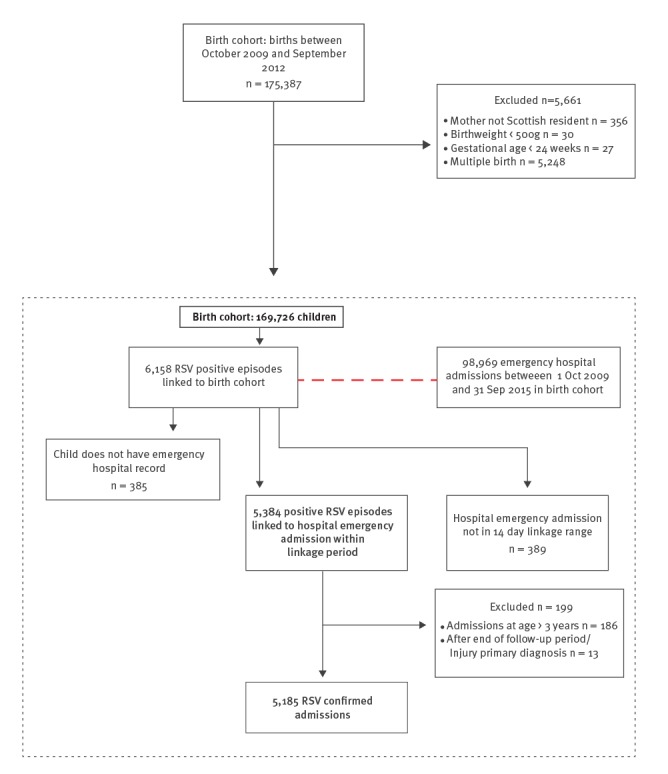
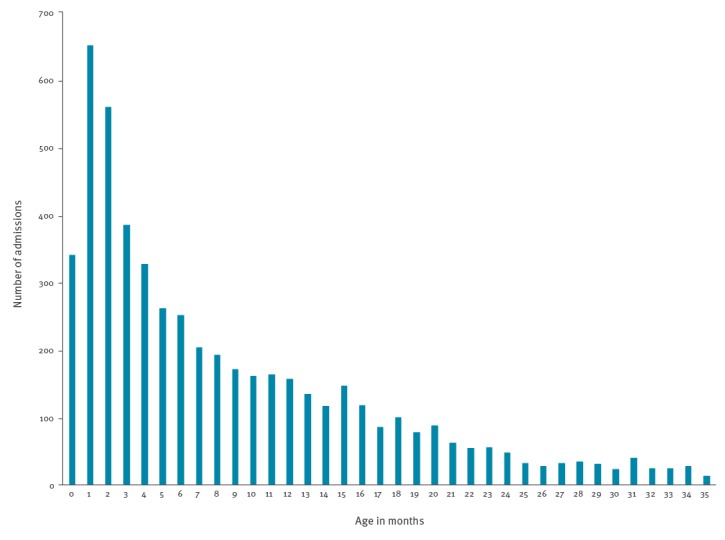
IntroductionSeveral vaccines for respiratory syncytial virus (RSV) are under development. Designing an effective vaccination programme for RSV requires information about the relative contribution of risk factors for severe RSV symptoms.AimTo inform preventive strategies in Europe by quantifying the contribution of key child, family and health service risk factors to the burden of RSV hospital admissions in young children.MethodsWe constructed a birth cohort study of all singleton children born in Scotland between October 2009 and September 2012 using linkage between birth registration, maternity, vaccination and hospital admission records, with follow-up until the age of 3 years. RSV-confirmed hospital admissions were defined using linkage to national laboratory surveillance data. We estimated hospital admission rates per 1,000 child years and length of stay according to each risk factor. Cox proportional hazard regression models were used to estimate adjusted hazard ratios.ResultsThere were 5,185 RSV admissions among the 169,726 children in the cohort: 48.6% of admissions occurred before the age of 6 months, and 29.6% after the age of 1 year. Children born prematurely, small for gestational age, between July and December, with chronic conditions, older siblings, mothers < 30 years old or delayed infant vaccination had a significantly increased risk of admission. Minimising the risk posed by older siblings could reduce RSV admissions by up to 34%.ConclusionFuture RSV vaccination programmes must protect children throughout early childhood. Vaccination and/or interventions to reduce transmission by older siblings could substantially reduce RSV hospital admissions.
简介
目前有多种针对呼吸道合胞病毒(RSV)的疫苗正在研发中。为了制定有效的 RSV 疫苗接种计划,我们需要了解导致 RSV 症状严重的相关风险因素。
目的
通过量化儿童、家庭和医疗服务相关风险因素对婴幼儿 RSV 住院负担的相对贡献,为欧洲的预防策略提供信息。
方法
我们构建了一个苏格兰 2009 年 10 月至 2012 年 9 月出生的单胎儿童队列研究,通过出生登记、产妇、疫苗接种和住院记录进行了链接,随访至 3 岁。通过与国家实验室监测数据的链接来定义 RSV 确诊的住院病例。我们根据每个风险因素估计了每 1000 名儿童年的住院率和住院时间。使用 Cox 比例风险回归模型来估计调整后的危险比。
结果
在该队列的 169726 名儿童中,共有 5185 例 RSV 住院病例:48.6%的住院发生在 6 个月之前,29.6%发生在 1 岁之后。早产、小于胎龄、7 月至 12 月出生、有慢性疾病、有哥哥姐姐、母亲年龄<30 岁或婴儿疫苗接种延迟的儿童,其住院风险显著增加。减少年龄较大的兄弟姐妹带来的风险,可使 RSV 住院减少多达 34%。
结论
未来的 RSV 疫苗接种计划必须在整个幼儿期为儿童提供保护。疫苗接种和/或干预措施来减少年龄较大的兄弟姐妹传播 RSV,可显著减少 RSV 住院。