Renal Division, Department of Medicine, Brigham and Women's Hospital, Boston, Massachusetts; and.
Department of Nephrology and Rheumatology, University Medical Center of the Johannes Gutenberg University Mainz, Mainz, Germany.
J Am Soc Nephrol. 2019 Feb;30(2):244-259. doi: 10.1681/ASN.2018090901. Epub 2019 Jan 8.
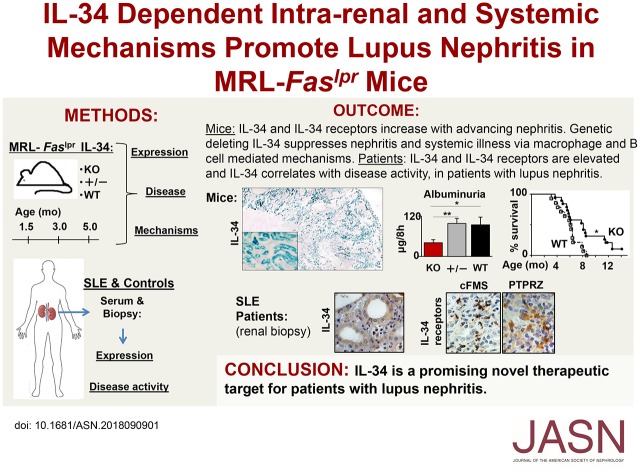
In people with SLE and in the MRL- lupus mouse model, macrophages and autoantibodies are central to lupus nephritis. IL-34 mediates macrophage survival and proliferation, is expressed by tubular epithelial cells (TECs), and binds to the cFMS receptor on macrophages and to a newly identified second receptor, PTPRZ.
To investigate whether IL-34-dependent intrarenal and systemic mechanisms promote lupus nephritis, we compared lupus nephritis and systemic illness in MRL- mice expressing IL-34 and IL-34 knockout (KO) MRL- mice. We also assessed expression of IL-34 and the cFMS and PTPRZ receptors in patients with lupus nephritis.
Intrarenal IL-34 and its two receptors increase during lupus nephritis in MRL- mice. In knockout mice lacking IL-34, nephritis and systemic illness are suppressed. IL-34 fosters intrarenal macrophage accumulation monocyte proliferation in bone marrow (which increases circulating monocytes that are recruited by chemokines into the kidney) and intrarenal macrophage proliferation. This accumulation leads to macrophage-mediated TEC apoptosis. We also found suppression of circulating autoantibodies and glomerular antibody deposits in the knockout mice. This is consistent with fewer activated and proliferating intrarenal and splenic B cells in mice lacking IL-34, and with our novel discovery that PTPRZ is expressed by macrophages, B and T cells. These findings appear translatable to human patients with lupus nephritis, whose expression of IL-34, cFMS, and PTPRZ is similar to that seen in the MRL- lupus mouse model. Moreover, expression of IL-34 in TECs correlates with disease activity.
IL-34 is a promising novel therapeutic target for patients with lupus nephritis.
在患有系统性红斑狼疮的患者和 MRL-狼疮小鼠模型中,巨噬细胞和自身抗体是狼疮肾炎的核心。IL-34 介导巨噬细胞的存活和增殖,由肾小管上皮细胞 (TEC) 表达,并与巨噬细胞上的 cFMS 受体以及新发现的第二个受体 PTPRZ 结合。
为了研究 IL-34 依赖性的肾内和全身机制是否促进狼疮肾炎,我们比较了表达 IL-34 的 MRL-小鼠和 IL-34 敲除 (KO) MRL-小鼠的狼疮肾炎和系统性疾病。我们还评估了狼疮肾炎患者中 IL-34 的表达及其两个受体。
在 MRL-小鼠的狼疮肾炎中,肾内 IL-34 及其两个受体增加。在缺乏 IL-34 的 KO 小鼠中,肾炎和系统性疾病受到抑制。IL-34 促进肾内巨噬细胞积聚和骨髓中单核细胞增殖(这增加了循环单核细胞,这些单核细胞通过趋化因子募集到肾脏)以及肾内巨噬细胞增殖。这种积聚导致巨噬细胞介导的 TEC 凋亡。我们还发现 KO 小鼠中循环自身抗体和肾小球抗体沉积减少。这与缺乏 IL-34 的小鼠中肾脏和脾脏内的活化和增殖 B 细胞减少一致,并且我们的新发现表明 PTPRZ 在巨噬细胞、B 和 T 细胞中表达。这些发现似乎可转化为狼疮肾炎患者,其 IL-34、cFMS 和 PTPRZ 的表达与 MRL-狼疮小鼠模型相似。此外,TEC 中 IL-34 的表达与疾病活动度相关。
IL-34 是狼疮肾炎患者有前途的新型治疗靶点。