Sarrionandia Ainize, Ramos-Díaz Estibaliz, Fernández-Lasarte Oihane
Department of Personality, Assessment and Psychological Treatments, Faculty of Psychology, University of the Basque Country, Donostia-San Sebastian, Spain.
Developmental and Educational Psychology Department, Education and Sport Faculty, University of the Basque Country, Vitoria-Gasteiz, Spain.
Front Psychol. 2018 Dec 21;9:2653. doi: 10.3389/fpsyg.2018.02653. eCollection 2018.
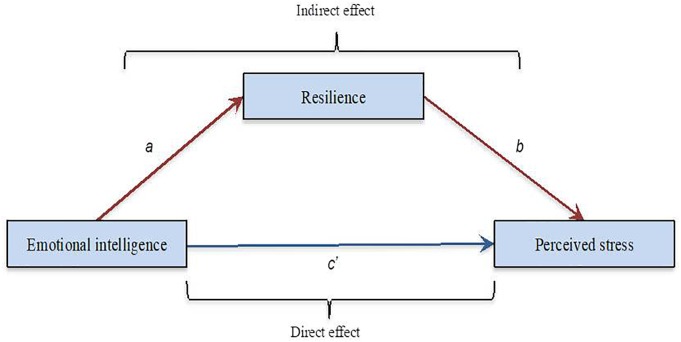
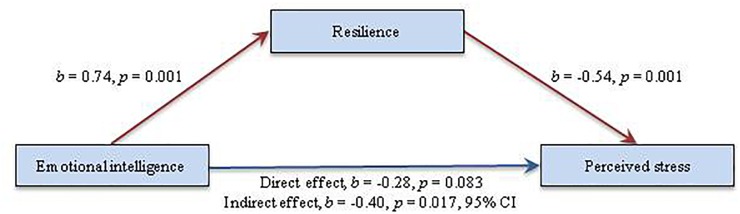
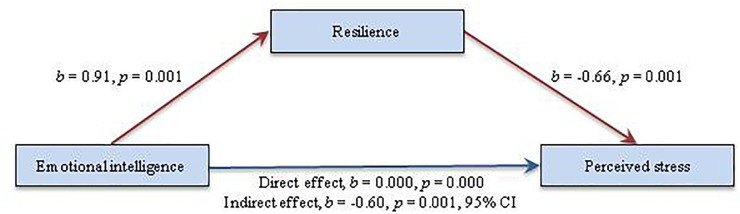
Existing literature provides evidence of the connection between emotional intelligence and resilience, both concepts being adversely related to perceived stress. Nevertheless, there is little evidence from cross-cultural and/or cross-country studies of the simultaneous relationship between these psychological variables. The objective of this study was to address this lack of research, examining the associations between emotional intelligence, resilience and perceived stress in a cross-country context. A total sample of 696 undergraduate students from two universities in the United States and the Basque Country (an autonomous community in northern Spain) participated in the study. Structural equation modeling was used to examine the effects of emotional intelligence and resilience that may affect students' perceived stress. The results revealed that emotional intelligence functions as a negative predictor of perceived stress through the mediating variable resilience for the American and Basque students. The findings suggest that university students with better emotional intelligence and resilience present lower perceived stress. Thus, improving emotional intelligence and resilience could prevent students from suffering perceived stress in higher education. Implications and directions for further research are discussed; in particular, it is highlighted that intervention programs that improve both EI and resilience could be helpful in reducing perceived stress.
现有文献证明了情商与心理韧性之间的联系,这两个概念均与感知压力呈负相关。然而,跨文化和/或跨国研究中关于这些心理变量之间同步关系的证据很少。本研究的目的是填补这一研究空白,在跨国背景下考察情商、心理韧性与感知压力之间的关联。来自美国和巴斯克地区(西班牙北部的一个自治区)两所大学的696名本科生参与了本研究。采用结构方程模型来检验情商和心理韧性可能对学生感知压力产生的影响。结果显示,对于美国和巴斯克地区的学生来说,情商通过中介变量心理韧性对感知压力起到负向预测作用。研究结果表明,情商和心理韧性较好的大学生感知压力较低。因此,提高情商和心理韧性可以防止大学生在高等教育中遭受感知压力。文中讨论了研究的意义和进一步研究的方向;特别强调的是,提高情商和心理韧性的干预项目可能有助于减轻感知压力。