Victor Sarah E, Hipwell Alison E, Stepp Stephanie D, Scott Lori N
Department of Psychiatry, University of Pittsburgh, Sterling Plaza Suite 408, Pittsburgh, PA 15213 USA.
Child Adolesc Psychiatry Ment Health. 2019 Jan 3;13:1. doi: 10.1186/s13034-018-0261-0. eCollection 2019.
Adolescence is characterized by developmental changes in social relationships, which may contribute to, or protect against, psychopathology and risky behaviors. Non-suicidal self-injury (NSSI) is one type of risky behavior that typically begins during adolescence and is associated with problems in relationships with family members and peers. Prior research on social factors in adolescent NSSI has been limited, however, by a narrow focus on specific interpersonal domains, cross-sectional methods, retrospective self-report of childhood experiences, and a failure to predict NSSI onset among as-yet-unaffected youth.
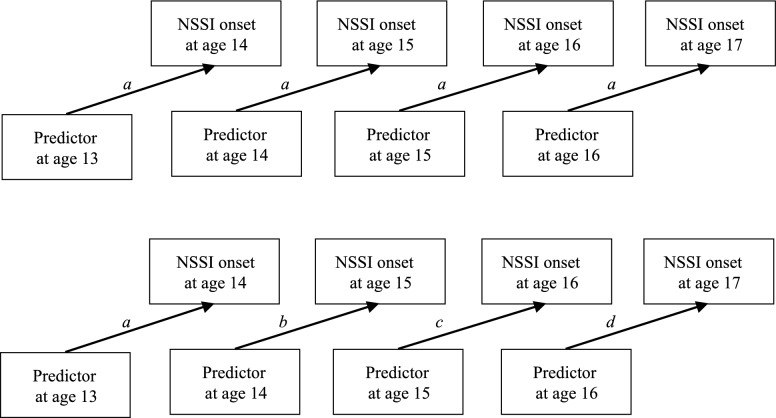
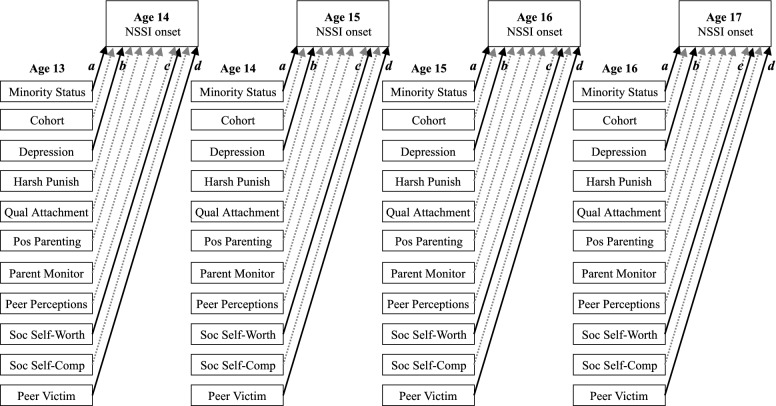
We investigated these relationships in 2127 urban-living adolescent girls with no NSSI history at age 13, who were participating in a longitudinal cohort study (Pittsburgh Girls Study). We used discrete-time survival analyses to examine the contribution of time-varying interpersonal risk factors, assessed yearly at ages 13-16, to NSSI onset assessed in the following year (ages 14-17), controlling for relevant covariates, such as depression and race. We considered both behavioral indicators (parental discipline, positive parenting, parental monitoring, peer victimization), and cognitive/affective indicators (quality of attachment to parent, perceptions of peers, and perceptions of one's own social competence and worth in relation to peers) of interpersonal difficulties.
Parental harsh punishment, low parental monitoring, and poor quality of attachment to parent predicted increased odds of subsequent adolescent NSSI onset, whereas positive parenting behaviors reduced the odds of next year NSSI onset. Youth who reported more frequent peer victimization, poorer social self-worth and self-competence, and more negative perceptions of peers were also at increased risk of NSSI onset in the following year. When tested simultaneously, no single parenting variable showed a unique association with later NSSI onset; in contrast, peer victimization and poor social self-worth each predicted increased odds of later NSSI onset in an omnibus model of peer and parent relationship characteristics.
In this urban sample of adolescent girls, both peer and parent factors predicted new onset NSSI, although only peer factors were associated with subsequent NSSI in combined multivariate models. Results further suggest that both behavioral and cognitive/affective indicators of interpersonal problems predict NSSI onset. These findings highlight the relevance of family and peer relationships to NSSI onset, with implications for prevention of NSSI onset among at-risk youth.
青春期的特点是社会关系发生发展变化,这可能会导致精神病理学和危险行为,也可能起到预防作用。非自杀性自伤(NSSI)是一种危险行为,通常始于青春期,与家庭成员和同伴关系中的问题有关。然而,先前关于青少年非自杀性自伤社会因素的研究存在局限性,主要集中在特定的人际领域,采用横断面研究方法,回顾性自我报告童年经历,并且未能预测尚未受影响的青少年中NSSI的发病情况。
我们对2127名13岁时无NSSI病史的城市青少年女孩进行了研究,她们参与了一项纵向队列研究(匹兹堡女孩研究)。我们使用离散时间生存分析来检验在13至16岁每年评估的随时间变化的人际风险因素对次年(14至17岁)评估的NSSI发病的影响,并控制相关协变量,如抑郁和种族。我们考虑了人际困难的行为指标(父母管教、积极养育、父母监督、同伴受害)和认知/情感指标(与父母的依恋质量、对同伴的看法以及对自己相对于同伴的社会能力和价值的看法)。
父母的严厉惩罚、父母监督不足以及与父母的依恋质量差预示着青少年后续NSSI发病几率增加,而积极的养育行为则降低了次年NSSI发病的几率。报告同伴受害更频繁、社会自我价值和自我能力较差以及对同伴的负面看法更多的青少年,次年NSSI发病风险也更高。同时进行测试时,没有单一的养育变量显示出与后期NSSI发病有独特关联;相比之下,在同伴和父母关系特征的综合模型中,同伴受害和社会自我价值差各自都预示着后期NSSI发病几率增加。
在这个城市青少年女孩样本中,同伴和父母因素都预示着新发性NSSI,尽管在多变量综合模型中只有同伴因素与后续NSSI相关。结果进一步表明,人际问题的行为和认知/情感指标都能预测NSSI发病。这些发现凸显了家庭和同伴关系与NSSI发病的相关性,对预防高危青少年的NSSI发病具有启示意义。