Psychiatry Institute of Mental Health/Peking University Sixth Hospital, Peking University, Beijing, China.
Henan Key Lab of Biological Psychiatry, The Second Affiliated Hospital of Xinxiang Medical University, Xinxiang, China.
Brain Behav. 2019 Feb;9(2):e01201. doi: 10.1002/brb3.1201. Epub 2019 Jan 9.
Cognitive behavioral therapy (CBT) is an effective treatment for Obsessive-compulsive disorder (OCD). Structural and functional white matter defects may suggest a vital neurobiological basis of OCD. However, the effects of CBT on white matter in OCD remain unknown.
The aim was to investigate white matter changes and the effect of CBT on white matter in OCD patients.
Fractional anisotropy (FA) maps were acquired using DTI. Participants included 85 patients with OCD and 90 healthy controls. VBM was then performed to detect regions with significant group differences.
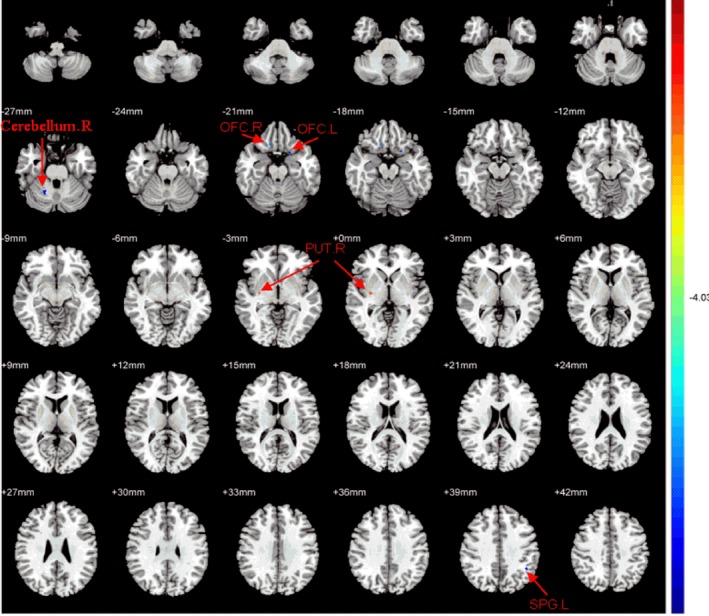
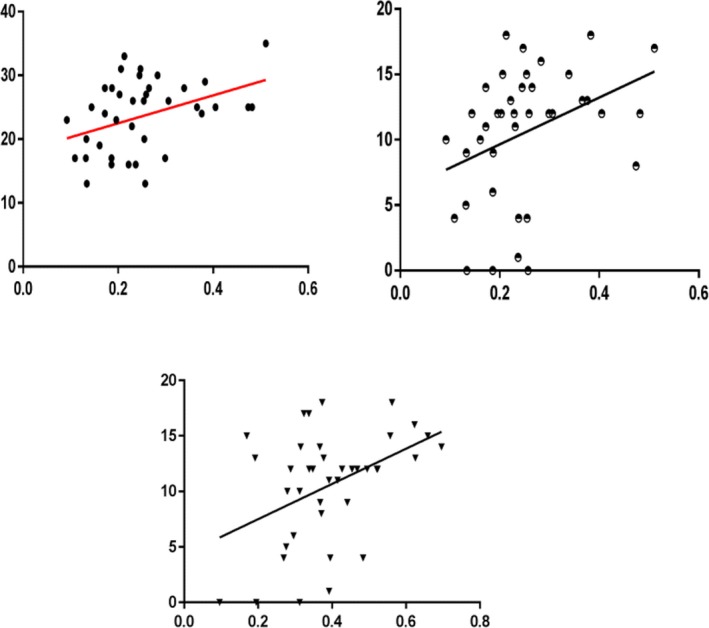
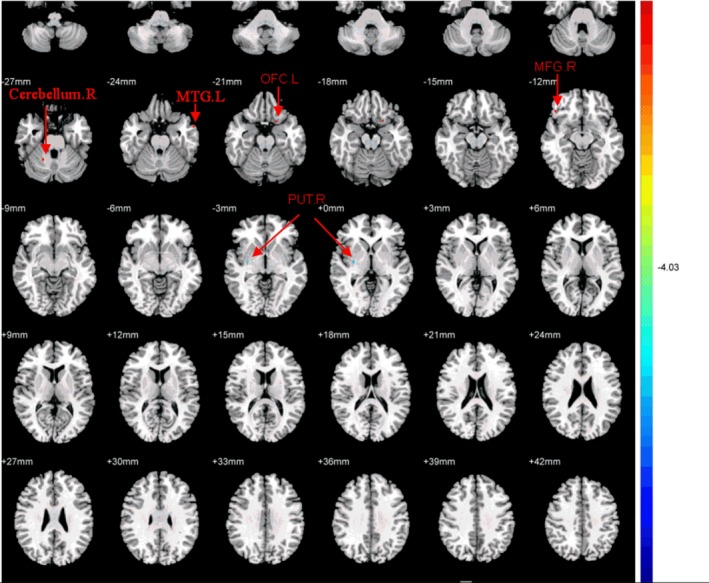
Obsessive-compulsive disorder patients exhibited significantly reduced FA values in bilateral OFC, right cerebellum, and left SPG, while higher FA values were observed in right PUT compared with healthy controls. Following CBT, OCD patients showed higher FA values in right MFG, left OFC, right cerebellum, and left MTG, and decreased FA values in right PUT in comparison with pretreatment. Furthermore, FA values in the left OFC of patients were significantly positively correlated with the Y-BOCS and its associated Compulsions subscale, and FA values in the right PUT were positively correlated with Compulsions subscale. In addition, the percentage change in FA values in left MTG was positively correlated with the percentage reduction in Compulsions subscale, while the percentage change in FA values in left OFC and right PUT was negatively correlated with the percentage reductions in Obsessive and Compulsions subscale, respectively.
Our findings demonstrate the abnormalities of white matter microstructure in unmedicated patients with OCD. These abnormalities may be partly reversed by CBT.
认知行为疗法(CBT)是治疗强迫症(OCD)的有效方法。结构和功能的白质缺陷可能提示 OCD 的重要神经生物学基础。然而,CBT 对 OCD 患者白质的影响尚不清楚。
旨在探讨 OCD 患者白质变化及 CBT 对其的影响。
采用弥散张量成像(DTI)获得各向异性分数(FA)图。研究对象包括 85 例 OCD 患者和 90 名健康对照者。然后进行基于体素的形态学分析(VBM)以检测组间存在显著差异的区域。
与健康对照组相比,OCD 患者双侧眶额皮质(OFC)、右侧小脑和左侧扣带回下回(SPG)的 FA 值明显降低,右侧壳核(PUT)的 FA 值明显升高。经 CBT 治疗后,OCD 患者右侧额中回(MFG)、左侧 OFC、右侧小脑和左侧颞中回(MTG)的 FA 值升高,右侧 PUT 的 FA 值降低。此外,患者左侧 OFC 的 FA 值与 Y-BOCS 及其相关的强迫症状子量表呈显著正相关,右侧 PUT 的 FA 值与强迫症状子量表呈正相关。此外,左侧 MTG 的 FA 值变化百分比与强迫症状子量表的降低百分比呈正相关,而左侧 OFC 和右侧 PUT 的 FA 值变化百分比与强迫和强迫观念子量表的降低百分比呈负相关。
本研究结果表明,未经药物治疗的 OCD 患者存在白质微观结构异常,CBT 可能部分逆转这些异常。