NIHR Newcastle Biomedical Research Center, Campus for Aging and Vitality, Newcastle upon Tyne, United Kingdom.
Institute for Cellular Medicine, Newcastle University, Newcastle upon Tyne, United Kingdom.
Am J Clin Nutr. 2019 Jan 1;109(1):207-217. doi: 10.1093/ajcn/nqy280.
Vitamin D insufficiency is common in older people and may lead to increased bone resorption, bone loss, and increased falls and fractures. However, clinical trials assessing the effect of vitamin D supplementation on bone mineral density (BMD) have yielded conflicting results.
This study examined the effect of vitamin D supplementation on BMD at the hip, using dual-energy X-ray absorptiometry.
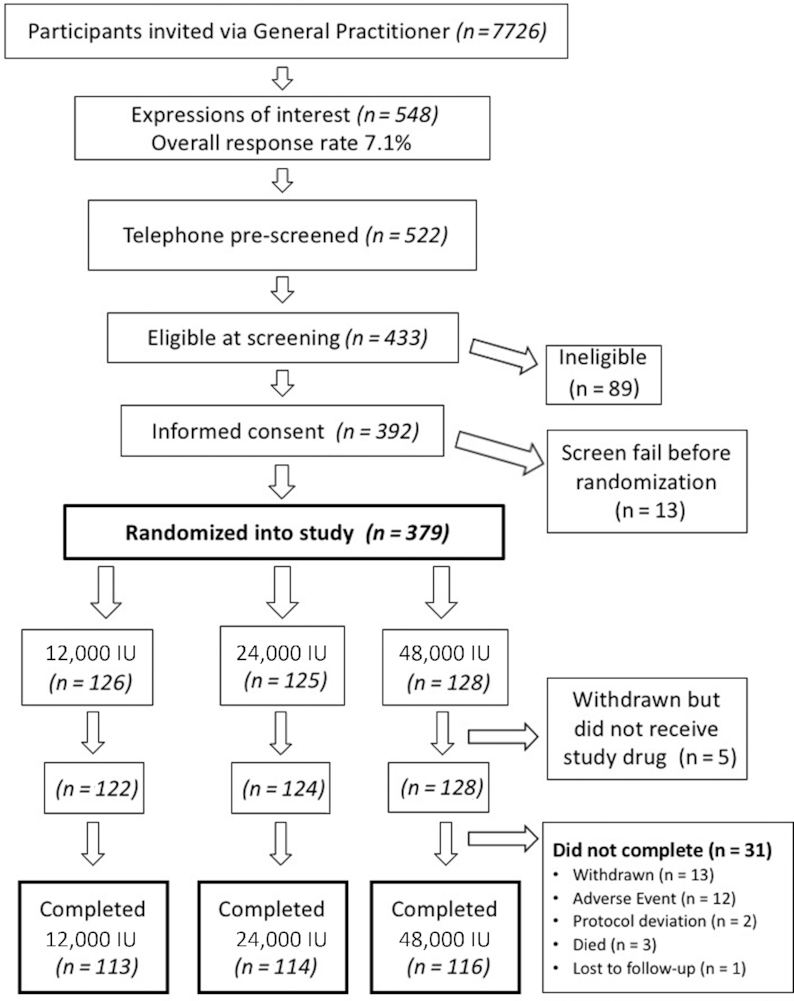
A total of 379 adults aged ≥70 y (48% women; mean age: 75 y) from the northeast of England were randomly allocated to 1 of 3 doses of vitamin D3 [12,000 international units (IU), 24,000 IU, or 48,000 IU] given once a month. The primary outcome was change in BMD (ΔBMD) at the hip. Secondary endpoints comprised the dose effects on femoral neck BMD, falls, circulating calciotropic hormones, bone turnover markers, and adverse events.
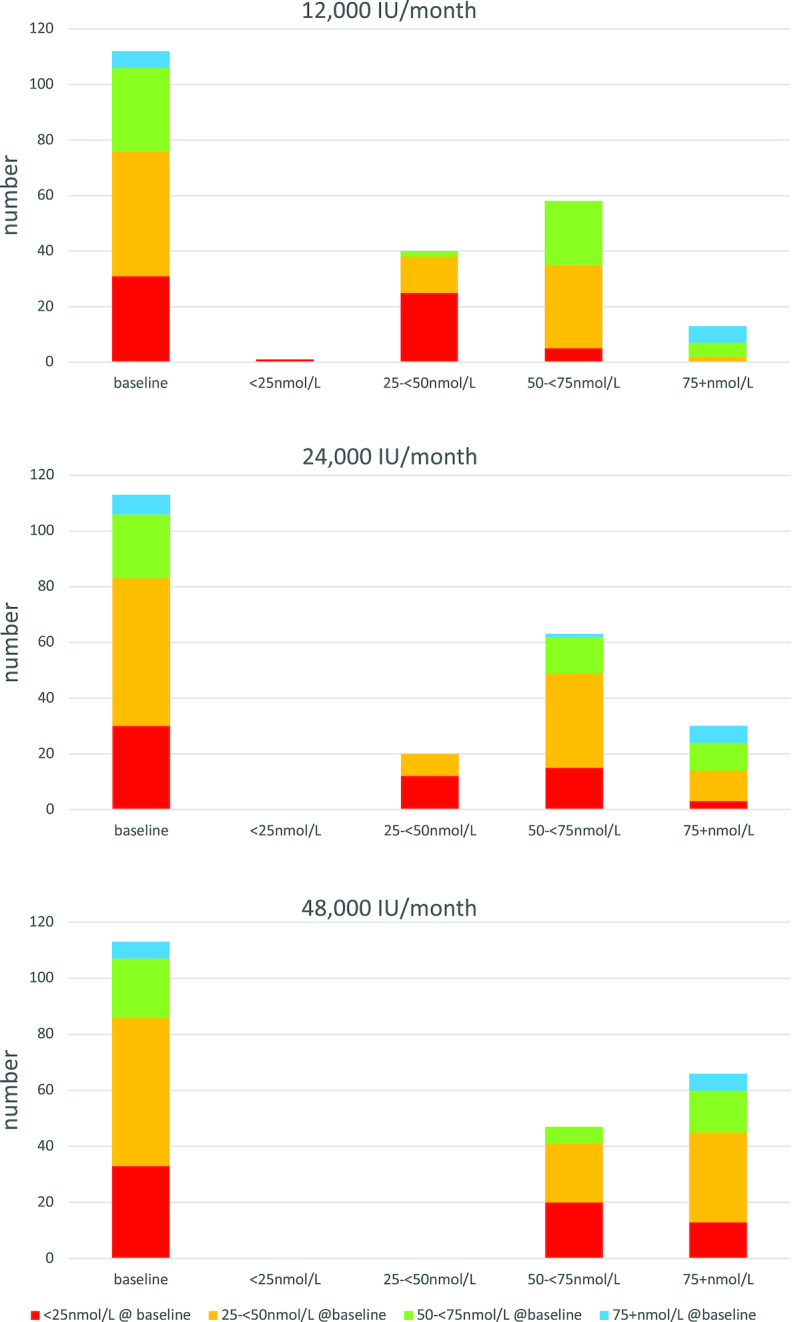
The mean ± SD baseline plasma 25-hydroxyvitamin D [25(OH)D] concentration was 40.0 ± 20.1 nmol/L, which increased after 12 mo to a mean 25(OH)D of 55.9, 64.6, or 79.0 nmol/L for participants receiving a monthly dose of 12,000, 24,000, or 48,000 IU, respectively (P < 0.01 for difference). There was no between-group difference in ΔBMD. However, parathyroid hormone concentrations decreased in all 3 groups, with a significantly greater decrease in the 48,000-IU group compared with the 12,000-IU group (P < 0.01). There were no differences in any adverse events between groups, with 3 cases of hypercalcemia, none of nephrolithiasis, and 249 falls observed.
There was no difference in change in BMD over 12 mo between the 3 doses of vitamin D, suggesting no effect of the intervention or a similar attenuation of the anticipated decrease in BMD over 12 mo. The treatment was safe and effective in increasing plasma 25(OH)D concentrations, with no dose-related adverse events. This trial was registered at the EU Clinical Trials Register (EudraCT 2011-004890-10) and the ISRCTN Registry (ISRCTN35648481).
老年人普遍存在维生素 D 不足的情况,这可能导致骨吸收增加、骨质流失增加,以及跌倒和骨折的风险增加。然而,评估维生素 D 补充对骨密度(BMD)影响的临床试验结果却存在差异。
本研究采用双能 X 射线吸收法检测维生素 D 补充对髋部 BMD 的影响。
共纳入英格兰东北部 379 名年龄≥70 岁的成年人(48%为女性;平均年龄:75 岁),他们被随机分配至 3 个剂量组(12000IU、24000IU 或 48000IU)的维生素 D3 治疗方案(每月一次)。主要结局为髋部 BMD 的变化(ΔBMD)。次要终点包括股骨颈 BMD、跌倒、循环钙调节激素、骨转换标志物和不良事件的剂量效应。
基线时,参与者的平均(±SD)血浆 25-羟维生素 D [25(OH)D] 浓度为 40.0±20.1nmol/L,12 个月后,分别接受 12000、24000 和 48000IU 剂量的参与者的 25(OH)D 浓度平均升高至 55.9、64.6 和 79.0nmol/L(组间差异 P<0.01)。各组之间的 ΔBMD 无差异。然而,甲状旁腺激素浓度在所有 3 个组中均下降,且 48000IU 组与 12000IU 组相比下降更为显著(P<0.01)。各组之间在任何不良事件方面均无差异,观察到 3 例高钙血症,无肾结石,发生 249 例跌倒。
在 12 个月期间,3 种剂量的维生素 D 对 BMD 的变化没有差异,这表明干预措施没有效果,或者对 12 个月期间 BMD 预期下降的抑制作用相似。该治疗方案在增加血浆 25(OH)D 浓度方面是安全有效的,没有剂量相关的不良事件。本试验在欧盟临床试验注册库(EudraCT 2011-004890-10)和国际临床试验注册平台(ISRCTN35648481)进行了注册。