Rieke Elizabeth L, Soupir Michelle L, Moorman Thomas B, Yang Fan, Howe Adina C
Agricultural and Biosystems Engineering, Iowa State University, Ames, IA, United States.
National Laboratory for Agriculture and the Environment, United States Department of Agriculture-Agricultural Research Service, Ames, IA, United States.
Front Microbiol. 2018 Dec 21;9:3197. doi: 10.3389/fmicb.2018.03197. eCollection 2018.
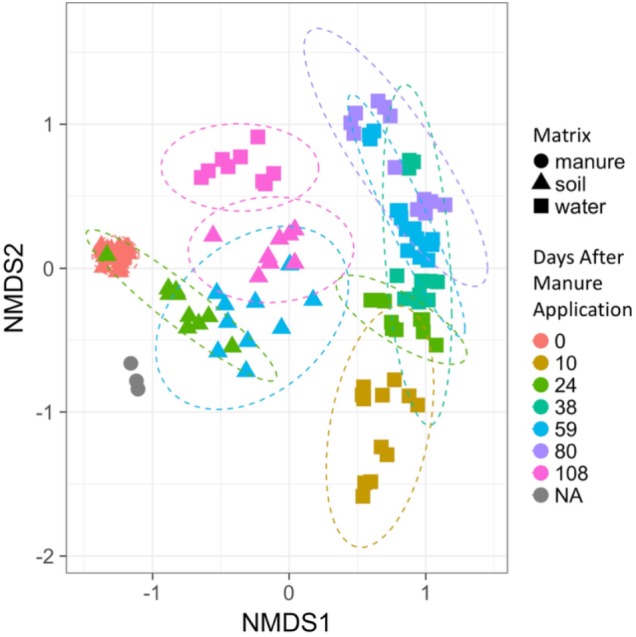
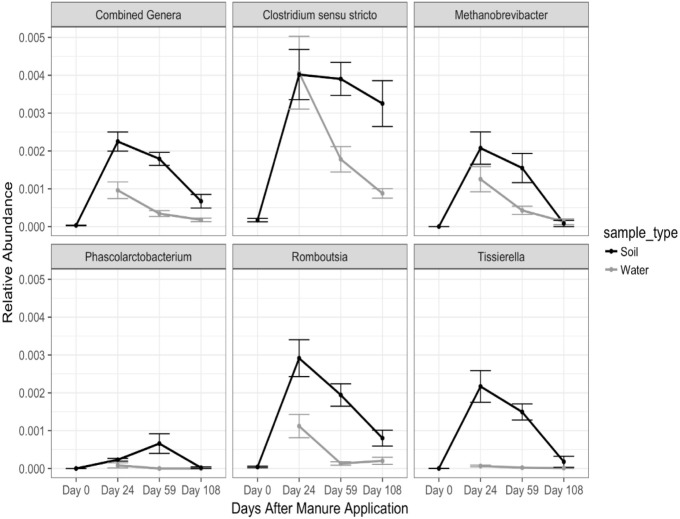
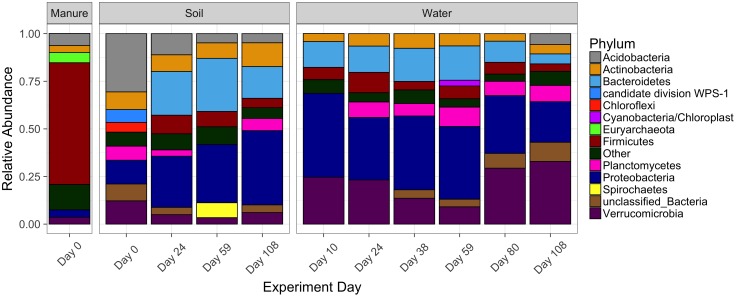
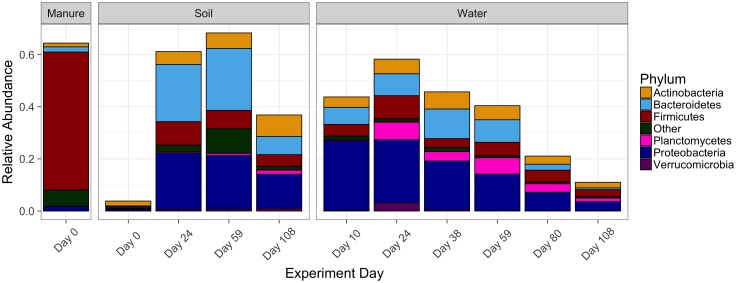
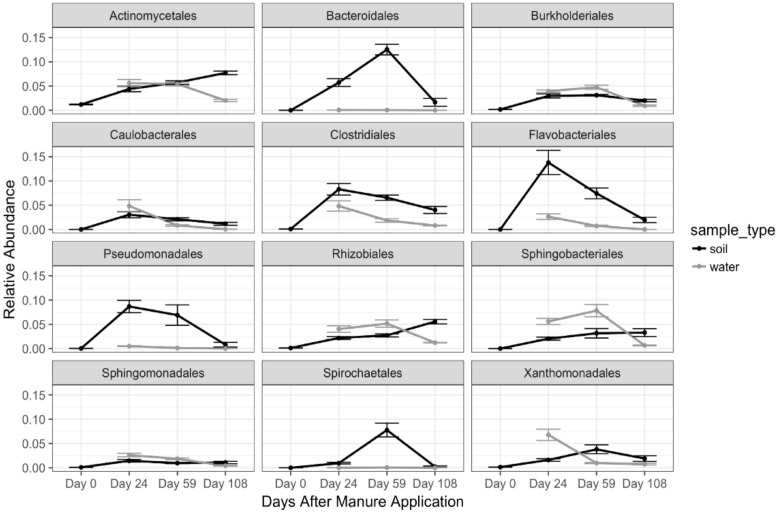
Application of swine manure to agricultural land allows recycling of plant nutrients, but excess nitrate, phosphorus and fecal bacteria impact surface and drainage water quality. While agronomic and water quality impacts are well studied, little is known about the impact of swine manure slurry on soil microbial communities. We applied swine manure to intact soil columns collected from plots maintained under chisel plow or no-till with corn and soybean rotation. Targeted 16S-rRNA gene sequencing was used to characterize and to identify shifts in bacterial communities in soil over 108 days after swine manure application. In addition, six simulated rainfalls were applied during this time. Drainage water from the columns and surface soil were sampled, and DNA was extracted and sequenced. Unique DNA sequences (OTU) associated with 12 orders of bacteria were responsible for the majority of OTUs stimulated by manure application. were most prevalent, followed by , , , and . While the majority of the 12 orders decreased after day 59, relative abundances of genes associated with and in soil increased. Bacterial orders which were stimulated by manure application in soil had varied responses in drainage waters over the course of the experiment. We also identified a "manure-specific core" of five genera who comprised 13% of the manure community and were not significantly abundant in non-manured control soils. Of these five genera, was the only genus which did not return to pre-manure relative abundance in soil by day 108. Our results show that enrichment responses after manure amendment could result from displacement of native soil bacteria by manure-borne bacteria during the application process or growth of native bacteria using manure-derived available nutrients.
将猪粪施用于农田可实现植物养分的循环利用,但过量的硝酸盐、磷和粪便细菌会影响地表水和排水水质。虽然对农艺和水质影响的研究较为充分,但关于猪粪浆对土壤微生物群落的影响却知之甚少。我们将猪粪施用于从采用凿耕法或免耕法种植玉米和大豆轮作的地块采集的原状土柱中。在施用猪粪后的108天内,使用靶向16S - rRNA基因测序来表征和识别土壤中细菌群落的变化。此外,在此期间进行了6次模拟降雨。对土柱的排水水和表层土壤进行采样,提取DNA并进行测序。与12个细菌目相关的独特DNA序列(OTU)是施用猪粪后受刺激的大多数OTU的原因。 最为普遍,其次是 、 、 和 。虽然在第59天后这12个目中的大多数数量减少,但土壤中与 和 相关的基因相对丰度增加。在实验过程中,土壤中因施用猪粪而受刺激的细菌目在排水水中有不同的反应。我们还确定了一个由五个属组成的“猪粪特异性核心”,它们占猪粪群落的13%,在未施肥的对照土壤中含量不显著。在这五个属中, 是唯一在第108天时土壤中相对丰度未恢复到施肥前水平的属。我们的结果表明,施肥后富集反应可能是由于施用过程中猪粪携带的细菌取代了原生土壤细菌,或者是原生细菌利用猪粪衍生的有效养分生长所致。