Department of Anesthesiology, Union Hospital, Tongji Medical College, Huazhong University of Science and Technology, Wuhan, China.
Medical College of Hubei Polytechnic University, Huangshi, China.
Biomed Res Int. 2018 Dec 9;2018:3560234. doi: 10.1155/2018/3560234. eCollection 2018.
Na-H exchanger-1 (NHE-1) is expressed in the lung of rats. Accumulating evidence shows that Na-H exchangers are involved in inflammation. Amiloride, an inhibitor of NHE-1, inhibits the activation of macrophages and endothelial cells and reduces their production of cytokines. Since these processes have been implicated in acute lung injury (ALI) induced by lipopolysaccharide (LPS), we examined the protective effect of amiloride on ALI induced by LPS in rats.
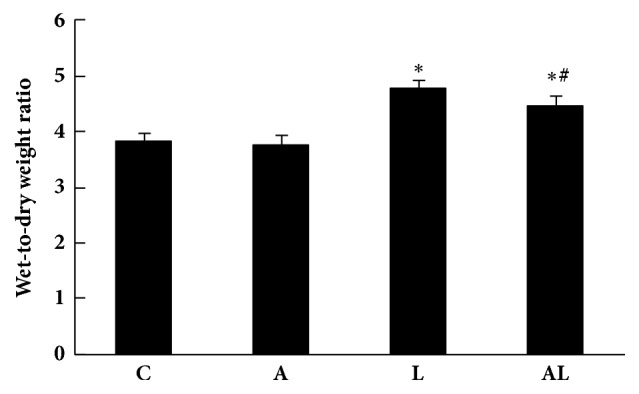
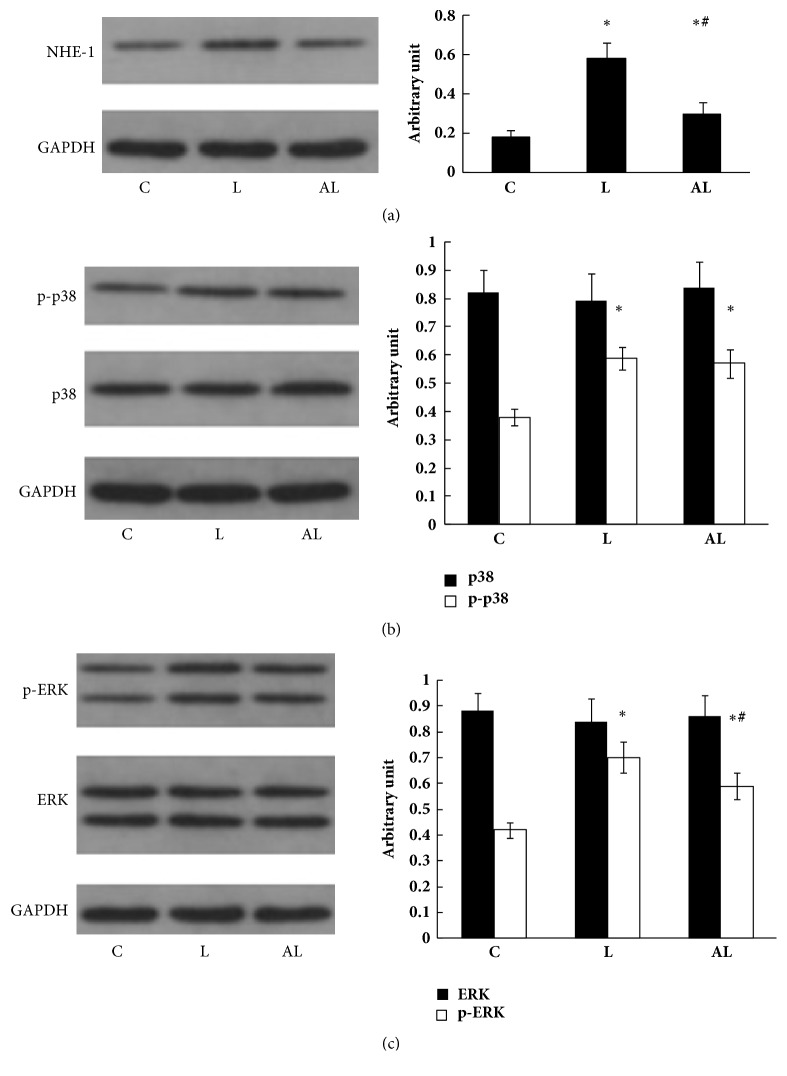
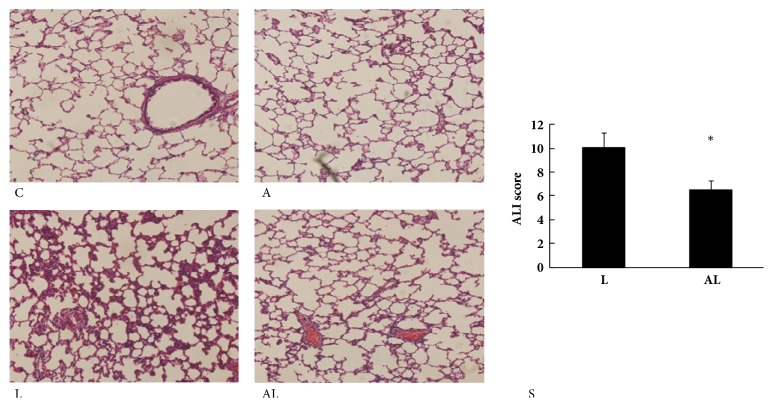
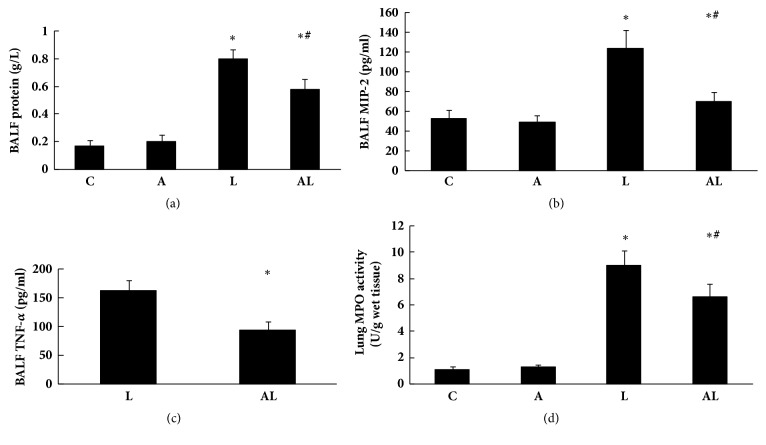
ALI in specific pathogen-free male Sprague-Dawley rats was induced by an intravenous injection of 6 mg/kg LPS. Amiloride pretreated rats received an intravenous injection of 10 mg/kg amiloride 30 min before the administration of LPS. Controls received normal saline in a similar manner. All animals were sacrificed 6 h after LPS or normal saline administration. The degree of ALI was assessed by wet-to-dry weight ratio (W/D) and lung histological examination. Neutrophilic infiltration was determined by myeloperoxidase (MPO) activity in lung tissue. Concentrations of total protein (TP), tumor necrosis factor-alpha (TNF-), and macrophage inflammatory protein-2 (MIP-2) in bronchoalveolar lavage fluid (BALF) were also measured. Expression of NHE-1 and mitogen-activated protein kinase (MAPK) p38, p-p38, ERK, and p-ERK was evaluated by western blot analysis.
Pretreatment with amiloride significantly reduced the increase in W/D, ALI score, lung tissue MPO activity, concentrations of TP, TNF-, and MIP-2 in BALF, resulting in attenuation of ALI induced by LPS. Meanwhile, levels of NHE-1 and p-ERK proteins were reversed, whereas that of p-p38 was not.
These findings suggest that NHE-1 inhibitor amiloride could attenuate ALI induced by LPS in rats. This effect is mediated through reversal of ERK.
钠氢交换蛋白-1(NHE-1)在大鼠的肺部表达。越来越多的证据表明,钠氢交换器参与炎症反应。NHE-1 的抑制剂阿米洛利可抑制巨噬细胞和内皮细胞的激活,并减少其细胞因子的产生。由于这些过程与脂多糖(LPS)诱导的急性肺损伤(ALI)有关,我们研究了阿米洛利对 LPS 诱导的大鼠 ALI 的保护作用。
采用静脉注射 6mg/kg LPS 诱导无特定病原体雄性 Sprague-Dawley 大鼠的 ALI。阿米洛利预处理组大鼠在 LPS 给药前 30 分钟静脉注射 10mg/kg 阿米洛利。对照组以类似方式给予生理盐水。所有动物在 LPS 或生理盐水给药后 6 小时处死。通过湿重/干重比(W/D)和肺组织学检查评估 ALI 的程度。通过肺组织髓过氧化物酶(MPO)活性确定中性粒细胞浸润程度。还测量支气管肺泡灌洗液(BALF)中总蛋白(TP)、肿瘤坏死因子-α(TNF-α)和巨噬细胞炎症蛋白-2(MIP-2)的浓度。通过 Western blot 分析评估 NHE-1 和丝裂原活化蛋白激酶(MAPK)p38、p-p38、ERK 和 p-ERK 的表达。
阿米洛利预处理显著降低了 W/D、ALI 评分、肺组织 MPO 活性、BALF 中 TP、TNF-α 和 MIP-2 的浓度,从而减轻了 LPS 诱导的 ALI。同时,NHE-1 和 p-ERK 蛋白水平逆转,而 p-p38 蛋白水平未逆转。
这些发现表明,NHE-1 抑制剂阿米洛利可减轻 LPS 诱导的大鼠 ALI。这种作用是通过逆转 ERK 来介导的。