Owesen Christian, Røtterud Jan-Harald, Engebretsen Lars, Årøen Asbjørn
Department of Orthopaedic Surgery, Akershus University Hospital, Lørenskog, Norway.
Department of Orthopaedics, Oslo University Hospital, Oslo, Norway.
Orthop J Sports Med. 2018 Dec 28;6(12):2325967118817297. doi: 10.1177/2325967118817297. eCollection 2018 Dec.
The outcomes after posterior cruciate ligament reconstruction (PCLR) have been shown to be inferior to those of anterior cruciate ligament reconstruction. There is a lack of knowledge regarding prognostic factors of PCLR outcomes.
To explore the effect of injury mechanism and concomitant ligament injuries on patient-reported outcomes at 2-year follow-up after PCLR.
Cohort study; Level of evidence, 2.
A total of 373 patients who underwent primary PCLR and who were registered in the Norwegian Knee Ligament Registry were included. The Knee injury and Osteoarthritis Outcome Score (KOOS) was used as the patient-reported outcome measure. At 2-year follow-up, 252 patients (68%) had completed the KOOS. Multiple regression analysis was used to evaluate the effects of injury activity and multiligament injuries on the KOOS outcomes.
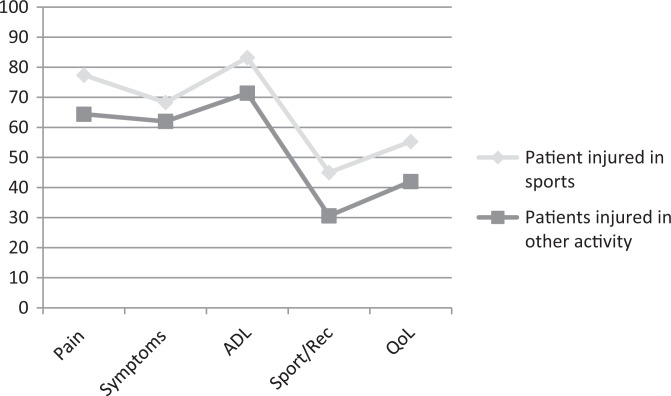
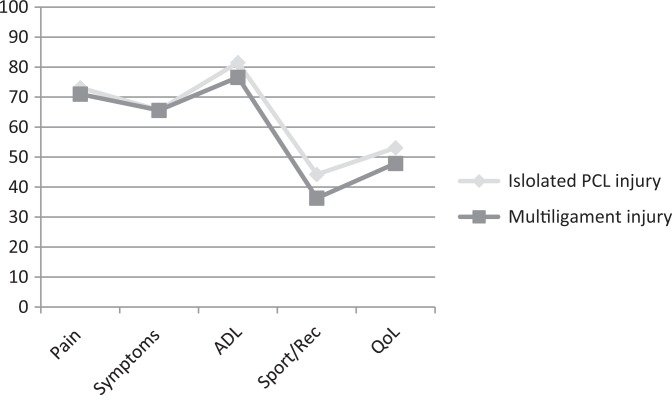
In the adjusted and unadjusted regression analyses, patients injured during sports reported significantly better outcome at 2-year follow-up after PCLR than patients injured during other activities ( < .001) according to all KOOS subscales. Adjusted analysis was as follows for the KOOS subscales: Symptoms (regression coefficient [β], 7.0; 95% CI, 1.9-12.2), Pain (β, 13.4; 95% CI, 8.0-18.9), Activities of Daily Living (β, 12.6; 95% CI, 7.1-18.1), Sport/Recreation (β, 15.3; 95% CI, 8.0-22.5), and Quality of Life (β, 13.5; 95% CI, 7.1-20.0). In the unadjusted analysis, patients with isolated PCL injuries reported higher scores in the Sport/Recreation subscale (β, -7.9; 95% CI, -15.5 to -0.3). The difference was not significant in the adjusted analysis. No other significant differences in KOOS outcomes were found between isolated and multiligament injuries.
Patients injured in sports reported better outcomes at 2 years after PCLR as compared with patients injured in other activities. Multiligament injuries involving the PCL do not seem to predict a worse outcome than for isolated PCL injuries.
后交叉韧带重建(PCLR)后的结果已被证明不如前交叉韧带重建。关于PCLR结果的预后因素,目前还缺乏相关知识。
探讨损伤机制和合并韧带损伤对PCLR术后2年患者报告结局的影响。
队列研究;证据等级,2级。
纳入挪威膝关节韧带登记处登记的373例行初次PCLR的患者。膝关节损伤和骨关节炎结局评分(KOOS)用作患者报告的结局指标。在2年随访时,252例患者(68%)完成了KOOS评分。采用多元回归分析评估损伤活动和多韧带损伤对KOOS结局的影响。
在调整和未调整的回归分析中,根据所有KOOS子量表,运动损伤患者在PCLR术后2年随访时的结局明显优于其他活动损伤患者(P<0.001)。KOOS子量表的调整分析如下:症状(回归系数[β],7.0;95%可信区间,¹.9-¹².2)、疼痛(β,¹³.4;95%可信区间,8.0-¹8.9)、日常生活活动(β,¹².6;95%可信区间,7.1-¹8.1)、运动/娱乐(β,¹5.3;95%可信区间,8.0-²².5)和生活质量(β,¹³.5;95%可信区间,7.1-²0.0)。在未调整分析中,单纯PCL损伤患者在运动/娱乐子量表中的得分较高(β,-7.9;95%可信区间,-¹5.5至-⁰.3)。调整分析中差异无统计学意义。单纯损伤和多韧带损伤在KOOS结局方面未发现其他显著差异。
与其他活动损伤的患者相比,运动损伤的患者在PCLR术后2年的结局更好。涉及PCL的多韧带损伤似乎并不预示比单纯PCL损伤更差的结局。