Feng Mingqian, Bian Hejiao, Wu Xiaolin, Fu Tianyun, Fu Ying, Hong Jessica, Fleming Bryan D, Flajnik Martin F, Ho Mitchell
Laboratory of Molecular Biology, Center for Cancer Research, National Cancer Institute, Bethesda, MD, USA.
Cancer Research Technology Program, Leidos Biomedical Research, Inc., Frederick National Laboratory for Cancer Research, Frederick, MD, USA.
Antib Ther. 2019 Jan;2(1):1-11. doi: 10.1093/abt/tby011. Epub 2018 Nov 7.
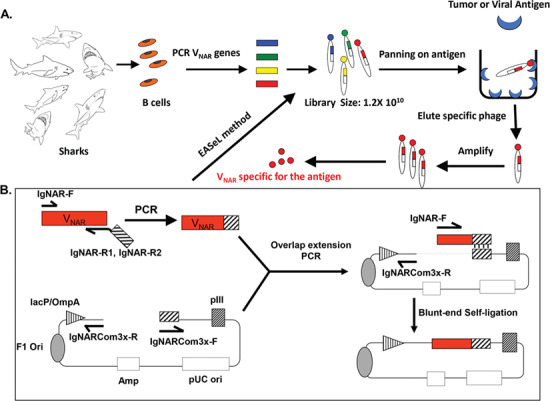
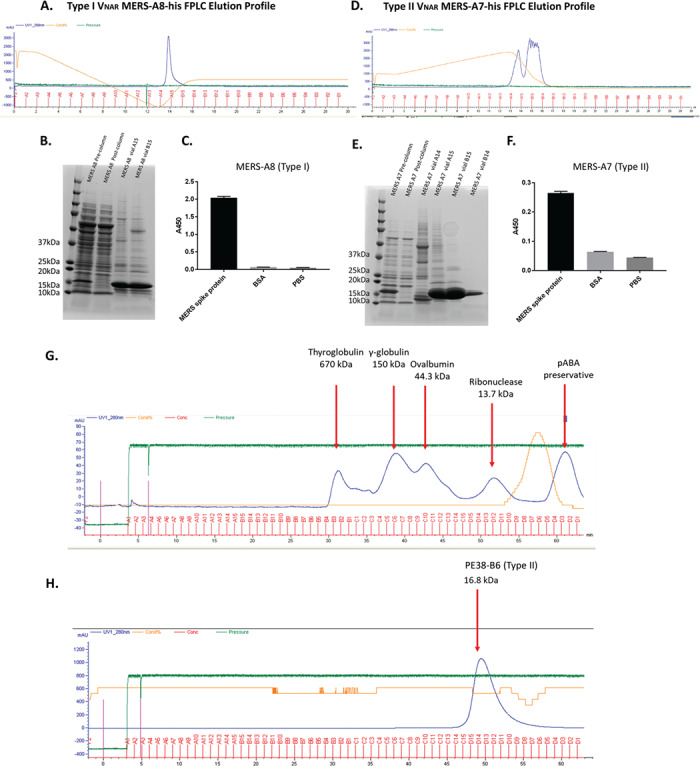
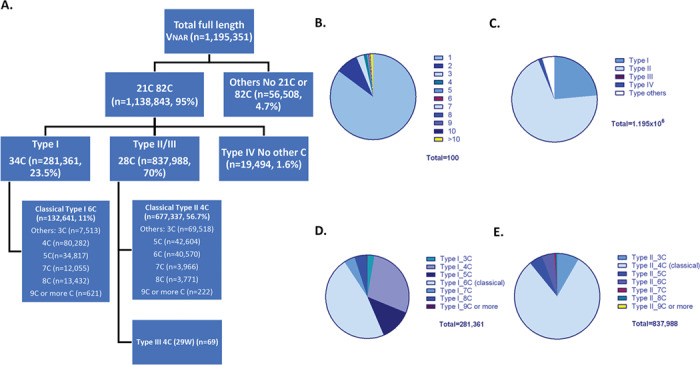
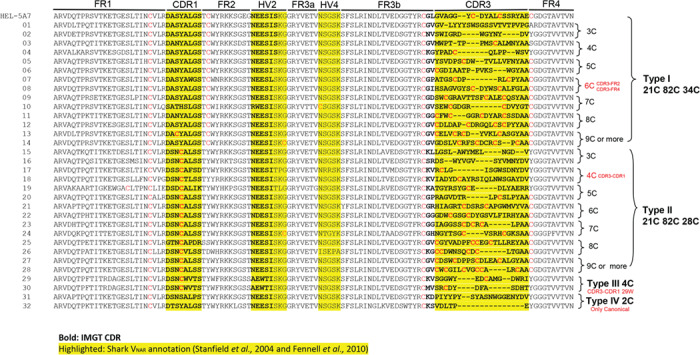
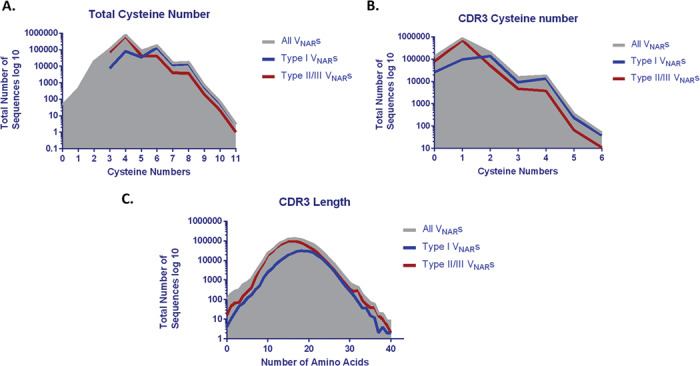
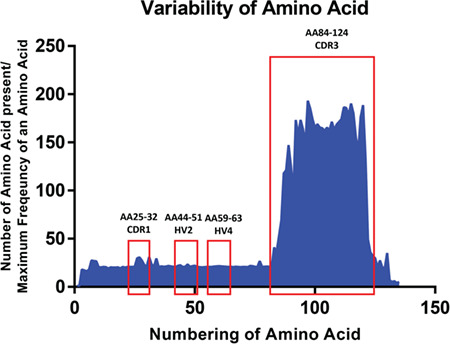
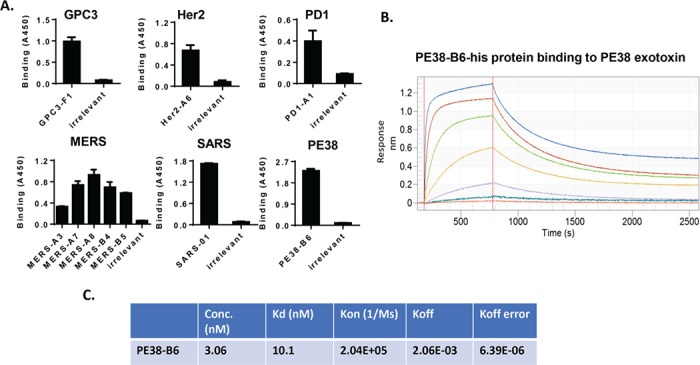
Shark new antigen receptor variable domain (V) antibodies can bind restricted epitopes that may be inaccessible to conventional antibodies. Here, we developed a library construction method based on polymerase chain reaction (PCR)-Extension Assembly and Self-Ligation (named "EASeL") to construct a large V antibody library with a size of 1.2 × 10 from six naïve adult nurse sharks (). The next-generation sequencing analysis of 1.19 million full-length Vs revealed that this library is highly diversified because it covers all four classical V types (Types I-IV) including 11% of classical Type I and 57% of classical Type II. About 30% of the total Vs could not be categorized as any of the classical types. The high variability of complementarity determining region (CDR) 3 length and cysteine numbers are important for the diversity of Vs. To validate the use of the shark V library for antibody discovery, we isolated a panel of V phage binders to cancer therapy-related antigens, including glypican-3, human epidermal growth factor receptor 2 (HER2), and programmed cell death-1 (PD1). Additionally, we identified binders to viral antigens that included the Middle East respiratory syndrome (MERS) and severe acute respiratory syndrome (SARS) spike proteins. The isolated shark single-domain antibodies including Type I and Type II Vs were produced in and validated for their antigen binding. A Type II V (PE38-B6) has a high affinity (K = 10.1 nM) for its antigen. The naïve nurse shark V library is a useful source for isolating single-domain antibodies to a wide range of antigens. The EASeL method may be applicable to the construction of other large diversity gene expression libraries.
鲨鱼新抗原受体可变区(V)抗体能够结合传统抗体可能无法触及的受限表位。在此,我们开发了一种基于聚合酶链反应(PCR)-延伸组装和自连接的文库构建方法(命名为“EASeL”),以构建一个来自六条成年未免疫护士鲨的大小为1.2×10的大型V抗体文库。对119万个全长V进行的下一代测序分析表明,该文库具有高度多样性,因为它涵盖了所有四种经典V类型(I-IV型),包括11%的经典I型和57%的经典II型。约30%的V无法归类为任何一种经典类型。互补决定区(CDR)3长度和半胱氨酸数量的高变异性对V的多样性很重要。为了验证鲨鱼V文库在抗体发现中的应用,我们分离了一组针对癌症治疗相关抗原的V噬菌体结合物,包括磷脂酰肌醇蛋白聚糖-3、人表皮生长因子受体2(HER2)和程序性细胞死亡蛋白1(PD1)。此外,我们还鉴定了针对病毒抗原的结合物,这些病毒抗原包括中东呼吸综合征(MERS)和严重急性呼吸综合征(SARS)刺突蛋白。所分离的包括I型和II型V的鲨鱼单域抗体在中表达,并对其抗原结合进行了验证。一种II型V(PE38-B6)对其抗原具有高亲和力(K = 10.1 nM)。未免疫护士鲨V文库是分离针对多种抗原的单域抗体的有用来源。EASeL方法可能适用于构建其他大多样性基因表达文库。