Segal Cancer Center, Lady Davis Institute of Medical Research, McGill University, Montreal, QC, Canada.
Department of Experimental Surgery, McGill University, Montreal, QC, Canada.
BMC Cancer. 2019 Jan 10;19(1):44. doi: 10.1186/s12885-018-5250-4.
Poly (ADP-ribose) polymerase inhibitors (PARPi) have become the first targeted therapies available in the treatment of patients with high-grade serous ovarian cancer (HGSOC). We recently described a significant reduction in PARP1 protein levels in vitro and in vivo in patients treated with standard carboplatinum-paclitaxel chemotherapy, raising the question whether the sequence of treatment used today with chemotherapy followed by PARPi is optimal. In this study, we aim to evaluate if the sequence of PARPi followed by chemotherapy could be more beneficial.
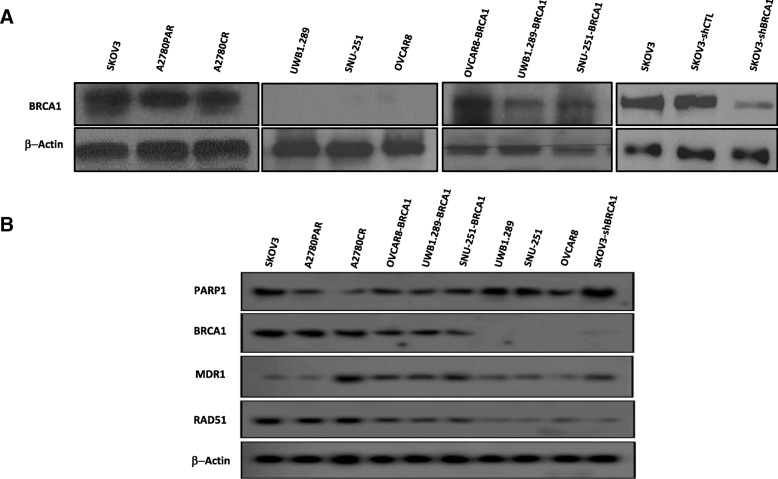
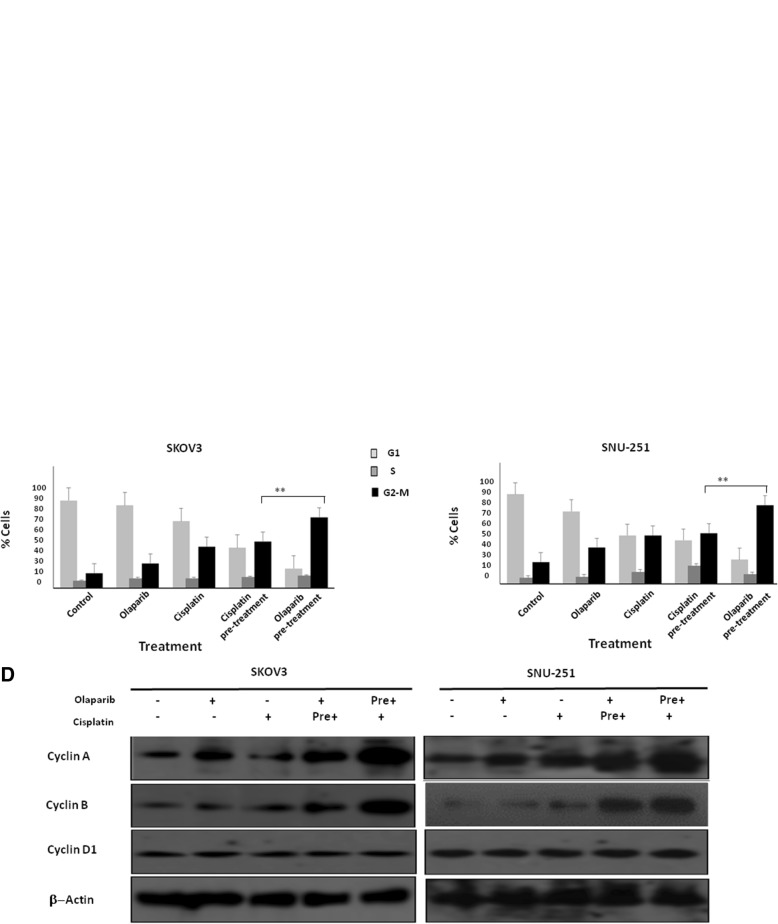
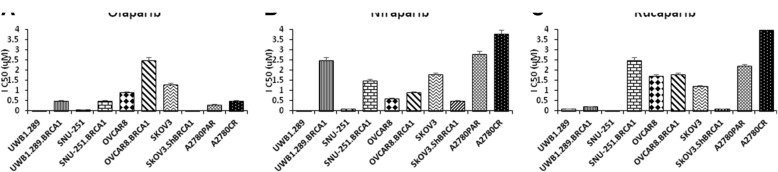
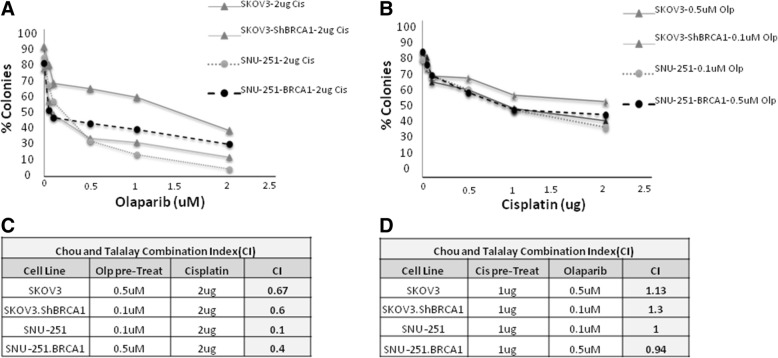
BRCA1-mutated (UWB1.287, SNU-251), epigenetically-silenced (OVCAR8), and wild-type (SKOV3, A2780PAR & A2780CR) ovarian cancer cell lines were exposed to clinically relevant doses of PARPi followed by different doses of standard chemotherapy and compared to the inverse treatment. The therapeutic efficacy was assessed using colony formation assays. Flow cytometry was used to evaluate cell apoptosis rate and the changes in cell cycle. Finally, apoptotic and cell cycle protein expression was immunodetected using western blot.
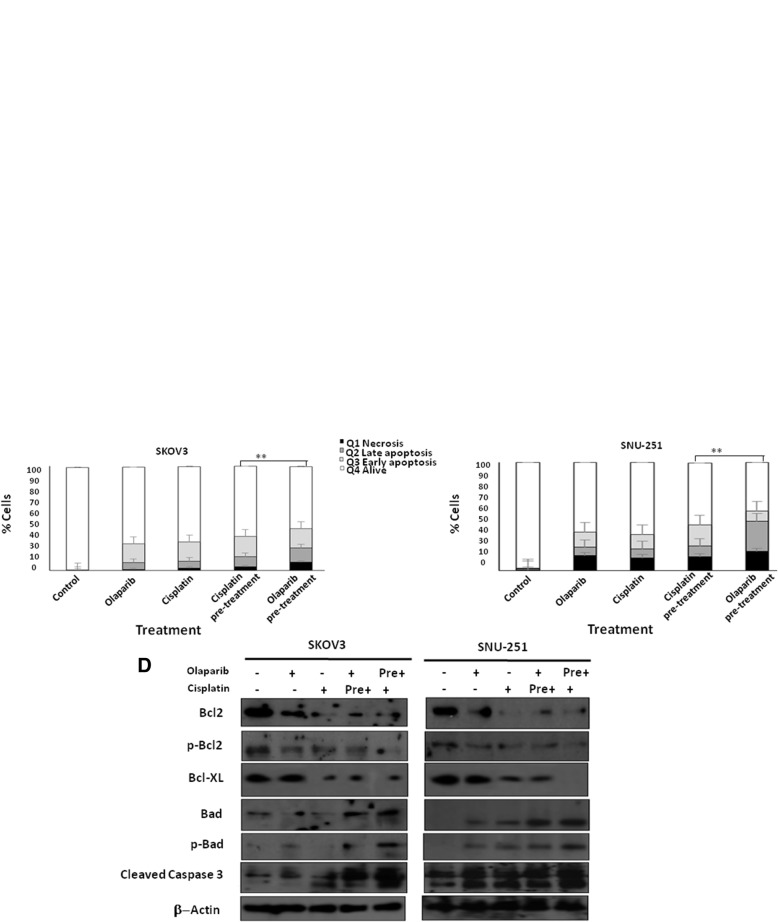
Exposure to PARPi prior to standard chemotherapy sensitized BRCA1-mutated or epigenetically-silenced BRCA1 cell lines to lower doses of chemotherapy. Similar results were observed in BRCA1 wild-type and cell lines in which BRCA1 functionality was restored. Moreover, this treatment increased the apoptotic rate in these cell lines.
Pre-treatment with PARPi followed by standard chemotherapy in vitro is more efficient in growth inhibition and induction of apoptosis compared to the administration of standard chemotherapy followed by PARPi.
聚(ADP-核糖)聚合酶抑制剂(PARPi)已成为治疗高级别浆液性卵巢癌(HGSOC)患者的首批靶向治疗药物。我们最近在接受标准卡铂紫杉醇化疗的患者中观察到 PARP1 蛋白水平在体外和体内均显著降低,这引发了一个问题,即目前使用化疗后序贯 PARPi 的治疗方案是否最佳。在这项研究中,我们旨在评估 PARPi 序贯化疗是否更有益。
BRCA1 突变型(UWB1.287、SNU-251)、表观遗传沉默型(OVCAR8)和野生型(SKOV3、A2780PAR 和 A2780CR)卵巢癌细胞系分别接受临床相关剂量的 PARPi 处理,然后接受不同剂量的标准化疗,并与相反的处理方案进行比较。通过集落形成实验评估治疗效果。采用流式细胞术评估细胞凋亡率和细胞周期变化。最后,使用 Western blot 免疫检测法检测凋亡和细胞周期蛋白的表达。
PARPi 预处理使 BRCA1 突变型或表观遗传沉默型 BRCA1 细胞系对低剂量化疗更敏感。在 BRCA1 野生型和 BRCA1 功能恢复的细胞系中观察到类似的结果。此外,这种治疗方法增加了这些细胞系中的细胞凋亡率。
与标准化疗后序贯 PARPi 相比,PARPi 预处理后序贯标准化疗在体外对生长抑制和诱导凋亡更有效。