McGill University Health Centre Research Institute, Division of Pediatric Neonatalogy, Montreal, PQ, Canada; School of Physical and Occupational Therapy, McGill University, Montreal, PQ, Canada; Center for the Developing Brain, Children's National Health System, Washington, D.C., United States.
Center for Translational Science, Children's National Health System, Washington, D.C., United States.
Neuroimage Clin. 2019;21:101646. doi: 10.1016/j.nicl.2018.101646. Epub 2018 Dec 19.
To compare third trimester global and regional cerebellar volumetric growth at two time-points between very preterm (PT) infants and healthy gestational age-matched fetuses in the PT period and at term equivalent age (TEA).
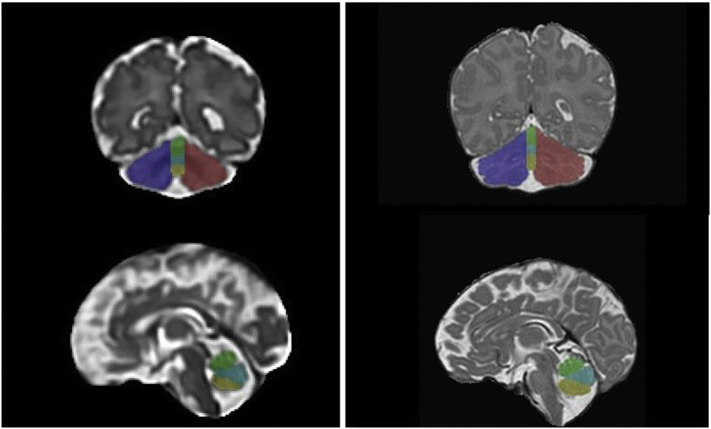
Using a prospective study design, high resolution anatomic magnetic resonance images (MRI) were acquired in PT infants (gestational age at birth < 32 weeks; birthweight < 1500 g) without cerebellar injury and healthy full-term controls. PT infants completed two MRIs, one as soon as medically stable and the other around TEA. Controls also completed two MRIs, one in utero (i.e. fetal MRI) and a postnatal MRI shortly after birth. The cerebellum of each participant was parcellated into 5 regions: left and right hemispheres, the anterior, neo and posterior vermis. Evidence of differences in regional volumes between term and pre-term infants matched for gestational age (GA) at the time of the first MRI were assessed using multiple linear regression.
WE STUDIED 76 SUBJECTS: 38 PT infants were matched to 38 healthy fetuses. At MRI-1, PT infants demonstrated decreased cerebellar hemispheric volumes and increased anterior, neo- and posterior vermian regional volumes when compared to healthy fetuses. At TEA, PT infants demonstrated a persistent increase in anterior, neo- and posterior vermian regional volumes but no longer showed reductions in cerebellar hemispheric volume. Only the neovermis volume demonstrated a significant negative association with birthweight, male gender and supratentorial injury.
In the absence of demonstrable cerebellar parenchymal injury evident on conventional MRI, PT birth is associated with cerebellar growth alterations that are regionally- and temporally-specific.
比较极早产儿(PT)和健康胎龄匹配胎儿在 PT 期和胎龄相等期(TEA)的两个时间点的第三孕期小脑整体和区域体积生长。
采用前瞻性研究设计,对无小脑损伤的 PT 婴儿(出生胎龄 < 32 周;出生体重 < 1500 克)和健康足月对照组进行高分辨率解剖磁共振成像(MRI)检查。PT 婴儿完成了两次 MRI,一次是在医学上稳定后,另一次是在 TEA 左右。对照组也完成了两次 MRI,一次是在宫内(即胎儿 MRI),一次是在出生后不久。每个参与者的小脑被分为 5 个区域:左半球和右半球、前叶、新叶和后叶。使用多元线性回归评估了与第一次 MRI 时胎龄(GA)相匹配的足月和早产儿之间区域体积差异的证据。
我们研究了 76 名受试者:38 名 PT 婴儿与 38 名健康胎儿相匹配。在 MRI-1 时,与健康胎儿相比,PT 婴儿的小脑半球体积减小,前叶、新叶和后叶区域体积增大。在 TEA 时,PT 婴儿的前叶、新叶和后叶区域体积持续增加,但小脑半球体积不再减少。只有新叶体积与出生体重、男性性别和幕上损伤呈显著负相关。
在没有明显的小脑实质损伤的情况下,PT 出生与小脑生长改变有关,这些改变具有区域性和时间特异性。