Thiengsusuk Artitaya, Muhamad Phunuch, Chaijaroenkul Wanna, Na-Bangchang Kesara
Drug Discovery and Development Center, Thammasat University (Rangsit Campus), Pathumtani 12121, Thailand.
Center of Excellence in Pharmacology and Molecular Biology of Malaria and Cholangiocarcinoma, Chulabhorn International College of Medicine, Thammasat University, Pathumthani 12121, Thailand.
J Trop Med. 2018 Dec 6;2018:9486905. doi: 10.1155/2018/9486905. eCollection 2018.
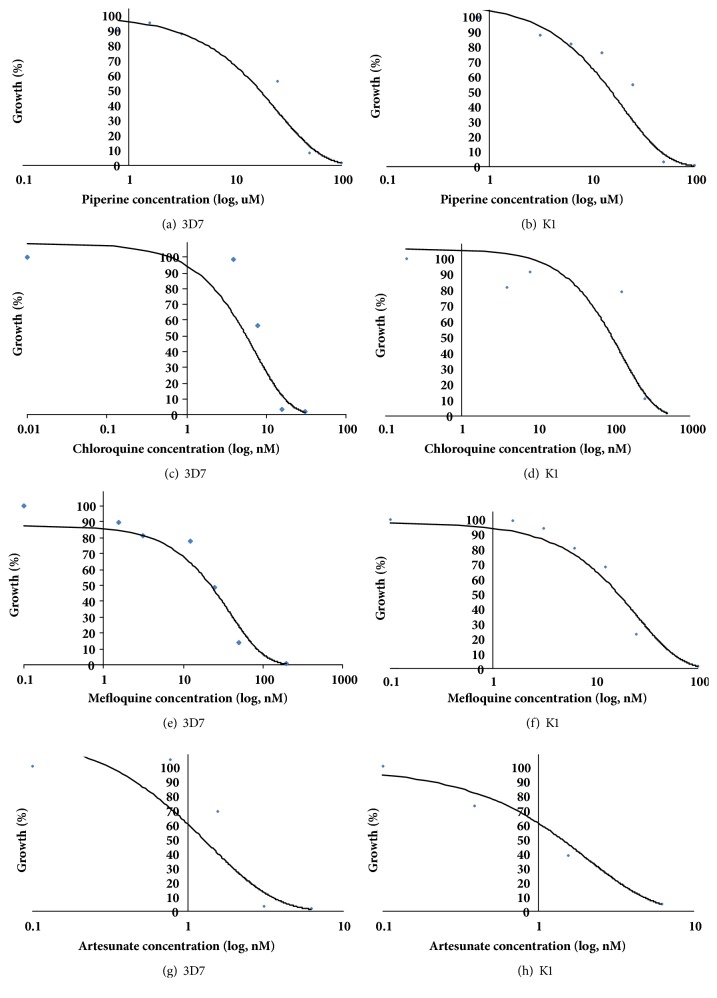
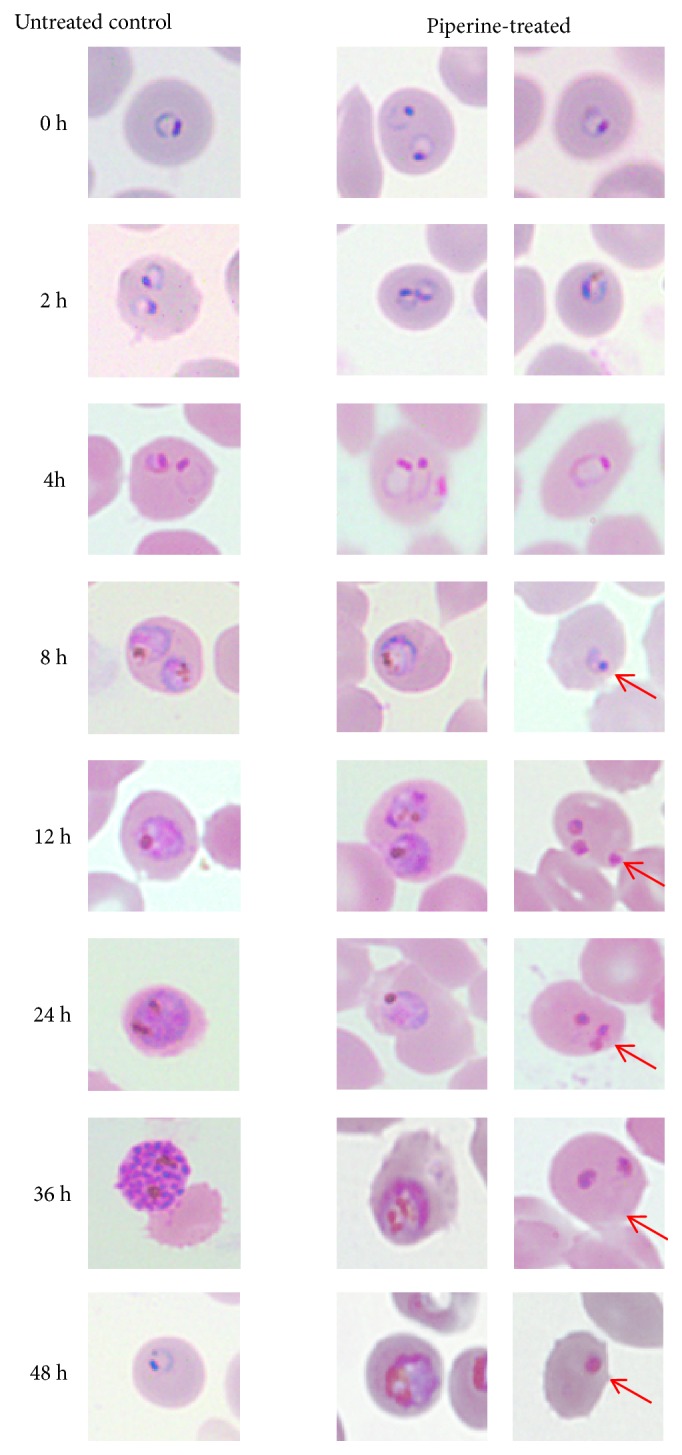
Malaria remains a public health problem in tropical and subtropical regions. Resistance of to artemisinins in Southeast Asia is a great concern for disease control and research on discovery and development of new alternative antimalarial drugs is urgently required. In a previous study, the fruit of Hunt. was demonstrated to exhibit promising antimalarial activity against the asexual stage of 3D7 (chloroquine-sensitive) and K1 (chloroquine-resistant) clones. The aim of the present study was to further investigate the antimalarial activity of piperine, the major isolated constituent of Hunt. fruits against both clones. The antimalarial activity was determined using SYBR green-I-based assay and morphological change was observed under the light microscope with Giemsa staining. The median IC (concentration that inhibits parasite growth by 50%) values of piperine against 3D7 and K1 were 111.5 and 59 M, respectively. A marked change in parasite morphology was observed within 48 hours of piperine exposure. Results of real-time PCR showed no effect of piperine on modulating the expression of the three genes associated with antimalarial drug resistance in , ., , , and . Piperine could be a promising candidate for further development as an antimalarial drug based on its antimalarial potency and low risk of resistance development.
疟疾在热带和亚热带地区仍然是一个公共卫生问题。东南亚地区疟原虫对青蒿素产生耐药性,这对疾病控制构成了重大担忧,因此迫切需要开展关于新型抗疟药物发现与开发的研究。在之前的一项研究中,[某种植物名称]Hunt.的果实被证明对3D7(氯喹敏感)和K1(氯喹耐药)克隆的无性阶段具有有前景的抗疟活性。本研究的目的是进一步研究胡椒碱([某种植物名称]Hunt.果实中分离出的主要成分)对这两种克隆的抗疟活性。使用基于SYBR green-I的测定法测定抗疟活性,并通过吉姆萨染色在光学显微镜下观察形态变化。胡椒碱对3D7和K1克隆的半数抑制浓度(IC,即抑制寄生虫生长50%的浓度)值分别为111.5和59 μM。在胡椒碱暴露48小时内观察到寄生虫形态有明显变化。实时PCR结果显示,胡椒碱对[疟原虫名称]中与抗疟药物耐药性相关的三个基因([具体基因名称1]、[具体基因名称2]、[具体基因名称3])的表达没有调节作用。基于其抗疟效力和低耐药性发展风险,胡椒碱有望作为一种抗疟药物进一步开发。