From the Gynecology and Obstetrics Department & Reproductive Medicine Center, Peking University Third Hospital.
National Center for Women and Children's Health, Chinese Center for Disease Control and Prevention.
J Patient Saf. 2020 Dec;16(4):e284-e291. doi: 10.1097/PTS.0000000000000570.
The aim of this study was to assess patient safety culture (PSC) in maternal and child health (MCH) institutions in China and its individual, organizational, and regional variations.
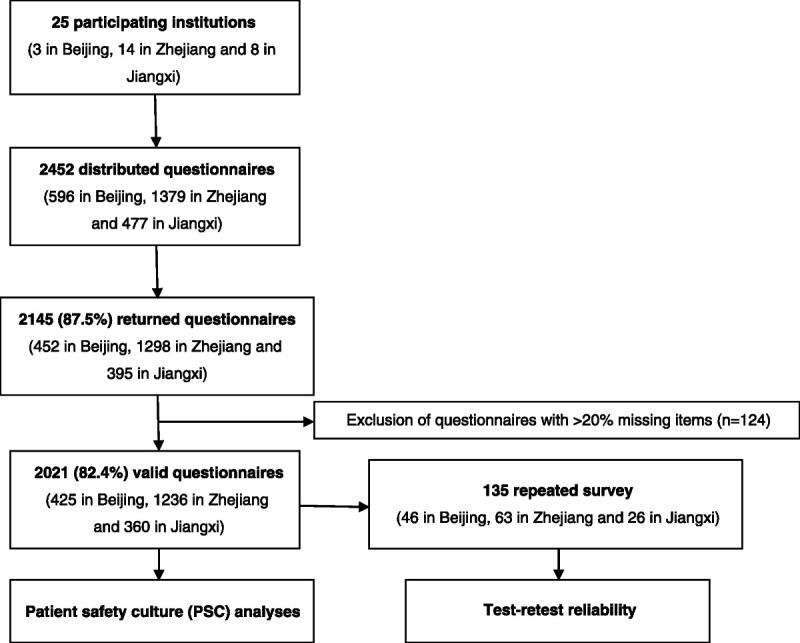
Using the PSC survey for MCH institutions (PSCS-MCHI), 2021 valid respondents from 25 participating institutions were investigated in three regions (Beijing, Zhejiang, and Jiangxi) of China. Patient safety culture and its subscale scores (1-5) and factors associated with PSC as revealed by multilevel modeling.
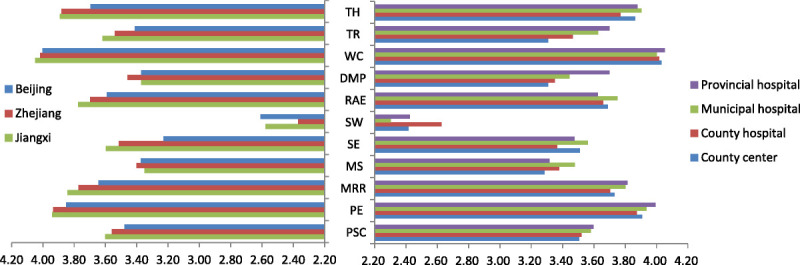
The respondents had an average PSC score of 3.55 (SD = 0.35), with subscale scores ranging between 2.46 ("staffing and workload") and 4.02 ("work commitment"). There were limited regional differences in PSC: a three-level regression model was only confirmed for the subscale "staff empowerment" (P = 0.006). However, significant organizational variations in PSC were evident: a two-level regression model was assumed for the PSC scale and nine subscales (P < 0.001). The fixed-effect models showed that male respondents, frontline workers, those who were in their mid-career (11-20 y), overloaded (≥9 hours), and had a masters or higher degree reported worse PSC. Frontline workers were less positive than managers in ratings on "managerial response to risks" (-0.11 [-0.20 to -0.02]), "management support" (-0.18 [-0.28 to -0.07]), and "staff empowerment" (-0.23[-0.35 to -0.11]).
Patient safety culture in MCH institutions is shaped by organizational and individual characteristics. We observed a gap in perceived PSC between frontline worker, who are less positive, and managers. Actions for improving PSC should consider interventions on organizational management (such as appropriate staffing and workload management) and engagement of frontline workers in the development of management and training activities.
本研究旨在评估中国妇幼保健机构的患者安全文化(PSC)及其个体、组织和区域差异。
采用妇幼保健机构患者安全文化调查(PSCS-MCHI),对中国三个地区(北京、浙江和江西)的 25 家参与机构的 2021 名有效受访者进行了调查。使用多层次模型揭示了患者安全文化及其子量表评分(1-5)和与 PSC 相关的因素。
受访者的 PSC 平均得分为 3.55(SD=0.35),子量表评分范围在 2.46(“人员配备和工作量”)和 4.02(“工作承诺”)之间。PSC 区域差异有限:仅对“员工赋权”子量表(P=0.006)确认了三级回归模型。然而,PSC 存在显著的组织差异:假设了 PSC 量表和九个子量表的两级回归模型(P<0.001)。固定效应模型显示,男性受访者、一线工作人员、处于职业生涯中期(11-20 年)、工作量过大(≥9 小时)和具有硕士或更高学位的受访者报告的 PSC 较差。一线工作人员在“管理层对风险的反应”(-0.11[-0.20 至-0.02])、“管理支持”(-0.18[-0.28 至-0.07])和“员工赋权”(-0.23[-0.35 至-0.11])方面的评价低于管理人员。
妇幼保健机构的患者安全文化受组织和个体特征的影响。我们观察到一线工作人员与管理人员之间在感知 PSC 方面存在差距,前者的评价较为消极。为了提高 PSC,应采取干预措施,改善组织管理(如适当的人员配备和工作量管理),并让一线工作人员参与管理和培训活动的制定。