Clinical Pharmacology and Pharmacometrics, AbbVie Inc., North Chicago, IL, USA.
Department of Statistics, AbbVie Inc., North Chicago, IL, USA.
J Clin Pharmacol. 2019 Jun;59(6):856-862. doi: 10.1002/jcph.1375. Epub 2019 Jan 11.
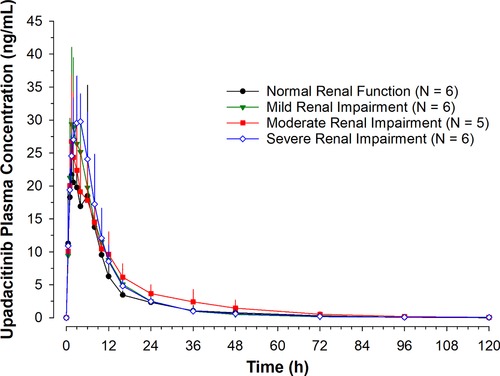
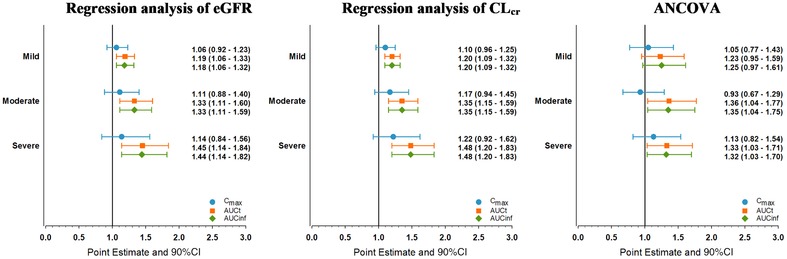
Upadacitinib is a novel selective Janus kinase 1 inhibitor developed for treatment of rheumatoid arthritis and other autoimmune diseases. The objective of this study was to assess the pharmacokinetics and safety of a single upadacitinib dose in subjects with normal renal function and in subjects with renal impairment. A total of 24 subjects between the ages of 18 and 75 years were assigned to 1 of 4 renal function groups based on estimated glomerular filtration rate (normal, mild, moderate, severe; N = 6/group). A single 15-mg dose of upadacitinib extended-release formulation was administered under fasting conditions. Serial plasma and urine samples were assayed to evaluate the effect of renal impairment on upadacitinib exposure through regression analysis and analysis of covariance. The primary analysis was the regression analysis of upadacitinib exposures versus estimated glomerular filtration rate. The point estimates for upadacitinib plasma exposure ratios (90% confidence interval [CI]) in subjects with mild, moderate, and severe renal impairment were 1.18 (90%CI, 1.06-1.32), 1.33 (90%CI, 1.11-1.59), and 1.44 (90%CI, 1.14-1.82) for area under the plasma concentration-time curve and 1.06 (90%CI, 0.92-1.23), 1.11 (90%CI, 0.88-1.40), and 1.14 (90%CI, 0.84-1.56) for maximum observed plasma concentration, respectively, relative to subjects with normal renal function based on the regression analysis. The analysis of covariance categorical analysis provided consistent results. Upadacitinib was well tolerated by all subjects, and no safety issues were identified in subjects with renal impairment. Renal impairment has a limited effect on upadacitinib pharmacokinetics. This is in agreement with the known limited role of urinary excretion in upadacitinib elimination. Based on the limited impact on exposure, no dose adjustment is necessary for upadacitinib in subjects with impaired renal function.
乌帕替尼是一种新型选择性 Janus 激酶 1 抑制剂,用于治疗类风湿关节炎和其他自身免疫性疾病。本研究旨在评估健康受试者和肾功能损害受试者单次给予乌帕替尼的药代动力学和安全性。总共 24 名年龄在 18 至 75 岁之间的受试者根据估计肾小球滤过率(正常、轻度、中度、重度;每组 6 人)被分配到 4 个肾功能组之一。空腹状态下单次给予乌帕替尼缓释制剂 15mg。通过回归分析和协方差分析,评估肾功能损害对乌帕替尼暴露的影响,检测连续采集的血浆和尿液样本。主要分析是乌帕替尼暴露与估计肾小球滤过率的回归分析。轻度、中度和重度肾功能损害受试者的乌帕替尼血浆暴露比(90%置信区间[CI])点估计值分别为 1.18(90%CI,1.06-1.32)、1.33(90%CI,1.11-1.59)和 1.44(90%CI,1.14-1.82),对于曲线下面积,1.06(90%CI,0.92-1.23)、1.11(90%CI,0.88-1.40)和 1.14(90%CI,0.84-1.56),分别为最大观察到的血浆浓度,相对于肾功能正常的受试者,这是基于回归分析的。协方差分类分析提供了一致的结果。所有受试者均能良好耐受乌帕替尼,且肾功能损害受试者未发现安全性问题。肾功能损害对乌帕替尼的药代动力学影响有限。这与尿排泄在乌帕替尼消除中所起的作用有限一致。基于暴露量的有限影响,肾功能损害受试者无需调整乌帕替尼剂量。