Division of Pulmonary Medicine, Department of Internal Medicine, Hsinchu Mackay Memorial Hospital, Hsinchu, Taiwan.
Division of Nephrology, Department of Internal Medicine, Changhua Christian Hospital, Changhua, Taiwan.
PLoS One. 2019 Jan 11;14(1):e0210656. doi: 10.1371/journal.pone.0210656. eCollection 2019.
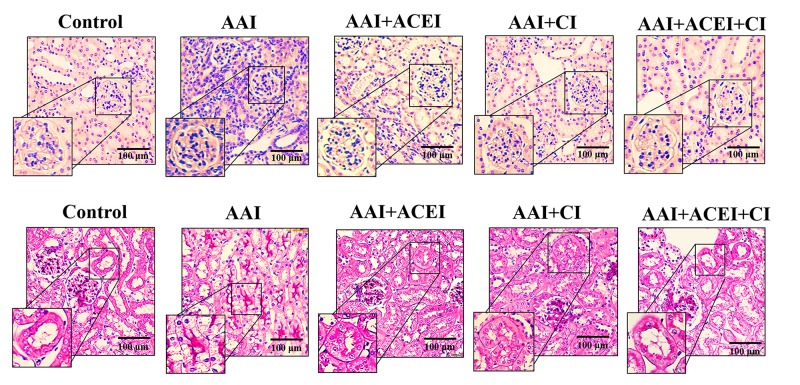
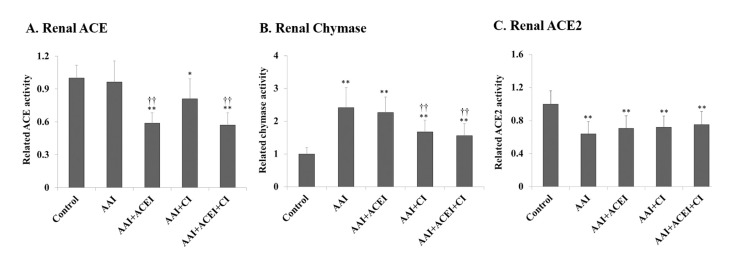
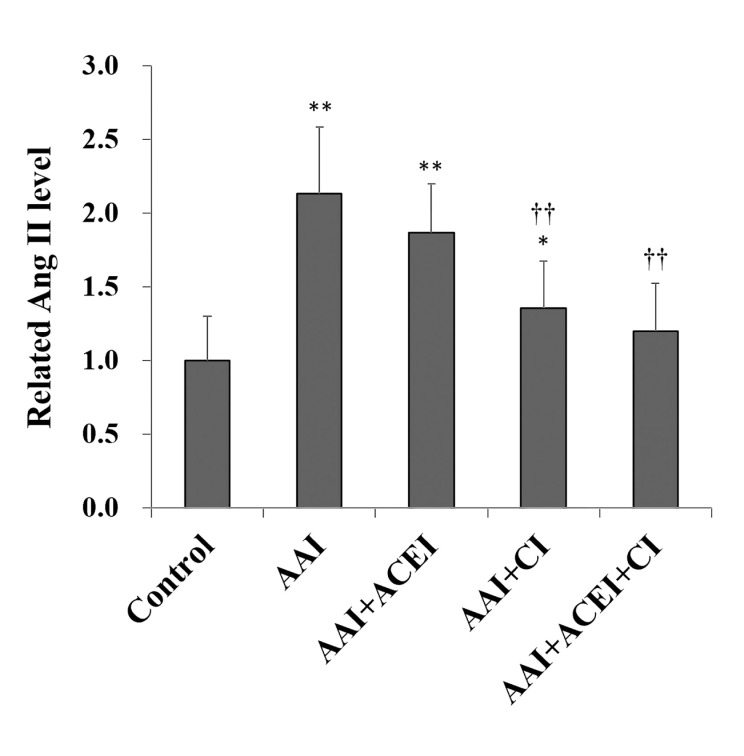
Angiotensin-converting enzyme (ACE) is the primary enzyme that converts angiotensin I (Ang I) to angiotensin II (Ang II) in the renin-angiotensin system (RAS). However, chymase hydrates Ang I to Ang II independently of ACE in some kidney diseases, and it may play an important role. The present study investigated whether chymase played a crucial role in aristolochic acid I (AAI)-induced nephropathy. C57BL/6 mice were treated with AAI via intraperitoneal injection for an accumulated AAI dosage of 45 mg/kg body weight (BW) (15 mg/kg BW per day for 3 days). The animals were sacrificed after acute kidney injury development, and blood, urine and kidneys were harvested for biochemical and molecular assays. Mice exhibited increased serum creatinine, BUN and urinary protein after the AAI challenge. Significant infiltrating inflammatory cells and tubular atrophy were observed in the kidneys, and high immunocytokine levels were detected. Renal RAS-related enzyme activities were measured, and a significantly increased chymase activity and slightly decreased ACE activity were observed in the AAI-treated mice. The renal Ang II level reflected the altered profile of RAS enzymes and was significantly increased in AAI-treated mice. Treatment of AAI-induced nephropathic mice with an ACE inhibitor (ACEI) or chymase inhibitor (CI; chymostatin) reduced renal Ang II levels. The combination of ACEI and CI (ACEI+CI) treatment significantly reversed the AAI-induced changes of Ang II levels and kidney inflammation and injuries. AAI treatment significantly increased renal p-MEK without increasing p-STAT3 and p-Smad3 levels, and p-MEK/p-ERK1/2 signalling pathway was significantly activated. CI and ACEI+CI treatments reduced this AAI-activated signaling pathway. AAI-induced nephropathy progression was significantly mitigated with CI and ACEI+CI treatment. This study elucidates the role of RAS in the pathogenesis of AAI-induced nephropathy.
血管紧张素转换酶(ACE)是肾素-血管紧张素系统(RAS)中主要将血管紧张素 I(Ang I)转化为血管紧张素 II(Ang II)的酶。然而,糜酶在某些肾脏疾病中独立于 ACE 将 Ang I 水合为 Ang II,并且可能发挥重要作用。本研究探讨了糜酶在马兜铃酸 I(AAI)诱导的肾病中的关键作用。通过腹腔注射将 C57BL/6 小鼠用 AAI 处理,累积 AAI 剂量为 45mg/kg 体重(BW)(每天 15mg/kg BW,共 3 天)。在急性肾损伤发展后,处死动物,并采集血液、尿液和肾脏进行生化和分子分析。AAI 攻击后,小鼠的血清肌酐、BUN 和尿蛋白增加。在肾脏中观察到明显的浸润性炎症细胞和肾小管萎缩,并检测到高免疫细胞因子水平。测量肾脏 RAS 相关酶活性,发现 AAI 处理的小鼠中糜酶活性显著增加,ACE 活性略有降低。肾脏 Ang II 水平反映了 RAS 酶的改变模式,在 AAI 处理的小鼠中显著增加。用 ACE 抑制剂(ACEI)或糜酶抑制剂(CI;糜蛋白酶抑制剂)治疗 AAI 诱导的肾病小鼠可降低肾脏 Ang II 水平。ACEI+CI(ACEI+CI)联合治疗可显著逆转 AAI 诱导的 Ang II 水平和肾脏炎症和损伤的变化。AAI 处理显著增加了肾 p-MEK 而不增加 p-STAT3 和 p-Smad3 水平,并且 p-MEK/p-ERK1/2 信号通路被显著激活。CI 和 ACEI+CI 处理降低了该 AAI 激活的信号通路。CI 和 ACEI+CI 治疗显著减轻了 AAI 诱导的肾病进展。本研究阐明了 RAS 在 AAI 诱导的肾病发病机制中的作用。