Department of Psychological Medicine, Yong Loo Lin School of Medicine, National University of Singapore, Singapore 119228, Singapore.
Department of Psychological Medicine, National University Hospital, Singapore 119074, Singapore.
Int J Mol Sci. 2019 Jan 10;20(2):257. doi: 10.3390/ijms20020257.
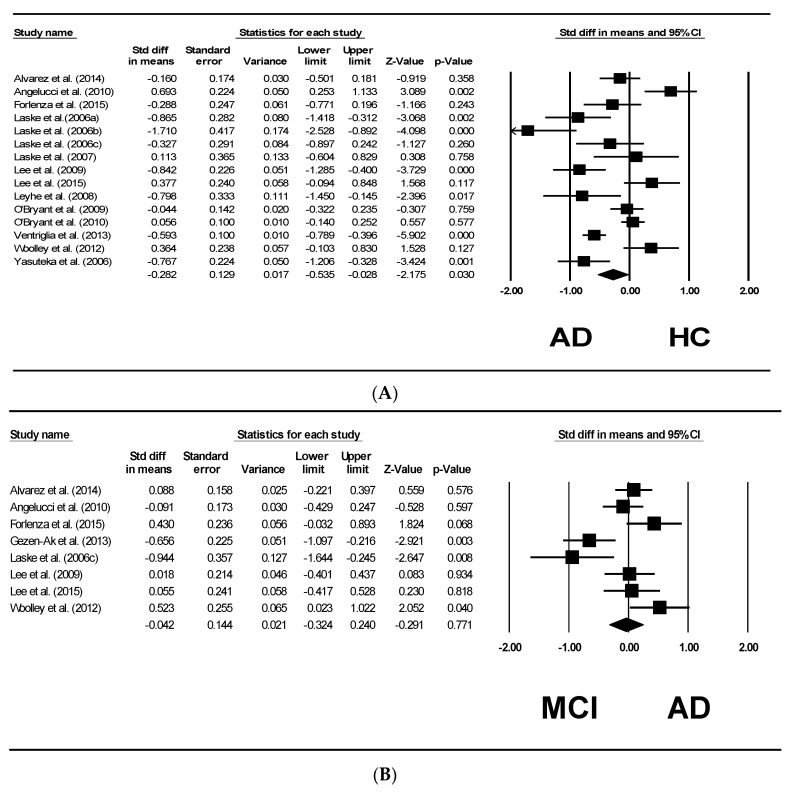
Findings from previous studies reporting the levels of serum brain-derived neurotrophic factor (BDNF) in patients with Alzheimer's disease (AD) and individuals with mild cognitive impairment (MCI) have been conflicting. Hence, we performed a meta-analysis to examine the aggregate levels of serum BDNF in patients with AD and individuals with MCI, in comparison with healthy controls. Fifteen studies were included for the comparison between AD and healthy control (HC) ( = 2067). Serum BDNF levels were significantly lower in patients with AD (SMD: -0.282; 95% confidence interval [CI]: -0.535 to -0.028; significant heterogeneity: I² = 83.962). Meta-regression identified age ( < 0.001) and MMSE scores ( < 0.001) to be the significant moderators that could explain the heterogeneity in findings in these studies. Additionally, there were no significant differences in serum BDNF levels between patients with AD and MCI (eight studies, = 906) and between MCI and HC (nine studies, = 5090). In all, patients with AD, but not MCI, have significantly lower serum BDNF levels compared to healthy controls. This meta-analysis confirmed the direction of change in serum BDNF levels in dementia. This finding suggests that a significant change in peripheral BDNF levels can only be detected at the late stage of the dementia spectrum. Molecular mechanisms, implications on interventional trials, and future directions for studies examining BDNF in dementia were discussed.
先前的研究报告显示,阿尔茨海默病(AD)患者和轻度认知障碍(MCI)个体的血清脑源性神经营养因子(BDNF)水平存在差异。因此,我们进行了一项荟萃分析,以检查 AD 患者和 MCI 个体与健康对照组相比的血清 BDNF 总水平。共有 15 项研究用于 AD 与健康对照组的比较(n=2067)。AD 患者的血清 BDNF 水平显著降低(SMD:-0.282;95%置信区间[CI]:-0.535 至 -0.028;显著异质性:I²=83.962)。元回归确定年龄(<0.001)和 MMSE 评分(<0.001)为可以解释这些研究结果中异质性的重要调节因素。此外,AD 患者与 MCI 患者之间(八项研究,n=906)和 MCI 患者与健康对照组之间(九项研究,n=5090)的血清 BDNF 水平没有显著差异。总之,与健康对照组相比,AD 患者但不是 MCI 患者的血清 BDNF 水平显著降低。这项荟萃分析证实了痴呆症患者血清 BDNF 水平变化的方向。这一发现表明,只有在痴呆症谱的晚期才能检测到外周 BDNF 水平的显著变化。讨论了分子机制、对干预试验的影响以及研究 BDNF 在痴呆症中的未来方向。