Department of Surgery, Division of Surgical Sciences, Duke University Medical Center, Durham, North Carolina.
Department of Medicine, Division of Medical Oncology, Duke University Medical Center, Durham, North Carolina.
Clin Cancer Res. 2019 May 1;25(9):2725-2736. doi: 10.1158/1078-0432.CCR-18-3102. Epub 2019 Jan 11.
Immune-based therapy for metastatic breast cancer has had limited success, particularly in molecular subtypes with low somatic mutations rates. Strategies to augment T-cell infiltration of tumors include vaccines targeting established oncogenic drivers such as the genomic amplification of HER2. We constructed a vaccine based on a novel alphaviral vector encoding a portion of HER2 (VRP-HER2).
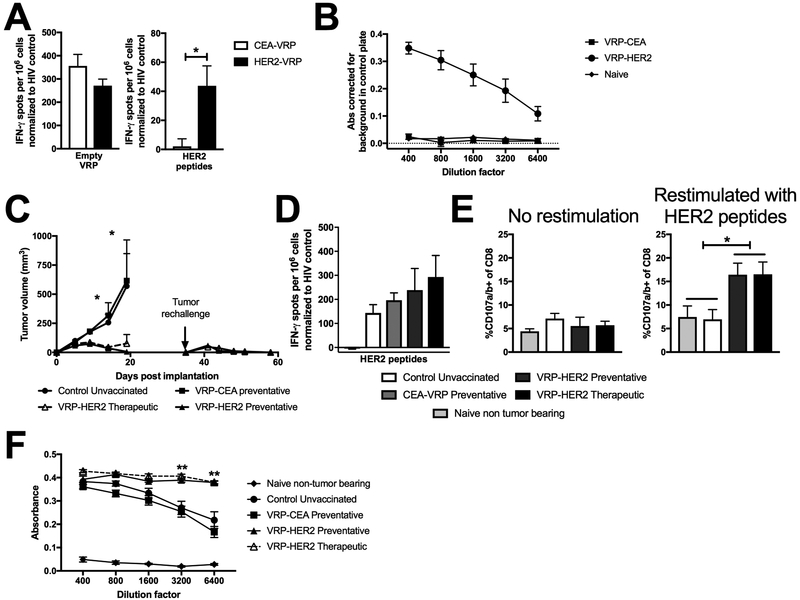
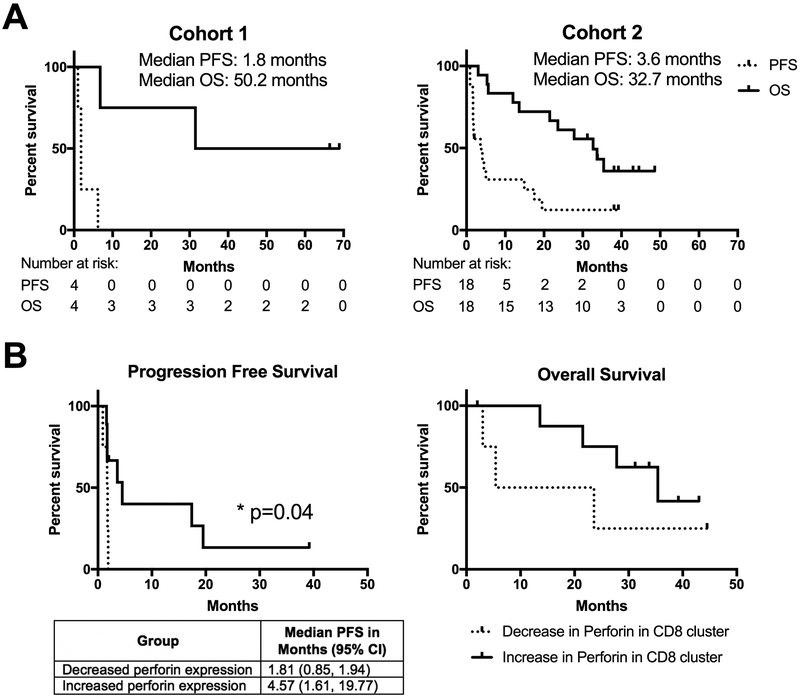
In preclinical studies, mice were immunized with VRP-HER2 before or after implantation of hHER2 tumor cells and HER2-specific immune responses and antitumor function were evaluated. We tested VRP-HER2 in a phase I clinical trial where subjects with advanced HER2-overexpressing malignancies in cohort 1 received VRP-HER2 every 2 weeks for a total of 3 doses. In cohort 2, subjects received the same schedule concurrently with a HER2-targeted therapy.
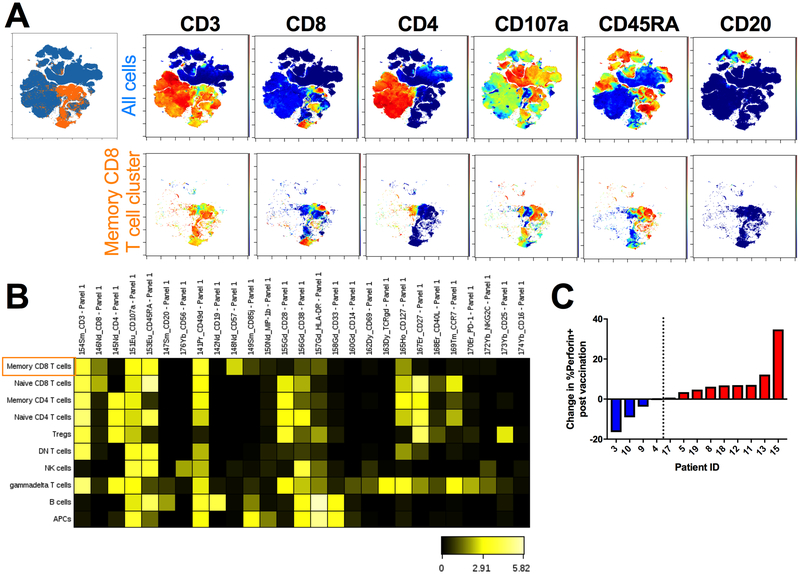
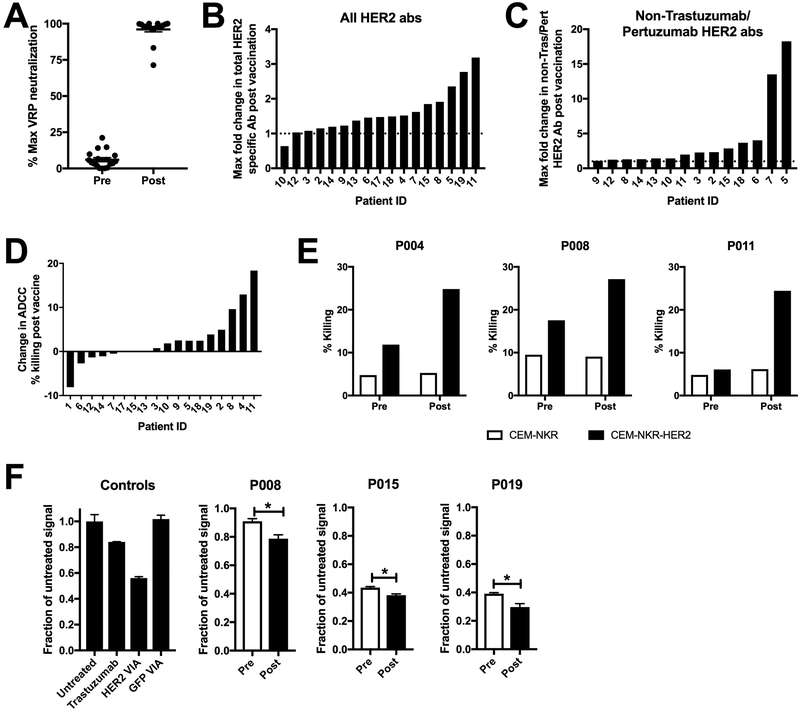
Vaccination in preclinical models with VRP-HER2 induced HER2-specific T cells and antibodies while inhibiting tumor growth. VRP-HER2 was well tolerated in patients and vaccination induced HER2-specific T cells and antibodies. Although a phase I study, there was 1 partial response and 2 patients with continued stable disease. Median OS was 50.2 months in cohort 1 ( = 4) and 32.7 months in cohort 2 ( = 18). Perforin expression by memory CD8 T cells post-vaccination significantly correlated with improved PFS.
VRP-HER2 increased HER2-specific memory CD8 T cells and had antitumor effects in preclinical and clinical studies. The expansion of HER2-specific memory CD8 T cells in vaccinated patients was significantly correlated with increased PFS. Subsequent studies will seek to enhance T-cell activity by combining with anti-PD-1.
针对转移性乳腺癌的免疫疗法取得的成效有限,尤其是在体细胞突变率较低的分子亚型中。增加 T 细胞浸润肿瘤的策略包括针对已确立的致癌驱动因素(如 HER2 基因的基因组扩增)的疫苗。我们构建了一种基于编码 HER2 部分序列的新型甲病毒载体的疫苗(VRP-HER2)。
在临床前研究中,在植入 hHER2 肿瘤细胞之前或之后,用 VRP-HER2 对小鼠进行免疫接种,并评估了 HER2 特异性免疫反应和抗肿瘤功能。我们在一项 I 期临床试验中测试了 VRP-HER2,其中队列 1 的晚期 HER2 过表达恶性肿瘤患者每 2 周接受一次 VRP-HER2 治疗,共 3 剂。在队列 2 中,患者同时接受 HER2 靶向治疗。
在临床前模型中,VRP-HER2 疫苗接种可诱导 HER2 特异性 T 细胞和抗体,同时抑制肿瘤生长。VRP-HER2 在患者中耐受性良好,可诱导 HER2 特异性 T 细胞和抗体。尽管这是一项 I 期研究,但有 1 例部分缓解,2 例患者疾病持续稳定。队列 1 的中位 OS 为 50.2 个月(n=4),队列 2 为 32.7 个月(n=18)。接种后记忆性 CD8 T 细胞中穿孔素的表达与改善 PFS 显著相关。
VRP-HER2 增加了 HER2 特异性记忆性 CD8 T 细胞,并在临床前和临床研究中具有抗肿瘤作用。接种患者中 HER2 特异性记忆性 CD8 T 细胞的扩增与 PFS 的增加显著相关。随后的研究将通过与抗 PD-1 联合来增强 T 细胞的活性。