Tomoeda Hiroshi, Mikasa Keita, Chihara Shingo, Sawada Kentaro, Tanaka Hiroyuki
Department of Cardiovascular Surgery, Chikugo City Hospital, Chikugo, Fukuoka, Japan.
Department of Surgery, Iizuka City Hospital, Iizuka, Fukuoka, Japan.
Ann Vasc Dis. 2018 Dec 25;11(4):511-519. doi: 10.3400/avd.oa.18-00116.
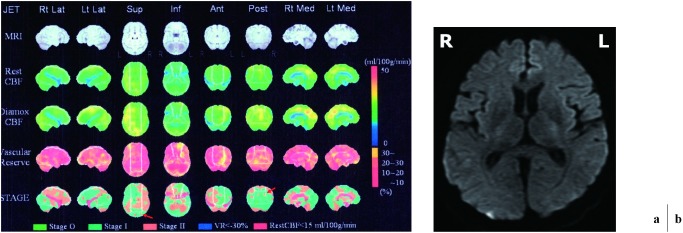
Prediction of postoperative cerebral infarction after cardiovascular surgery is difficult. The present study investigated whether quantitative evaluation of preoperative cerebral blood flow used in the Japanese EC-IC Bypass Trial (JET) study is useful for the prediction of postoperative cerebral infarction after cardiovascular surgery. First, patients were divided into two groups based on preoperative cerebral blood flow. In an evaluation using preoperative imaging, patients with good or mildly decreased preoperative cerebral blood flow, divided into clinical stage I or II by quantitative evaluation showed no postoperative cerebral infarction. However, 24% of patients with poor cerebral blood flow who were categorized as clinical stage II, experienced postoperative cerebral infarction. The incidence rate was not statistically significantly different when the groups were compared. Second, patients were divided into two groups based on the anatomical area of the brain affected corresponding to clinical stage II. Patients with a 10% and greater brain involvement had a significantly higher incidence of postoperative cerebral infarction (38%) compared to others (0%, p<0.01). This method may be useful for the prediction of postoperative cerebral infarction after cardiovascular surgery, but a further prospective study is needed. (This is a translation of J Jpn Coll Angiol 2017; 57: 125-133.).
预测心血管手术后的术后脑梗死具有挑战性。本研究调查了日本EC-IC搭桥试验(JET)研究中使用的术前脑血流量定量评估是否有助于预测心血管手术后的术后脑梗死。首先,根据术前脑血流量将患者分为两组。在使用术前成像的评估中,术前脑血流量良好或轻度降低的患者,通过定量评估分为临床I期或II期,未发生术后脑梗死。然而,被归类为临床II期的脑血流量差的患者中有24%发生了术后脑梗死。比较各组时,发病率无统计学显著差异。其次,根据与临床II期相对应的受影响脑区将患者分为两组。脑受累10%及以上的患者术后脑梗死发生率(38%)明显高于其他患者(0%,p<0.01)。这种方法可能有助于预测心血管手术后的术后脑梗死,但需要进一步的前瞻性研究。(本文翻译自《日本血管外科学会杂志》2017年;57:125 - 133。)