Doghmi Nawfal, Elkoundi Abdelghafour, Belghiti Amine, Baite Abdelouahed, Haimeur Charki
Service de Réanimation Médicale, Pôle Anesthésie-Réanimation, Hôpital Militaire Mohamed V, Rabat, Maroc.
Pan Afr Med J. 2018 Aug 7;30:259. doi: 10.11604/pamj.2018.30.259.10787. eCollection 2018.
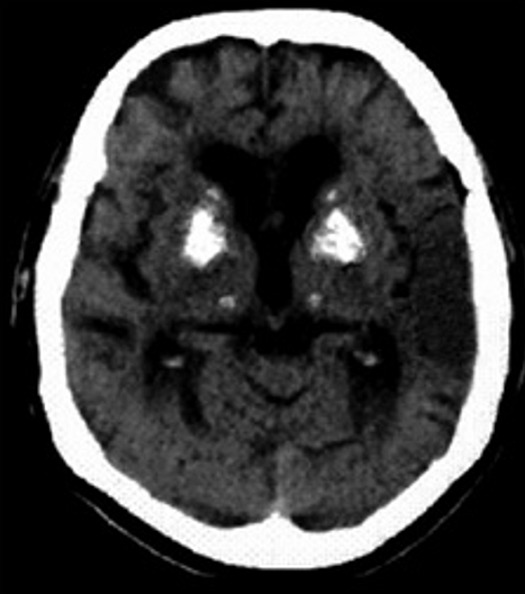
Fahr's syndrome is defined as the presence of bilateral intracerebral, symmetrical, nonarteriosclerotic calcifications involving the basal ganglia. Their detection during stroke is exceptional. Phosphocalcium metabolism should be investigated with human parathyroid hormone (HPH) dosage. Diagnosis is based on the evaluation of clinical and laboratory data as well as on radiological imaging. Long-term antiepileptic treatment can cause basal ganglia calcification resulting in Fahr's syndrome. Prognosis is favorable. The correction of phosphocalcium metabolism usually leads to significant improvement.
Fahr综合征定义为双侧脑内存在累及基底神经节的对称性、非动脉硬化性钙化。在中风期间检测到这些钙化极为罕见。应通过检测人甲状旁腺激素(HPH)来研究磷酸钙代谢。诊断基于临床和实验室数据评估以及影像学检查。长期抗癫痫治疗可导致基底神经节钙化,进而引发Fahr综合征。预后良好。纠正磷酸钙代谢通常会带来显著改善。