Hallanzy Jacqueline, Kron Martina, Goethe Veronika E, Köhn Frank-Michael, Schmautz Maximilian, Arsov Christian, Hadaschik Boris, Imkamp Florian, Gschwend Jürgen E, Herkommer Kathleen
Department of Urology, Klinikum rechts der Isar, Technical University of Munich, Munich, Germany.
Institute of Epidemiology and Medical Biometrics, University of Ulm, Ulm, Germany.
Sex Med. 2019 Mar;7(1):26-34. doi: 10.1016/j.esxm.2018.11.004. Epub 2019 Jan 9.
Erectile dysfunction (ED) is a common public health issue with a significant impact on quality of life. The associations between ED and several risk factors have been reported previously. The continuously increasing incidence of these factors is contributing to the increasing prevalence of ED.
To assess ED prevalence and severity in a representative sample of 45-year-old German men and to analyze the association with risk factors (lifestyle risk factors/comorbidities).
Data were collected within the German Male Sex-Study. Randomly selected 45-year-old men were invited. A total of 10,135 Caucasian, heterosexual, sexually active men were included in this analysis. The self-reported prevalence of ED was assessed using the Erectile Function domain of the International Index of Erectile Function. Risk factors for ED were ascertained using self-report questionnaires. An anamnesis interview and a short physical examination were performed.
ED prevalence and severity were evaluated in a cross-sectional design. The associations of ED with comorbidities (eg, depression, diabetes, hypertension, lower urinary tract symptoms) and lifestyle factors (ie, smoking, obesity, central obesity, physical inactivity, and poor self-perceived health-status) were analyzed by logistic regression.
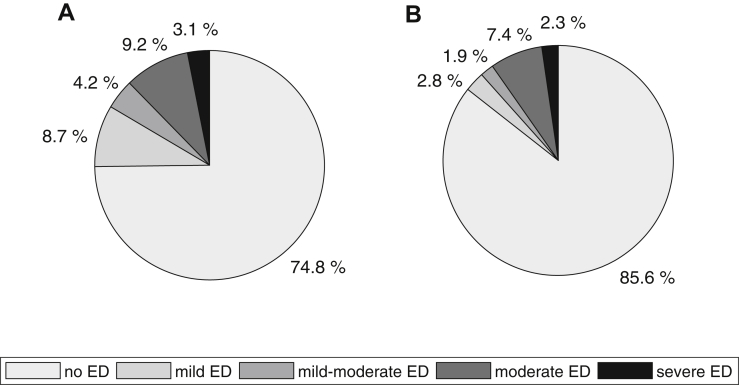
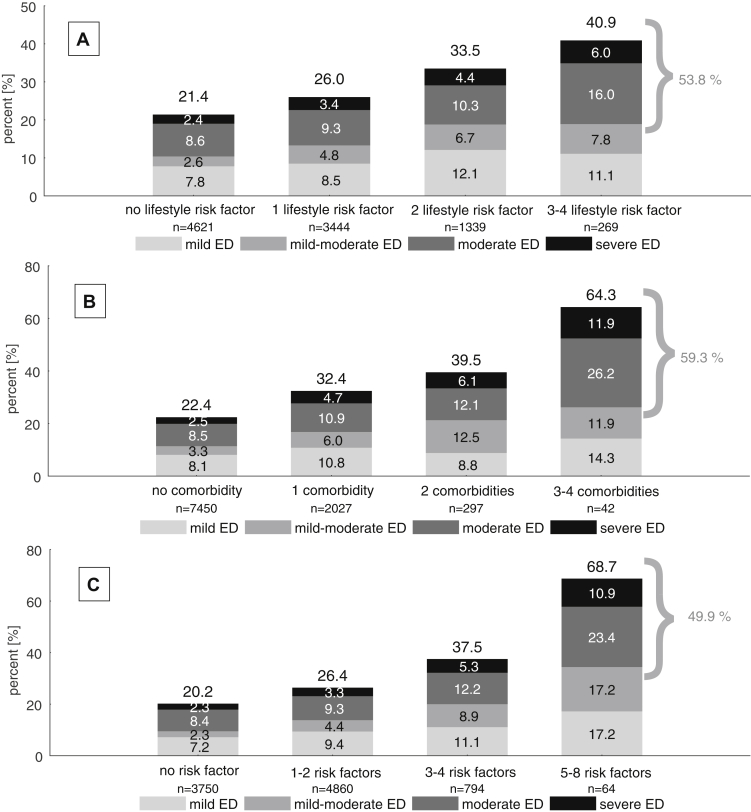
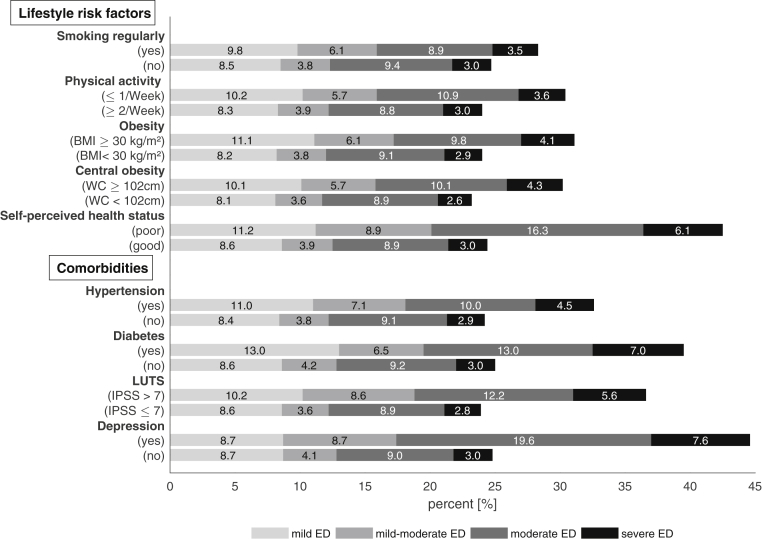
The overall prevalence of ED was 25.2% (severe, 3.1%; moderate, 9.2%; mild to moderate, 4.2%; mild, 8.7%). Among the men with ED, 48.8% had moderate or severe symptoms. ED prevalence increased with the number of risk factors, to as high as 68.7% in men with 5-8 risk factors. In multiple logistic regression with backward elimination, the strongest associations with ED were found for depression (odds ratio [OR] = 1.87), poor self-perceived health status (OR = 1.72), lower urinary tract symptoms (OR = 1.68), and diabetes (OR = 1.38).
One out of 4 men already had symptoms of ED at age 45. Almost one-half of the men with ED had moderate to severe symptoms. ED was strongly associated with each analyzed risk factor, and the prevalence and severity of ED increased with an increasing number of risk factors. Hallanzy J, Kron M, Goethe VE, et al. Erectile Dysfunction in 45-Year-Old Heterosexual German Men and Associated Lifestyle Risk Factors and Comorbidities: Results From the German Male Sex Study. Sex Med 2019;7:26-34.
勃起功能障碍(ED)是一个常见的公共卫生问题,对生活质量有重大影响。此前已有关于ED与多种风险因素之间关联的报道。这些因素发病率的持续上升导致了ED患病率的增加。
评估45岁德国男性代表性样本中的ED患病率和严重程度,并分析其与风险因素(生活方式风险因素/合并症)的关联。
数据收集于德国男性性研究中。随机邀请45岁男性。本分析纳入了10135名白人、异性恋、有性活动的男性。使用国际勃起功能指数的勃起功能领域评估ED的自我报告患病率。通过自我报告问卷确定ED的风险因素。进行了病史访谈和简短的体格检查。
采用横断面设计评估ED患病率和严重程度。通过逻辑回归分析ED与合并症(如抑郁症、糖尿病、高血压、下尿路症状)和生活方式因素(即吸烟、肥胖、中心性肥胖、身体活动不足和自我感觉健康状况差)之间的关联。
ED的总体患病率为25.2%(重度,3.1%;中度,9.2%;轻度至中度,4.2%;轻度,8.7%)。在患有ED的男性中,48.8%有中度或重度症状。ED患病率随风险因素数量的增加而升高,在有5 - 8个风险因素的男性中高达68.7%。在采用向后排除法的多因素逻辑回归中,发现与ED关联最强的因素为抑郁症(比值比[OR]=1.87)、自我感觉健康状况差(OR = 1.72)、下尿路症状(OR = 1.68)和糖尿病(OR = 1.38)。
45岁时,每4名男性中就有1人已有ED症状。几乎一半患有ED的男性有中度至重度症状。ED与每个分析的风险因素密切相关,且ED的患病率和严重程度随风险因素数量的增加而升高。哈兰齐J、克伦M、歌德VE等。45岁德国异性恋男性的勃起功能障碍及相关生活方式风险因素和合并症:德国男性性研究的结果。性医学2019;7:26 - 34。