Notre-Dame Hospital, Université de Montréal, Montreal, Quebec, Canada.
University of Calgary Multiple Sclerosis Clinic, Calgary, Alberta, Canada.
PLoS One. 2019 Jan 14;14(1):e0210417. doi: 10.1371/journal.pone.0210417. eCollection 2019.
Compliance to disease modifying therapy (DMT) is associated with a reduced risk of relapse, lower healthcare resource utilization, and improved health-related quality of life in patients with multiple sclerosis (MS). Our objective was to assess the compliance and discontinuation rates of fingolimod relative to other oral, injectable, and infusible DMTs available on the market at the time of the study in Canada in patients with relapsing-remitting MS (RRMS).
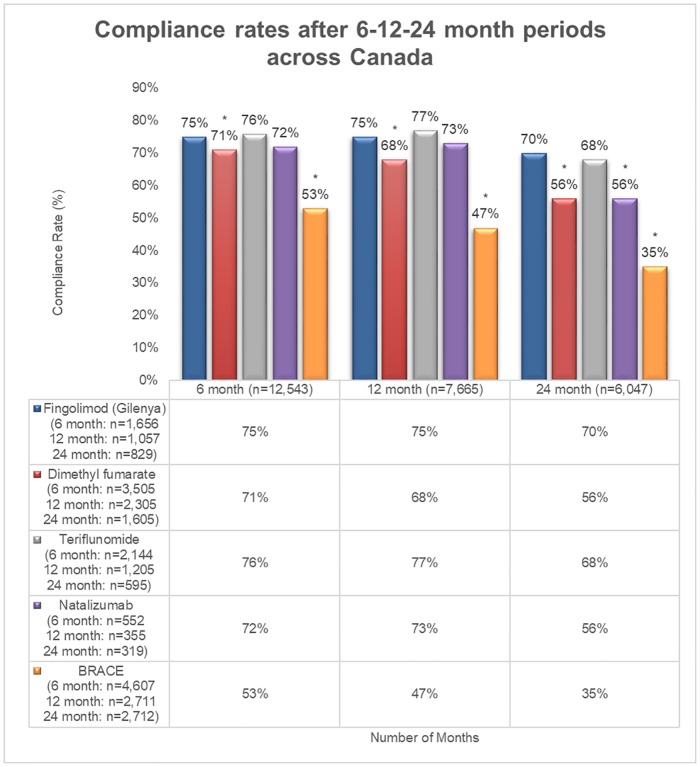
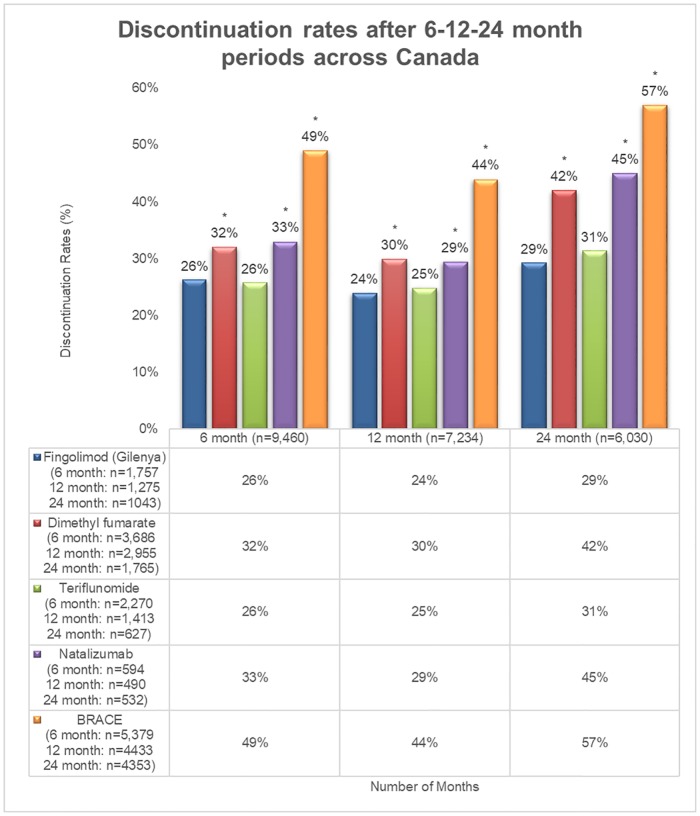
We conducted a retrospective claims analysis. Patients with RRMS with ≥ 1 prescription for each DMT were included. Compliance (medication possession ratio of ≥ 80%) and discontinuation (gap > 30 days from the end of the index prescription) were calculated at the 6-, 12- and 24-month time points. Compliance with fingolimod at the 6-, 12- and 24-month time points was 75%, 75% and 70%, respectively; compared with DMF [70% (P < 0.001), 68% (P < 0.001), and 56% (P < 0.001), respectively], and BRACE [53% (P < 0.001), 47% (P < 0.001), and 35% (P < 0.001), respectively]. Compliance with fingolimod was comparable to teriflunomide at each time point, but was higher compared to natalizumab [70% versus 57% (P < 0.001)] at the 24-month time point. At the 6-, 12- and 24-month time points, patients on fingolimod had the lowest discontinuation rate (26%, 24%, and 29%, respectively) compared to BRACE [49% (P < 0.001), 44% (P < 0.001), and 57% (P < 0.001)], respectively], and natalizumab [33% (P < 0.001), 29% (P < 0.001), and 45% (P < 0.001), respectively], and was similar to teriflunomide (26%, 25%, and 31%, respectively).
The compliance rate in fingolimod treated patients at the 24 month time point was higher than that observed in natalizumab treated patients. The discontinuation rate was lower with fingolimod compared to other DMTs at all time points but was similar to teriflunomide.
在多发性硬化症(MS)患者中,遵医嘱使用疾病修正疗法(DMT)可降低复发风险、减少医疗资源利用、提高健康相关生活质量。我们的目的是评估在研究时加拿大市场上可用的各种口服、注射和输注 DMT 中,芬戈莫德相对于其他药物的依从性和停药率,这些药物适用于复发性缓解型多发性硬化症(RRMS)患者。
我们进行了回顾性理赔分析。纳入至少有 1 次每种 DMT 处方的 RRMS 患者。在第 6、12 和 24 个月时计算药物依从性(药物持有率≥80%)和停药(从索引处方结束后超过 30 天的差距)。第 6、12 和 24 个月时,芬戈莫德的依从率分别为 75%、75%和 70%;与 DMF[70%(P<0.001)、68%(P<0.001)和 56%(P<0.001)]相比,与 BRACE[53%(P<0.001)、47%(P<0.001)和 35%(P<0.001)]相比。芬戈莫德的依从性与特立氟胺在每个时间点相当,但与那他珠单抗相比,24 个月时更高[70%比 57%(P<0.001)]。在第 6、12 和 24 个月时,与 BRACE[49%(P<0.001)、44%(P<0.001)和 57%(P<0.001)]相比,和那他珠单抗[33%(P<0.001)、29%(P<0.001)和 45%(P<0.001)]相比,服用芬戈莫德的患者停药率最低(分别为 26%、24%和 29%),与特立氟胺相似(分别为 26%、25%和 31%)。
在第 24 个月时,服用芬戈莫德的患者的依从率高于那他珠单抗治疗的患者。与其他 DMT 相比,芬戈莫德的停药率在所有时间点都较低,但与特立氟胺相似。