Division of Psychological Medicine and Clinical Neurosciences, Cardiff University, Cardiff, UK.
Department of Neurology, University Hospital of Wales, Cardiff, UK.
Eur J Neurol. 2024 Jul;31(7):e16289. doi: 10.1111/ene.16289. Epub 2024 Apr 3.
Treatment persistence is the continuation of therapy over time. It reflects a combination of treatment efficacy and tolerability. We aimed to describe real-world rates of persistence on disease-modifying therapies (DMTs) for people with multiple sclerosis (pwMS) and reasons for DMT discontinuation.
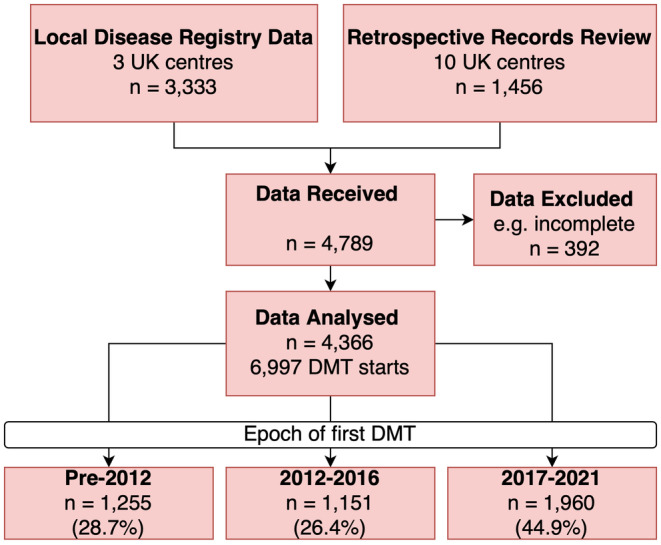
Treatment data on 4366 consecutive people with relapse-onset multiple sclerosis (MS) were pooled from 13 UK specialist centres during 2021. Inclusion criteria were exposure to at least one MS DMT and a complete history of DMT prescribing. PwMS in blinded clinical trials were excluded. Data collected included sex, age at MS onset, age at DMT initiation, DMT treatment dates, and reasons for stopping or switching DMT. For pwMS who had received immune reconstituting therapies (cladribine/alemtuzumab), discontinuation date was defined as starting an alternative DMT. Kaplan-Meier survival analyses were used to express DMT persistence.
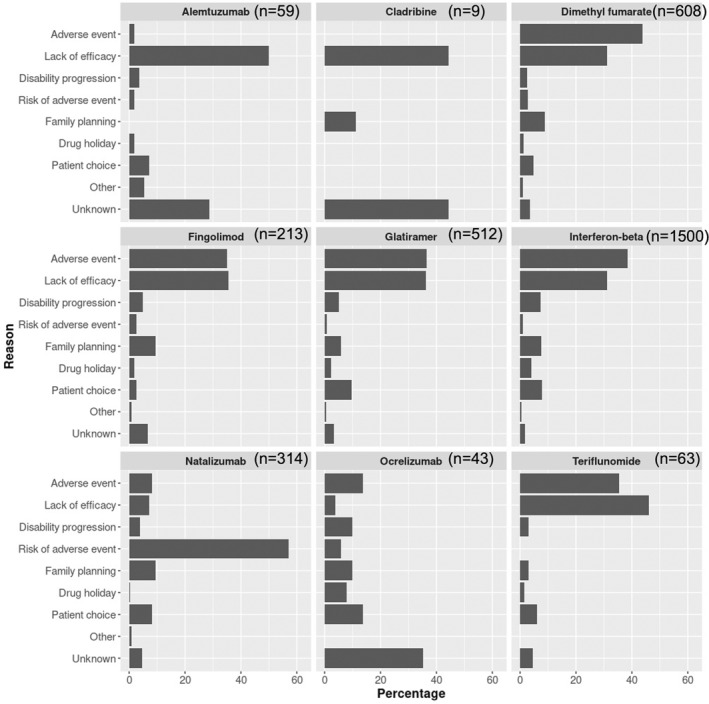
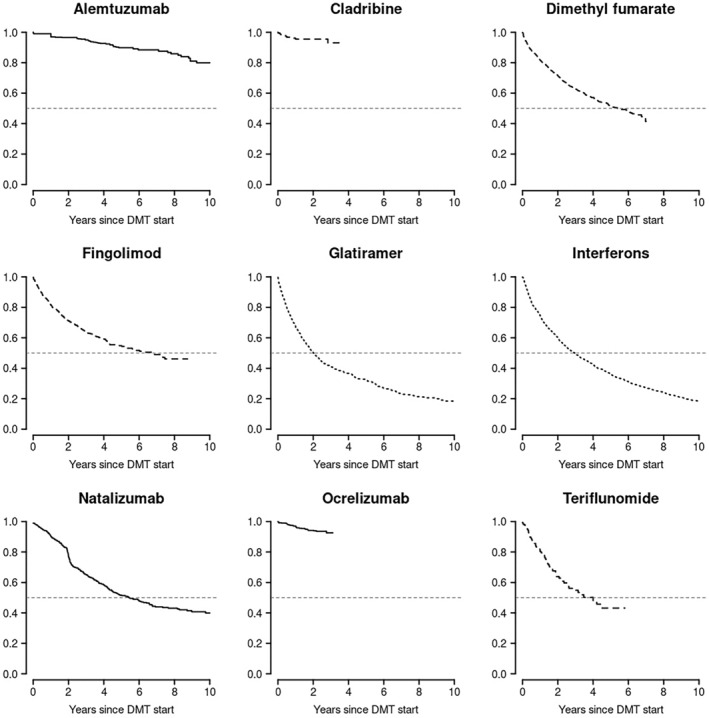
In 6997 treatment events (1.6 per person with MS), median time spent on any single maintenance DMT was 4.3 years (95% confidence interval = 4.1-4.5 years). The commonest overall reasons for DMT discontinuation were adverse events (35.0%) and lack of efficacy (30.3%). After 10 years, 20% of people treated with alemtuzumab had received another subsequent DMT, compared to 82% of people treated with interferon or glatiramer acetate.
Immune reconstituting DMTs may have the highest potential to offer a single treatment for relapsing MS. Comparative data on DMT persistence and reasons for discontinuation are valuable to inform treatment decisions and in personalizing treatment in MS.
治疗持续性是指随着时间的推移继续进行治疗。它反映了治疗效果和耐受性的综合表现。我们旨在描述多发性硬化症(MS)患者使用疾病修正疗法(DMT)的真实世界持续性率及其停止 DMT 的原因。
2021 年,我们汇集了来自英国 13 个专科中心的 4366 名复发型多发性硬化症(MS)患者的治疗数据。纳入标准为至少接受过一种 MS DMT 治疗且有完整的 DMT 处方史。排除参与盲法临床试验的患者。收集的数据包括性别、MS 发病年龄、DMT 起始年龄、DMT 治疗日期以及停止或转换 DMT 的原因。对于接受过免疫重建疗法(克拉屈滨/阿仑单抗)的患者,停药日期定义为开始使用替代 DMT。使用 Kaplan-Meier 生存分析来表示 DMT 的持续性。
在 6997 次治疗事件(每位 MS 患者 1.6 次)中,任何单一维持性 DMT 的中位使用时间为 4.3 年(95%置信区间为 4.1-4.5 年)。最常见的总体 DMT 停药原因是不良反应(35.0%)和疗效不佳(30.3%)。10 年后,接受阿仑单抗治疗的患者中有 20%接受了另一种后续 DMT,而接受干扰素或那他珠单抗治疗的患者中有 82%接受了另一种后续 DMT。
免疫重建性 DMT 可能为复发性 MS 提供单次治疗的最大潜力。关于 DMT 持续性和停药原因的比较数据对于指导治疗决策和在 MS 中进行个体化治疗非常有价值。