• 文献检索
  • 文档翻译
  • 深度研究
  • 学术资讯
  • Suppr Zotero 插件Zotero 插件
  • 邀请有礼
  • 套餐&价格
  • 历史记录
应用&插件
Suppr Zotero 插件Zotero 插件浏览器插件Mac 客户端Windows 客户端微信小程序
定价
高级版会员购买积分包购买API积分包
服务
文献检索文档翻译深度研究API 文档MCP 服务
关于我们
关于 Suppr公司介绍联系我们用户协议隐私条款
关注我们

Suppr 超能文献

核心技术专利:CN118964589B侵权必究
粤ICP备2023148730 号-1Suppr @ 2026

文献检索

告别复杂PubMed语法,用中文像聊天一样搜索,搜遍4000万医学文献。AI智能推荐,让科研检索更轻松。

立即免费搜索

文件翻译

保留排版,准确专业,支持PDF/Word/PPT等文件格式,支持 12+语言互译。

免费翻译文档

深度研究

AI帮你快速写综述,25分钟生成高质量综述,智能提取关键信息,辅助科研写作。

立即免费体验

多发性硬化症患者疾病修饰疗法的治疗转换:来自德国多发性硬化症注册中心的长期经验。

Treatment switches of disease-modifying therapies in people with multiple sclerosis: long-term experience from the German MS Registry.

作者信息

Frahm Niklas, Ellenberger David, Stahmann Alexander, Fneish Firas, Lüftenegger Daniel, Salmen Hans C, Schirduan Ksenija, Schaak Tom P A, Flachenecker Peter, Kleinschnitz Christoph, Paul Friedemann, Krefting Dagmar, Zettl Uwe K, Peters Melanie, Warnke Clemens

机构信息

German MS Registry, MS Forschungs- und Projektentwicklungs-gGmbH (MS Research and Project Development gGmbH [MSFP]), Krausenstr. 50, Hannover, Niedersachsen 30171, Germany.

German MS Registry, MS Forschungs- und Projektentwicklungs-gGmbH (MS Research and Project Development gGmbH [MSFP]), Hannover, Germany.

出版信息

Ther Adv Neurol Disord. 2024 Mar 29;17:17562864241239740. doi: 10.1177/17562864241239740. eCollection 2024.

DOI:10.1177/17562864241239740
PMID:38560408
原文链接:https://pmc.ncbi.nlm.nih.gov/articles/PMC10981260/
Abstract

BACKGROUND

The spectrum of disease-modifying therapies (DMTs) for people with multiple sclerosis (PwMS) has expanded over years, but data on treatment strategies is largely lacking. DMT switches are common clinical practice.

OBJECTIVE

To compare switchers and non-switchers, characterize the first DMT switch and identify reasons and predictors for switching the first DMT.

METHODS

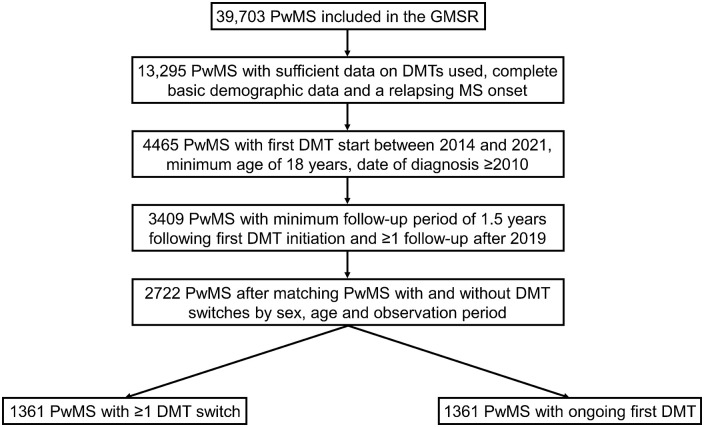
Data on 2722 PwMS from the German MS Registry were retrospectively analyzed regarding sociodemographic/clinical differences between 1361 switchers (PwMS discontinuing the first DMT) and non-switchers matched according to age, sex, and observation period. Frequencies of first and second DMTs were calculated and switch reasons identified. Predictors for DMT switches were revealed using univariable and multivariable regression models.

RESULTS

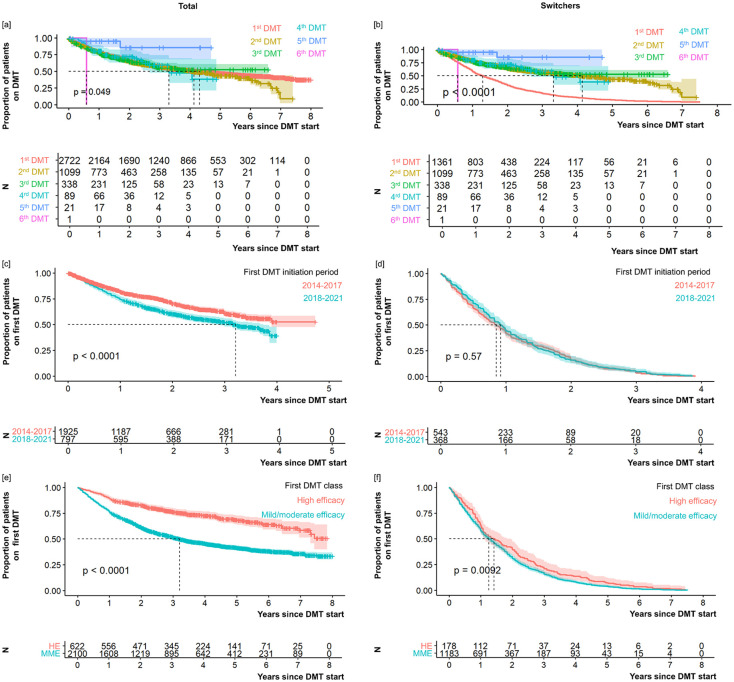
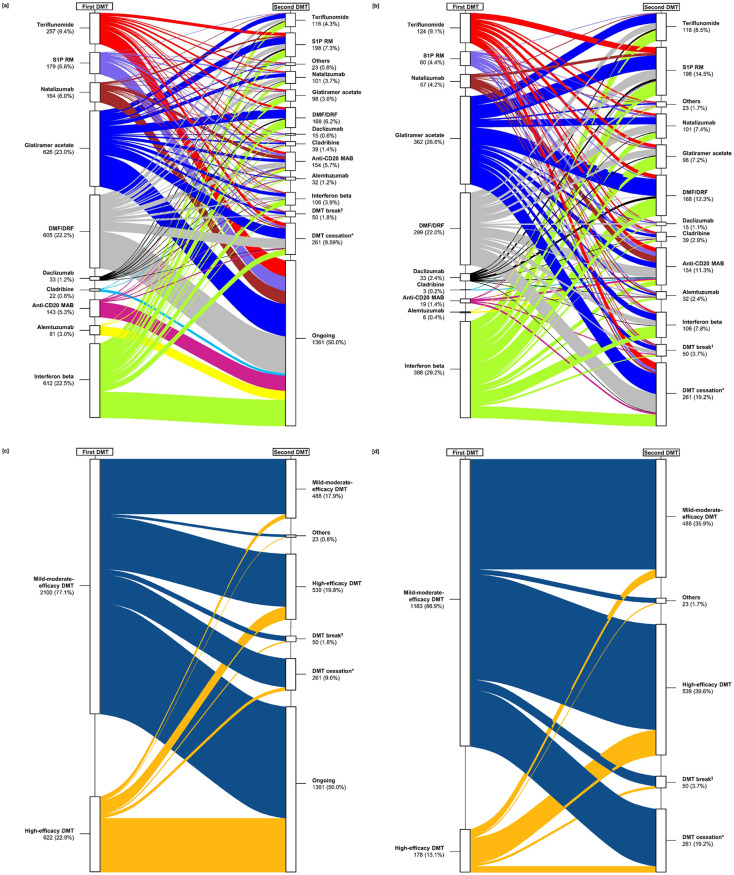
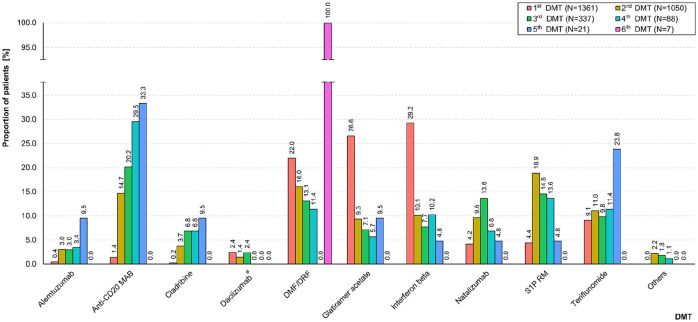
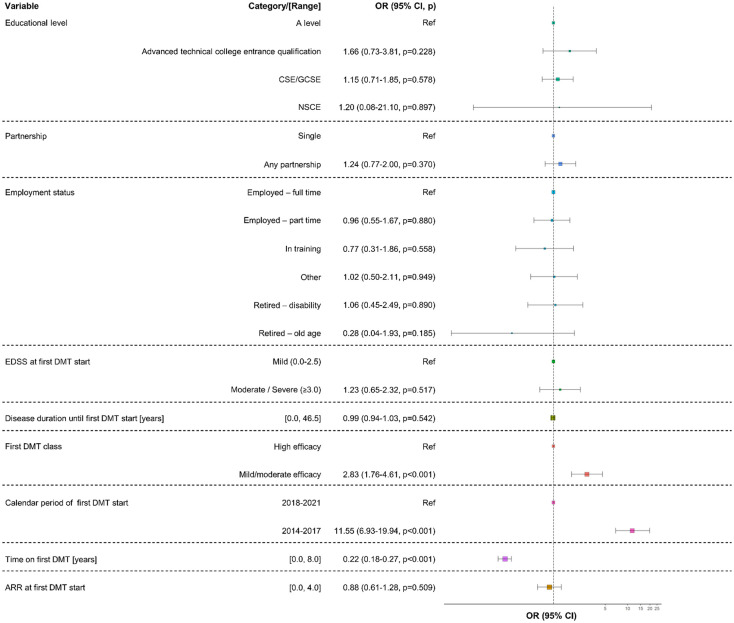
Switchers and non-switchers differed significantly regarding time to first DMT, education, calendar period of the first DMT start (2014-2017 2018-2021), first DMT class used [mild-to-moderate efficacy (MME) high-efficacy (HE) DMT], time on first DMT, and disease activity at first DMT start or cessation/last follow-up. The majority of PwMS started with MME DMTs (77.1%), with the most common being glatiramer acetate, dimethyl/diroximel fumarate, and beta-interferon variants. Switchers changed treatment more often to HE DMTs (39.6%), most commonly sphingosine-1-phosphate receptor modulators, anti-CD20 monoclonal antibodies, and natalizumab. Fewer PwMS switched to MME DMTs (35.9%), with the most common being dimethyl/diroximel fumarate, teriflunomide, or beta-interferon. Among 1045 PwMS with sufficient data (76.8% of 1361 switchers), the most frequent reasons for discontinuing the first DMT were disease activity despite DMT (63.1%), adverse events (17.1%), and patient request (8.3%). Predictors for the first DMT switch were MME DMT as initial treatment [odds ratio (OR) = 2.83 (1.76-4.61),  < 0.001; reference: HE DMT], first DMT initiation between 2014 and 2017 [OR = 11.55 (6.93-19.94),  < 0.001; reference: 2018-2021], and shorter time on first DMT [OR = 0.22 (0.18-0.27),  < 0.001].

CONCLUSION

The initial use of MME DMTs was among the strongest predictors of DMT discontinuation in a large German retrospective MS cohort, arguing for the need for prospective treatment strategy trials, not only but also on the initial broad use of HE DMTs in PwMS.

摘要

背景

多年来,用于多发性硬化症患者(PwMS)的疾病修正疗法(DMTs)种类有所增加,但关于治疗策略的数据大多缺乏。DMT转换是常见的临床操作。

目的

比较转换者和未转换者,描述首次DMT转换的特征,并确定首次DMT转换的原因和预测因素。

方法

回顾性分析德国多发性硬化症登记处2722例PwMS的数据,分析1361例转换者(停用首次DMT的PwMS)与根据年龄、性别和观察期匹配的未转换者之间的社会人口统计学/临床差异。计算首次和第二次DMT的使用频率,并确定转换原因。使用单变量和多变量回归模型揭示DMT转换的预测因素。

结果

转换者和未转换者在首次使用DMT的时间、教育程度、首次开始使用DMT的日历期(2014 - 2017年与2018 - 2021年)、首次使用的DMT类别[轻度至中度疗效(MME)与高效(HE)DMT]、首次使用DMT的时间以及首次开始使用DMT或停止使用/最后一次随访时的疾病活动度方面存在显著差异。大多数PwMS最初使用MME DMT(77.1%),最常见的是醋酸格拉替雷、富马酸二甲酯/二羟丙茶碱和β-干扰素变体。转换者更常将治疗转换为HE DMT(39.6%),最常见的是鞘氨醇-1-磷酸受体调节剂、抗CD20单克隆抗体和那他珠单抗。较少的PwMS转换为MME DMT(35.9%),最常见的是富马酸二甲酯/二羟丙茶碱、特立氟胺或β-干扰素。在1045例有足够数据的PwMS中(1361例转换者中的76.8%),停用首次DMT的最常见原因是尽管使用了DMT仍有疾病活动(63.1%)、不良事件(17.1%)和患者要求(8.3%)。首次DMT转换的预测因素是初始治疗使用MME DMT[比值比(OR)=2.83(1.76 - 4.61),P<0.001;参考:HE DMT]、2014年至2017年开始首次DMT[OR = 11.55(6.93 - 19.94),P<0.001;参考:2018 - 2021年]以及首次DMT使用时间较短[OR = 0.22(0.18 - 0.27),P<0.001]。

结论

在一个大型德国回顾性多发性硬化症队列中,初始使用MME DMT是DMT停用的最强预测因素之一,这表明不仅需要进行前瞻性治疗策略试验,还需要对PwMS广泛初始使用HE DMT进行研究。
https://cdn.ncbi.nlm.nih.gov/pmc/blobs/321c/10981260/dd6e337d7ea8/10.1177_17562864241239740-fig5.jpg
https://cdn.ncbi.nlm.nih.gov/pmc/blobs/321c/10981260/57211c462edd/10.1177_17562864241239740-fig1.jpg
https://cdn.ncbi.nlm.nih.gov/pmc/blobs/321c/10981260/fa323934642b/10.1177_17562864241239740-fig2.jpg
https://cdn.ncbi.nlm.nih.gov/pmc/blobs/321c/10981260/bf03612adb12/10.1177_17562864241239740-fig3.jpg
https://cdn.ncbi.nlm.nih.gov/pmc/blobs/321c/10981260/542459f3cf16/10.1177_17562864241239740-fig4.jpg
https://cdn.ncbi.nlm.nih.gov/pmc/blobs/321c/10981260/dd6e337d7ea8/10.1177_17562864241239740-fig5.jpg
https://cdn.ncbi.nlm.nih.gov/pmc/blobs/321c/10981260/57211c462edd/10.1177_17562864241239740-fig1.jpg
https://cdn.ncbi.nlm.nih.gov/pmc/blobs/321c/10981260/fa323934642b/10.1177_17562864241239740-fig2.jpg
https://cdn.ncbi.nlm.nih.gov/pmc/blobs/321c/10981260/bf03612adb12/10.1177_17562864241239740-fig3.jpg
https://cdn.ncbi.nlm.nih.gov/pmc/blobs/321c/10981260/542459f3cf16/10.1177_17562864241239740-fig4.jpg
https://cdn.ncbi.nlm.nih.gov/pmc/blobs/321c/10981260/dd6e337d7ea8/10.1177_17562864241239740-fig5.jpg

相似文献

1
Treatment switches of disease-modifying therapies in people with multiple sclerosis: long-term experience from the German MS Registry.多发性硬化症患者疾病修饰疗法的治疗转换:来自德国多发性硬化症注册中心的长期经验。
Ther Adv Neurol Disord. 2024 Mar 29;17:17562864241239740. doi: 10.1177/17562864241239740. eCollection 2024.
2
Trajectories of disease-modifying therapies and associated sickness absence and disability pension among 1923 people with multiple sclerosis in Sweden.瑞典1923例多发性硬化症患者的疾病改善治疗轨迹及相关病假和残疾抚恤金情况
Mult Scler Relat Disord. 2023 Jan;69:104456. doi: 10.1016/j.msard.2022.104456. Epub 2022 Dec 9.
3
Persistence, Adherence, and Switching to Higher-Cost Therapy in Patients with Multiple Sclerosis Initiating Oral Disease-Modifying Therapies: A Retrospective Real-World Study.多发性硬化症患者开始口服疾病修正治疗后的持续治疗、依从性及转换至更高成本治疗:一项回顾性真实世界研究
Neurol Ther. 2022 Dec;11(4):1735-1748. doi: 10.1007/s40120-022-00404-1. Epub 2022 Sep 24.
4
Risk of Getting COVID-19 in People With Multiple Sclerosis: A Case-Control Study.多发性硬化症患者感染 COVID-19 的风险:一项病例对照研究。
Neurol Neuroimmunol Neuroinflamm. 2022 Jan 19;9(2). doi: 10.1212/NXI.0000000000001141. Print 2022 Mar.
5
Quality of life among injectable and oral disease-modifying therapy users in the Pacific Northwest Multiple Sclerosis Registry.西北太平洋多发性硬化症注册中心中接受注射和口服疾病修正治疗患者的生活质量。
BMC Neurol. 2020 Dec 4;20(1):439. doi: 10.1186/s12883-020-02016-4.
6
Rituximab for people with multiple sclerosis.利妥昔单抗治疗多发性硬化症。
Cochrane Database Syst Rev. 2021 Nov 8;11(11):CD013874. doi: 10.1002/14651858.CD013874.pub2.
7
Immunomodulators and immunosuppressants for relapsing-remitting multiple sclerosis: a network meta-analysis.免疫调节剂和免疫抑制剂治疗复发缓解型多发性硬化症的网状 Meta 分析。
Cochrane Database Syst Rev. 2024 Jan 4;1(1):CD011381. doi: 10.1002/14651858.CD011381.pub3.
8
Use of the new oral disease-modifying therapies for multiple sclerosis in British Columbia, Canada: the first five-years.加拿大不列颠哥伦比亚省新的多发性硬化症口服疾病修正疗法的使用:头五年。
Mult Scler Relat Disord. 2018 Oct;25:57-60. doi: 10.1016/j.msard.2018.07.012. Epub 2018 Jul 9.
9
Costs of Potential Medication Wastage Due to Switching Treatment Among People With Multiple Sclerosis.多发性硬化症患者因更换治疗方案导致的潜在药物浪费成本。
J Health Econ Outcomes Res. 2024 Oct 28;11(2):103-108. doi: 10.36469/001c.123336. eCollection 2024.
10
Evaluation of drivers of treatment switch in relapsing multiple sclerosis: a study from the Italian MS Registry.评估复发型多发性硬化症治疗转换的驱动因素:来自意大利多发性硬化症注册研究。
J Neurol. 2024 Mar;271(3):1150-1159. doi: 10.1007/s00415-023-12137-8. Epub 2023 Dec 22.

引用本文的文献

1
Age-related differences in switching highly effective disease-modifying therapy in patients with multiple sclerosis.多发性硬化症患者转换高效疾病修正治疗的年龄相关差异。
J Neurol. 2025 Sep 4;272(9):609. doi: 10.1007/s00415-025-13330-7.

本文引用的文献

1
Risk of new disease activity in patients with multiple sclerosis who continue or discontinue disease-modifying therapies (DISCOMS): a multicentre, randomised, single-blind, phase 4, non-inferiority trial.多发性硬化症患者继续或停止疾病修正治疗后新发疾病活动的风险(DISCOMS):一项多中心、随机、单盲、四期、非劣效性试验。
Lancet Neurol. 2023 Jul;22(7):568-577. doi: 10.1016/S1474-4422(23)00154-0.
2
Personality as a Predictor of Disability in Multiple Sclerosis.人格特质对多发性硬化症致残的预测作用。
Arch Clin Neuropsychol. 2023 Jul 25;38(5):657-666. doi: 10.1093/arclin/acad010.
3
The Quality of Life and Medication Adherence in Patients with Multiple Sclerosis-Cross-Sectional Study.
多发性硬化症患者的生活质量和药物依从性的横断面研究。
Int J Environ Res Public Health. 2022 Nov 5;19(21):14549. doi: 10.3390/ijerph192114549.
4
New drugs for multiple sclerosis: new treatment algorithms.多发性硬化症的新药:新的治疗方案。
Curr Opin Neurol. 2022 Jun 1;35(3):262-270. doi: 10.1097/WCO.0000000000001063.
5
Real-world disease-modifying therapy pathways from administrative claims data in patients with multiple sclerosis.从多发性硬化症患者的行政索赔数据中看现实世界的疾病修正治疗途径。
BMC Neurol. 2022 Jun 7;22(1):211. doi: 10.1186/s12883-022-02738-7.
6
Risk of fingolimod rebound after switching to cladribine or rituximab in multiple sclerosis.多发性硬化症患者换用克拉屈滨或利妥昔单抗后出现芬戈莫德反弹风险。
Mult Scler Relat Disord. 2022 Jun;62:103812. doi: 10.1016/j.msard.2022.103812. Epub 2022 Apr 17.
7
Adherence to Therapy in Patients with Multiple Sclerosis-Review.多发性硬化症患者的治疗依从性-综述。
Int J Environ Res Public Health. 2022 Feb 15;19(4):2203. doi: 10.3390/ijerph19042203.
8
The need for a strategic therapeutic approach: multiple sclerosis in check.采取战略性治疗方法的必要性:控制多发性硬化症。
Ther Adv Chronic Dis. 2022 Jan 18;13:20406223211063032. doi: 10.1177/20406223211063032. eCollection 2022.
9
Escalation vs. Early Intense Therapy in Multiple Sclerosis.多发性硬化症中的强化治疗与早期强化治疗对比
J Pers Med. 2022 Jan 17;12(1):119. doi: 10.3390/jpm12010119.
10
Therapy Switches in Fingolimod-Treated Patients with Multiple Sclerosis: Long-Term Experience from the German MS Registry.芬戈莫德治疗的多发性硬化症患者的治疗转换:来自德国多发性硬化症注册中心的长期经验。
Neurol Ther. 2022 Mar;11(1):319-336. doi: 10.1007/s40120-021-00320-w. Epub 2022 Jan 12.