Department of Veterinary Biosciences, Melbourne Veterinary School, The University of Melbourne, Parkville, Victoria, 3010, Australia.
Bio21 Molecular Science and Biotechnology Institute, The University of Melbourne, Parkville, Victoria, 3010, Australia.
Parasit Vectors. 2019 Jan 14;12(1):32. doi: 10.1186/s13071-018-3265-y.
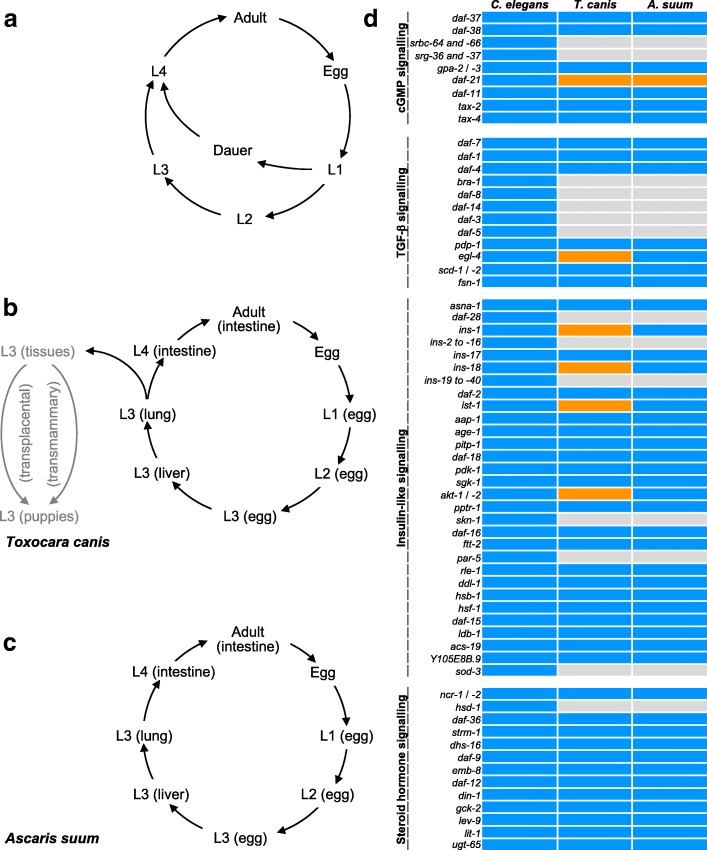
Toxocara canis is quite closely related to Ascaris suum but its biology is more complex, involving a phase of arrested development (diapause or hypobiosis) in tissues as well as transplacental and transmammary transmission routes. In the present study, we explored and compared dauer-like signalling pathways of T. canis and A. suum to infer which components in these pathways might associate with, or regulate, this added complexity in T. canis.
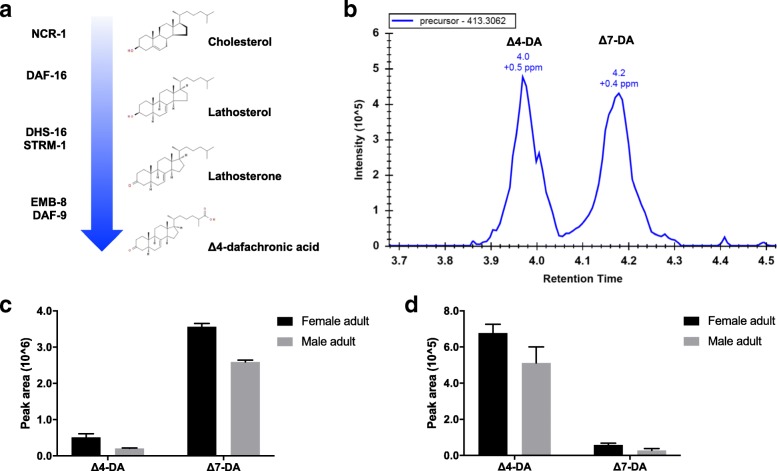
Guided by information for Caenorhabditis elegans, we bioinformatically inferred and compared components of dauer-like signalling pathways in T. canis and A. suum using genomic and transcriptomic data sets. In these two ascaridoids, we also explored endogenous dafachronic acids (DAs), which are known to be critical in regulating larval developmental processes in C. elegans and other nematodes, by liquid chromatography-mass spectrometry (LC-MS).
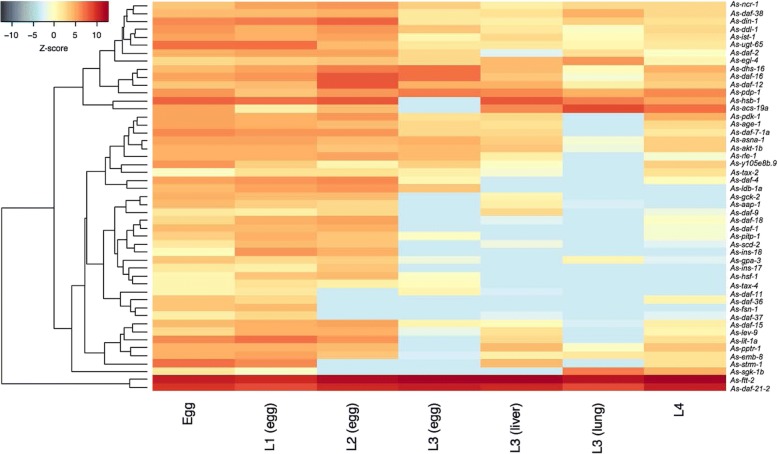
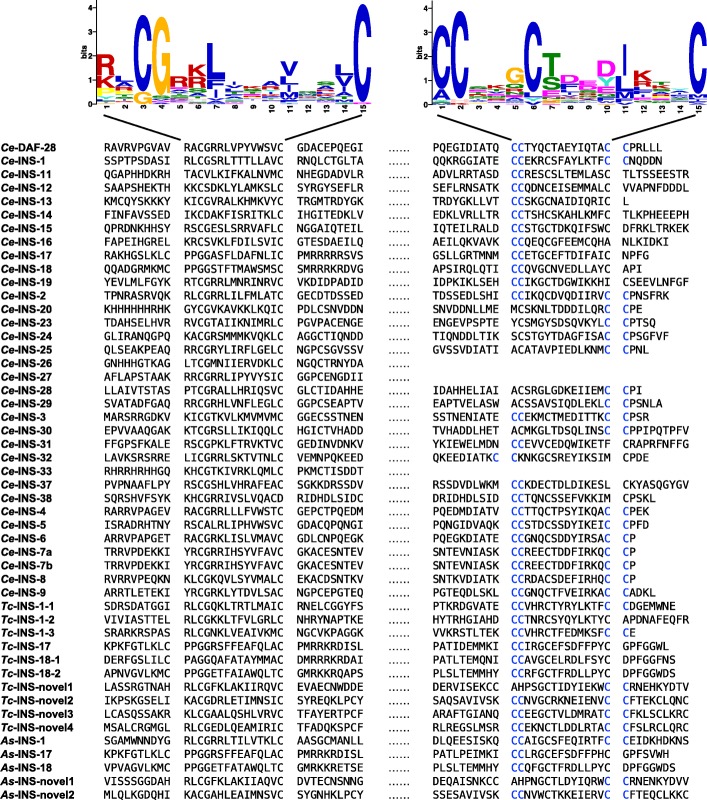
Orthologues of C. elegans dauer signalling genes were identified in T. canis (n = 55) and A. suum (n = 51), inferring the presence of a dauer-like signalling pathway in both species. Comparisons showed clear differences between C. elegans and these ascaridoids as well as between T. canis and A. suum, particularly in the transforming growth factor-β (TGF-β) and insulin-like signalling pathways. Specifically, in both A. suum and T. canis, there was a paucity of genes encoding SMAD transcription factor-related protein (daf-3, daf-5, daf-8 and daf-14) and insulin/insulin-like peptide (daf-28, ins-4, ins-6 and ins-7) homologues, suggesting an evolution and adaptation of the signalling pathway in these parasites. In T. canis, there were more orthologues coding for homologues of antagonist insulin-like peptides (Tc-ins-1 and Tc-ins-18), an insulin receptor substrate (Tc-ist-1) and a serine/threonine kinase (Tc-akt-1) than in A. suum, suggesting potentiated functional roles for these molecules in regulating larval diapause and reactivation. A relatively conserved machinery was proposed for DA synthesis in the two ascaridoids, and endogenous Δ4- and Δ7-DAs were detected in them by LC-MS analysis. Differential transcription analysis between T. canis and A. suum suggests that ins-17 and ins-18 homologues are specifically involved in regulating development and migration in T. canis larvae in host tissues.
The findings of this study provide a basis for functional explorations of insulin-like peptides, signalling hormones (i.e. DAs) and related nuclear receptors, proposed to link to development and/or parasite-host interactions in T. canis. Elucidating the functional roles of these molecules might contribute to the discovery of novel anthelmintic targets in ascaridoids.
犬弓首蛔虫与猪蛔虫关系密切,但生物学更为复杂,在组织中存在发育停滞(休眠或滞育)阶段,以及胎盘和乳腺传播途径。在本研究中,我们探索和比较了犬弓首蛔虫和猪蛔虫的 dauer 样信号通路,以推断这些通路中的哪些成分可能与犬弓首蛔虫的这种额外复杂性相关或调节这种复杂性。
根据秀丽隐杆线虫的信息,我们使用基因组和转录组数据集,通过生物信息学推断和比较犬弓首蛔虫和猪蛔虫 dauer 样信号通路的成分。在这两种蛔虫中,我们还通过液相色谱-质谱(LC-MS)探索了内源性的 dafachronic 酸(DA),已知 DA 在调节秀丽隐杆线虫和其他线虫的幼虫发育过程中起着关键作用。
在犬弓首蛔虫(n=55)和猪蛔虫(n=51)中鉴定出秀丽隐杆线虫 dauer 信号基因的同源物,推断这两种物种都存在 dauer 样信号通路。比较表明,秀丽隐杆线虫与这两种蛔虫以及犬弓首蛔虫与猪蛔虫之间存在明显差异,特别是在转化生长因子-β(TGF-β)和胰岛素样信号通路。具体来说,在猪蛔虫和犬弓首蛔虫中,编码 SMAD 转录因子相关蛋白(daf-3、daf-5、daf-8 和 daf-14)和胰岛素/胰岛素样肽(daf-28、ins-4、ins-6 和 ins-7)同源物的基因明显较少,表明这些寄生虫的信号通路发生了进化和适应。在犬弓首蛔虫中,编码拮抗胰岛素样肽(Tc-ins-1 和 Tc-ins-18)、胰岛素受体底物(Tc-ist-1)和丝氨酸/苏氨酸激酶(Tc-akt-1)的同源物的基因比猪蛔虫多,这表明这些分子在调节幼虫休眠和再激活方面的功能作用得到了增强。提出了两种蛔虫中 DA 合成的相对保守机制,并通过 LC-MS 分析检测到它们中的内源性 Δ4-和 Δ7-DA。犬弓首蛔虫和猪蛔虫之间的差异转录分析表明,ins-17 和 ins-18 同源物特异性参与调节犬弓首蛔虫幼虫在宿主组织中的发育和迁移。
本研究的结果为探索胰岛素样肽、信号激素(即 DA)和相关核受体提供了基础,这些激素被认为与犬弓首蛔虫的发育和/或寄生虫-宿主相互作用有关。阐明这些分子的功能作用可能有助于发现蛔虫中的新型驱虫靶点。