Department of Radiation Oncology, Penn State Cancer Institute, Hershey, PA, 17033, USA.
Department of Public Health Sciences, Penn State College of Medicine, Hershey, PA, 17033, USA.
Nat Commun. 2019 Jan 14;10(1):207. doi: 10.1038/s41467-018-08170-1.
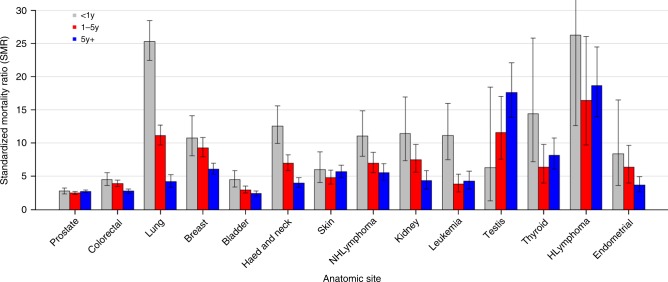
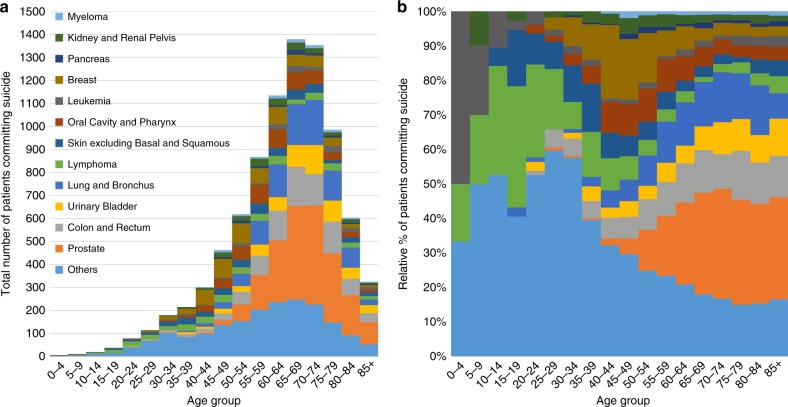
Our purpose is to identify cancer patients at highest risk of suicide compared to the general population and other cancer patients. This is a retrospective, population-based study using nationally representative data from the Surveillance, Epidemiology, and End Results program, 1973-2014. Among 8,651,569 cancer patients, 13,311 committed suicide; the rate of suicide was 28.58/ 100,000-person years, and the standardized mortality ratio (SMR) of suicide was 4.44 (95% CI, 4.33, 4.55). The predominant patients who committed suicide were male (83%) and white (92%). Cancers of the lung, head and neck, testes, bladder, and Hodgkin lymphoma had the highest SMRs ( > 5-10) through the follow up period. Elderly, white, unmarried males with localized disease are at highest risk vs other cancer patients. Among those diagnosed at < 50 years of age, the plurality of suicides is from hematologic and testicular tumors; if > 50, from prostate, lung, and colorectal cancer patients.
我们的目的是确定与一般人群和其他癌症患者相比自杀风险最高的癌症患者。这是一项回顾性的、基于人群的研究,使用了来自 1973 年至 2014 年监测、流行病学和最终结果计划的全国代表性数据。在 8651569 名癌症患者中,有 13311 人自杀;自杀率为 28.58/10 万人口年,自杀标准化死亡率(SMR)为 4.44(95%CI,4.33,4.55)。自杀的主要患者是男性(83%)和白人(92%)。在随访期间,肺癌、头颈部癌、睾丸癌、膀胱癌和霍奇金淋巴瘤的 SMR 最高(>5-10)。在老年人、白人、未婚男性中,局限性疾病患者的风险最高,与其他癌症患者相比。在诊断年龄<50 岁的患者中,多数自杀来自血液和睾丸肿瘤;如果>50 岁,则来自前列腺癌、肺癌和结直肠癌患者。