Faculty of Dentistry, Division of Periodontics, University of British Columbia, Room: JBM 366, 2199 Wesbrook Mall, Vancouver, British Columbia, Canada.
Alfred E. Mann Institute, University of Southern California, Los Angeles, CA, USA.
J Periodontol. 2019 Jul;90(7):691-700. doi: 10.1002/JPER.18-0236. Epub 2019 Feb 6.
Due to the risk of peri-implantitis, following dental implant placement, this study aimed to evaluate risk indicators associated with marginal bone loss from a retrospective open cohort study of 4,591 dental implants, placed in private practice, with 5- to 10-year follow-up. Furthermore, the prevalence of mucositis and peri-implantitis among the study cohort was evaluated, comparing strict versus relaxed criteria for bleeding on probing.
Periapical radiographs were used to evaluate changes in crestal bone level. Peri-implant soft tissue was evaluated using an ordinal mucosal index in comparison with the conventional binary threshold for bleeding (i.e., present or not). Periodontal probing depth was not evaluated. Linear mixed models were used to evaluate bone level over time, and other risk indicators, at the patient and implant level.
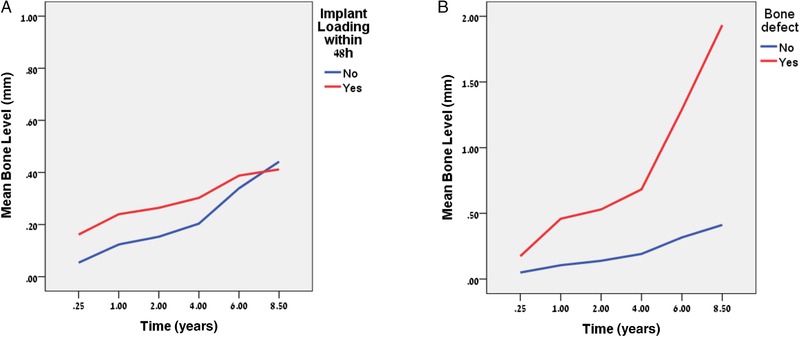
Risk indicators found to have a significant impact on bone level included: autoimmune disease, heavy smoking, bisphosphonate therapy, implant location, diameter and design, and the presence of a bone defect at site of implantation. The prevalence of mucositis at the implant level was 38.6% versus 14.2% at 6 to 7 years, when using strict versus relaxed criteria, respectively. The prevalence of peri-implantitis after 6 to 7 years was 4.7% and 3.6% when using strict versus relaxed criteria, respectively.
The results of this study identify several risk factors associated with bone loss. Furthermore, the prevalence of mucositis and peri-implantitis was shown to be lower at both the implant and the patient when using strict versus relaxed criteria based on the assessment of oral health surrounding dental implants.
由于种植体周围炎的风险,本研究旨在评估 4591 例种植体的回顾性开放队列研究中与边缘骨丧失相关的风险指标,这些种植体在私人诊所中植入,随访时间为 5-10 年。此外,评估了研究队列中黏膜炎和种植体周围炎的患病率,并比较了探诊出血的严格标准和宽松标准。
使用根尖片评估牙槽嵴顶骨水平的变化。使用序贯黏膜指数评估种植体周围软组织,与传统的出血二元阈值(即存在或不存在)进行比较。未评估牙周探诊深度。线性混合模型用于评估患者和种植体水平的骨水平随时间的变化和其他风险指标。
发现对骨水平有显著影响的风险指标包括:自身免疫性疾病、重度吸烟、双膦酸盐治疗、种植体位置、直径和设计以及植入部位的骨缺损。在第 6 至 7 年时,使用严格标准和宽松标准时,种植体水平的黏膜炎患病率分别为 38.6%和 14.2%。使用严格标准和宽松标准时,第 6 至 7 年后种植体周围炎的患病率分别为 4.7%和 3.6%。
本研究结果确定了与骨丧失相关的几个风险因素。此外,与宽松标准相比,基于对种植体周围口腔健康的评估,使用严格标准时,种植体和患者的黏膜炎和种植体周围炎的患病率均较低。