Iqbal Hina, Khan Muhammad Salman, Muneeb Aeman, Mirza Waseem A
Radiology, Aga Khan University, Karachi, PAK.
Cureus. 2018 Nov 8;10(11):e3564. doi: 10.7759/cureus.3564.
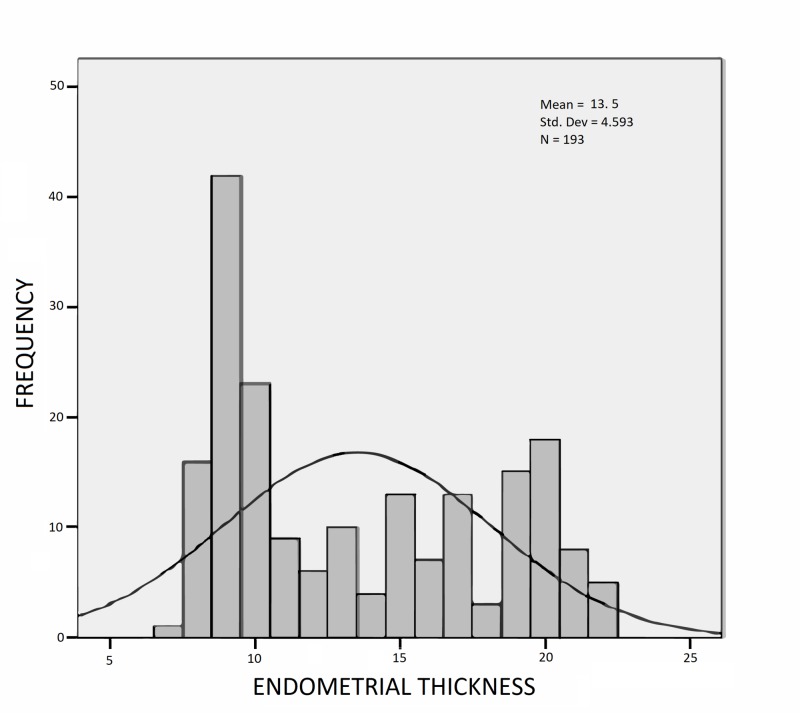
Introduction Retained products of conception (RPOC) are a known complication after abortion or childbirth. To improve clinical evaluation and avoid unnecessary surgery, transvaginal scan is performed in suspected cases. However, both RPOC and blood clots appear isoechoic on ultrasound, and false positives can lead to unnecessary intervention. In this study, the ultrasound findings have been correlated with the histopathology (as a gold standard) to determine the diagnostic value of sonography in the detection of RPOC in postpartum or post-abortion patients. Methods This cross-sectional study was carried out to determine the diagnostic accuracy of ultrasound in the detection of the retained products of conception in relation with the histopathological findings at the Department of Radiology, Aga Khan University Hospital (AKUH), Karachi. A total of 193 patients with suspicion of RPOC undergoing a transvaginal scan in the Department of Radiology, AKUH, were enrolled. The study was conducted for a period of 12 months from October 2014 to October 2015. Results Our results yielded that out of 193 cases, 113 cases (87.05%) had histopathology positive for RPOC, while 107 (55.44%) RPOC cases were identified by ultrasound as having RPOC. The mean endometrial thickness of the patients included in the study was 13.5 mm. According to our results, ultrasound has a sensitivity of 75.22%, specificity of 72.50%, a positive predictive value (PPV) of 79.44%, a negative predictive value (NPV) of 67.44%, and a diagnostic accuracy of 74.09%. Conclusion Transvaginal ultrasound is a modality that can be used for early diagnosis of the retained products of conception including fetal parts and could prove to be lifesaving. However, the operator and equipment variables need to be looked at, and a uniform criterion needs to be agreed on.
引言 妊娠物残留(RPOC)是流产或分娩后已知的并发症。为了改善临床评估并避免不必要的手术,对于疑似病例需进行经阴道超声检查。然而,RPOC和血凝块在超声检查中均表现为等回声,假阳性可能导致不必要的干预。在本研究中,将超声检查结果与组织病理学结果(作为金标准)进行关联,以确定超声检查在产后或流产后患者中检测RPOC的诊断价值。
方法 本横断面研究旨在确定在卡拉奇阿迦汗大学医院(AKUH)放射科,超声检查在检测妊娠物残留方面相对于组织病理学结果的诊断准确性。共有193名疑似RPOC的患者在AKUH放射科接受了经阴道超声检查并被纳入研究。该研究从2014年10月至2015年10月进行了12个月。
结果 我们的结果显示,在193例病例中,113例(87.05%)组织病理学检查显示RPOC阳性,而超声检查将107例(55.44%)RPOC病例诊断为存在RPOC。纳入研究的患者的平均子宫内膜厚度为13.5毫米。根据我们的结果,超声检查的敏感性为75.22%,特异性为72.50%,阳性预测值(PPV)为79.44%,阴性预测值(NPV)为67.44%,诊断准确性为74.09%。
结论 经阴道超声是一种可用于早期诊断包括胎儿部分在内的妊娠物残留的方法,可能挽救生命。然而,需要考虑操作者和设备变量,并达成统一的标准。