Department of Economics, Bentley University, NBER, and IZA, Waltham, Massachusetts, United States.
Division of IMPAQ Health, Columbia, Maryland, United States.
Health Econ. 2019 Mar;28(3):419-436. doi: 10.1002/hec.3854. Epub 2019 Jan 15.
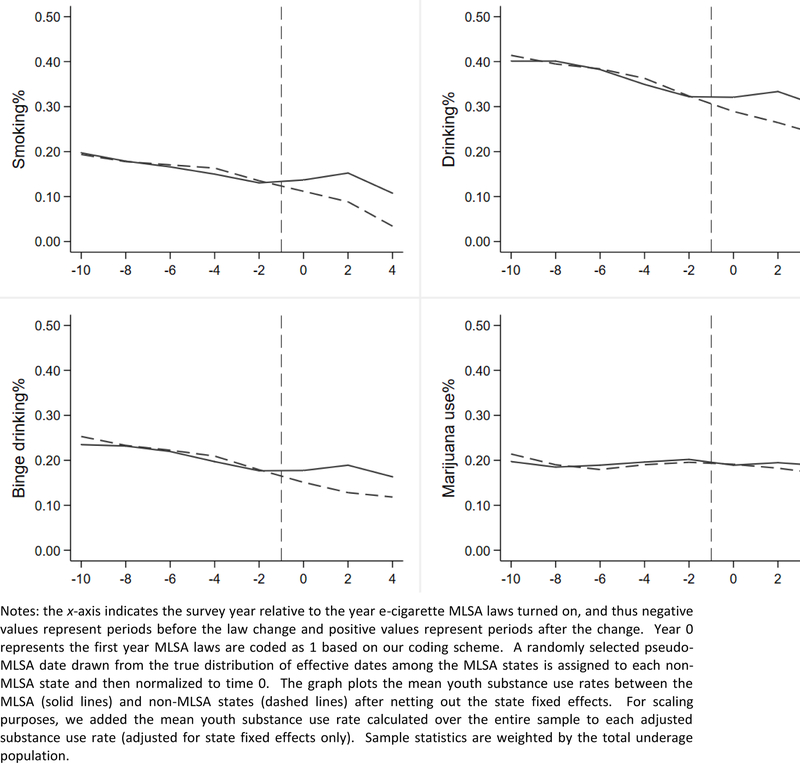
We use difference-in-differences models and individual-level data from the national and state Youth Risk Behavior Surveillance System from 2005 to 2015 to examine the effects of e-cigarette minimum legal sale age (MLSA) laws on youth cigarette smoking, alcohol consumption, and marijuana use. Our results suggest that these laws increased youth smoking participation by about one percentage point and approximately half of the increased smoking participation could be attributed to smoking initiation. We find little evidence of higher cigarette smoking persisting beyond the point at which youth age out of the laws. Our results also show little effect of the laws on youth drinking, binge drinking, and marijuana use. Taking these together, our findings suggest a possible unintended effect of e-cigarette MLSA laws-rising cigarette use in the short term while youth are restricted from purchasing e-cigarettes.
我们使用来自国家和州青少年风险行为监测系统的 2005 年至 2015 年的差异模型和个人层面数据,研究电子烟最低合法销售年龄(MLSA)法对青少年吸烟、饮酒和使用大麻的影响。我们的结果表明,这些法律使青少年吸烟的参与率增加了约一个百分点,其中约一半的吸烟参与率增加可以归因于吸烟开始。我们几乎没有发现青少年超出法律年龄限制后,吸烟率持续上升的证据。我们的研究结果还表明,这些法律对青少年饮酒、狂饮和使用大麻的影响很小。综合来看,我们的研究结果表明,电子烟 MLSA 法可能会产生意想不到的后果——在限制青少年购买电子烟的短期时间内,吸烟率上升。