• 文献检索
  • 文档翻译
  • 深度研究
  • 学术资讯
  • Suppr Zotero 插件Zotero 插件
  • 邀请有礼
  • 套餐&价格
  • 历史记录
应用&插件
Suppr Zotero 插件Zotero 插件浏览器插件Mac 客户端Windows 客户端微信小程序
定价
高级版会员购买积分包购买API积分包
服务
文献检索文档翻译深度研究API 文档MCP 服务
关于我们
关于 Suppr公司介绍联系我们用户协议隐私条款
关注我们

Suppr 超能文献

核心技术专利:CN118964589B侵权必究
粤ICP备2023148730 号-1Suppr @ 2026

文献检索

告别复杂PubMed语法,用中文像聊天一样搜索,搜遍4000万医学文献。AI智能推荐,让科研检索更轻松。

立即免费搜索

文件翻译

保留排版,准确专业,支持PDF/Word/PPT等文件格式,支持 12+语言互译。

免费翻译文档

深度研究

AI帮你快速写综述,25分钟生成高质量综述,智能提取关键信息,辅助科研写作。

立即免费体验

认知性饮食抑制、非抑制性饮食和饥饿感与 24 小时能量消耗有关。

Cognitive dietary restraint, disinhibition, and hunger are associated with 24-h energy expenditure.

机构信息

Obesity and Diabetes Clinical Research Section, National Institute of Diabetes and Digestive and Kidney Diseases, National Institutes of Health, Phoenix, AZ, 85016, USA.

出版信息

Int J Obes (Lond). 2019 Jul;43(7):1456-1465. doi: 10.1038/s41366-018-0305-9. Epub 2019 Jan 16.

DOI:10.1038/s41366-018-0305-9
PMID:30651576
原文链接:https://pmc.ncbi.nlm.nih.gov/articles/PMC6610661/
Abstract

BACKGROUND

Higher energy expenditure (EE) is associated with greater food intake, possibly because the human body senses EE and modifies eating behaviors to regulate food intake and ultimately achieve energy balance. As eating behaviors are also influenced by social and cultural factors, any association between EE and eating behavior may differ between ethnicities and sexes.

OBJECTIVE

To assess relationships between EE and eating behavior constructs of the Three-Factor Eating Questionnaire (TFEQ).

SUBJECTS/METHODS: In all, 307 healthy adults (201 M/106 F, 160 Native Americans) completed the TFEQ and had measures of 24-h EE in a whole-room calorimeter during energy balance. Body composition was assessed by DXA.

RESULTS

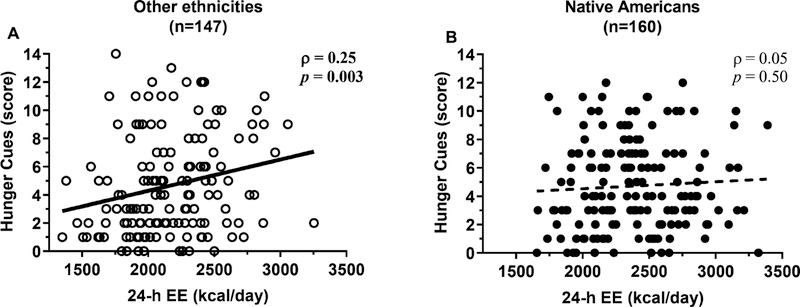
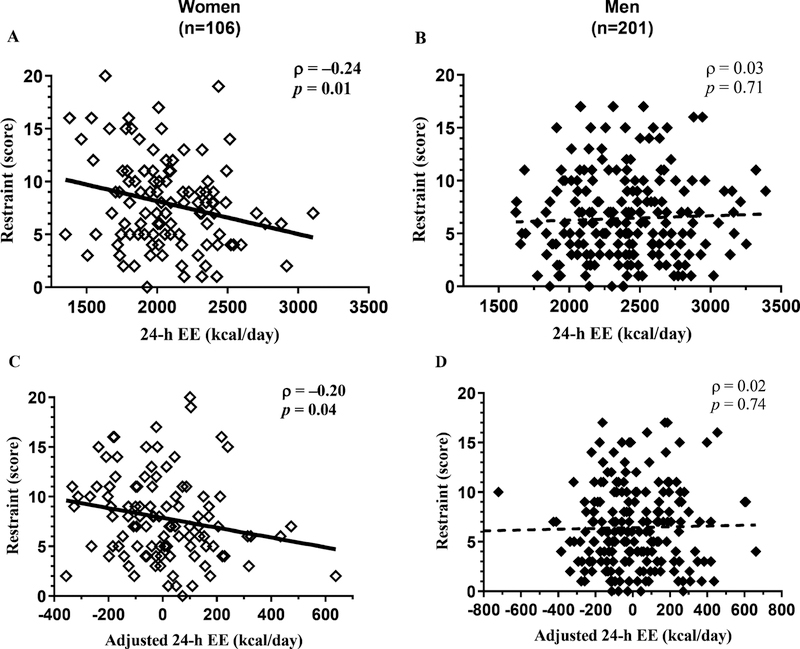
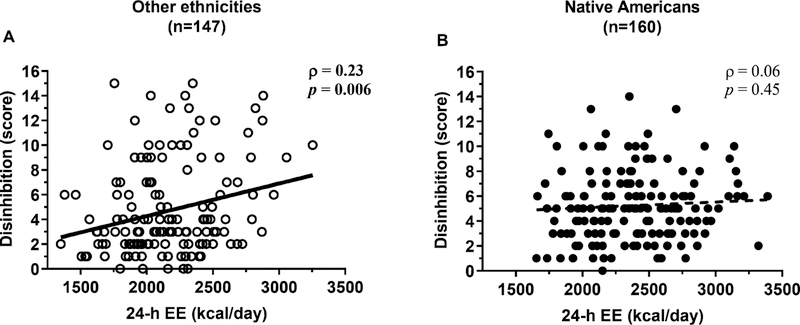
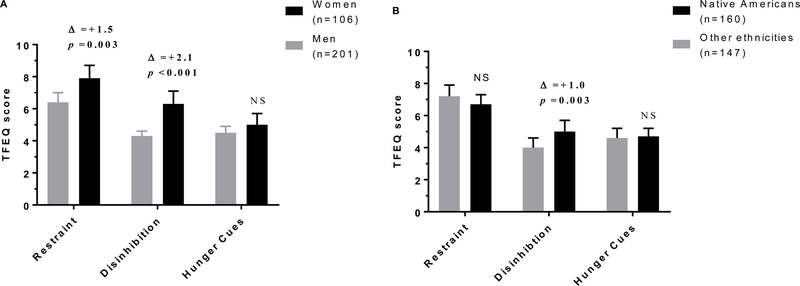
On average, adjusted 24-h EE was lower (β = -229 kcal/day, CI: -309 to -148, p < 0.001) but cognitive restraint (Δ = + 1.5; CI: 0.5 to 2.5, p = 0.003) and disinhibition (Δ = + 2.1, CI: 1.3 to 2.8, p < 0.001) scores were higher in women compared with men. In Native Americans, adjusted 24-h EE (β = + 94 kcal/day, CI: 48 to 139, p < 0.001) and disinhibition scores (Δ = + 1.0, CI: 0.1 to 2.0, p = 0.003) were higher compared with other ethnicities. Higher 24-h EE associated with lower cognitive restraint in women (ρ = -0.20, p = 0.04), but not men (p = 0.71; interaction term p = 0.01) with no ethnic differences. Greater 24-h EE associated with higher disinhibition (ρ = 0.20, p = 0.001) and hunger cues (ρ = 0.16, p = 0.004) with no gender differences. These associations were primarily present in non-Native Americans (ρ = 0.23, p = 0.006 and ρ = 0.25, p = 0.003) but not observed in Native Americans (both p > 0.40).

CONCLUSIONS

Higher EE is associated with psychological constructs of eating behaviors that favors overeating including lower cognitive restraint, higher dietary disinhibition, and greater susceptibility to hungers cues, supporting the existence of energy-sensing mechanisms influencing human eating behavior. These associations were observed in ethnicities other than Native Americans, possibly explaining the contradictory relationships reported between EE and weight change in different ethnic groups. We propose that increased EE may alter eating behaviors, potentially leading to uncontrolled overeating and weight gain.

摘要

背景

更高的能量消耗(EE)与更大的食物摄入量有关,这可能是因为人体感知 EE 并改变饮食行为以调节食物摄入,最终达到能量平衡。由于饮食行为也受到社会和文化因素的影响,EE 与饮食行为之间的任何关联在不同种族和性别之间可能有所不同。

目的

评估 EE 与三因素饮食问卷(TFEQ)的饮食行为结构之间的关系。

对象/方法:共有 307 名健康成年人(201 名男性/106 名女性,160 名美国原住民)在能量平衡期间完成了 TFEQ,并在整个房间热量计中测量了 24 小时 EE。通过 DXA 评估身体成分。

结果

平均而言,调整后的 24 小时 EE 较低(β=-229kcal/天,CI:-309 至-148,p<0.001),但女性的认知约束(Δ=+1.5;CI:0.5 至 2.5,p=0.003)和抑制性(Δ=+2.1,CI:1.3 至 2.8,p<0.001)评分高于男性。在美洲原住民中,调整后的 24 小时 EE(β=+94kcal/天,CI:48 至 139,p<0.001)和抑制性评分(Δ=+1.0,CI:0.1 至 2.0,p=0.003)高于其他种族。较高的 24 小时 EE 与女性的认知约束较低相关(ρ=-0.20,p=0.04),但与男性无关(p=0.71;交互项 p=0.01),且不存在种族差异。较高的 24 小时 EE 与更高的抑制性(ρ=0.20,p=0.001)和饥饿线索(ρ=0.16,p=0.004)相关,且不存在性别差异。这些关联主要存在于非美洲原住民中(ρ=0.23,p=0.006 和 ρ=0.25,p=0.003),但在美洲原住民中没有观察到(两者 p>0.40)。

结论

较高的 EE 与有利于暴饮暴食的饮食行为的心理结构有关,包括较低的认知约束、较高的饮食抑制和对饥饿线索的更大敏感性,这支持了存在影响人类饮食行为的能量感应机制。这些关联在除美洲原住民以外的种族中观察到,这可能解释了不同种族群体中报告的 EE 与体重变化之间的矛盾关系。我们提出,较高的 EE 可能会改变饮食行为,导致无法控制的暴饮暴食和体重增加。
https://cdn.ncbi.nlm.nih.gov/pmc/blobs/30b4/6610661/298fea25a3e8/nihms-1516305-f0004.jpg
https://cdn.ncbi.nlm.nih.gov/pmc/blobs/30b4/6610661/05fe46cc8ea1/nihms-1516305-f0001.jpg
https://cdn.ncbi.nlm.nih.gov/pmc/blobs/30b4/6610661/31f4d834d548/nihms-1516305-f0002.jpg
https://cdn.ncbi.nlm.nih.gov/pmc/blobs/30b4/6610661/94b1d926e5c7/nihms-1516305-f0003.jpg
https://cdn.ncbi.nlm.nih.gov/pmc/blobs/30b4/6610661/298fea25a3e8/nihms-1516305-f0004.jpg
https://cdn.ncbi.nlm.nih.gov/pmc/blobs/30b4/6610661/05fe46cc8ea1/nihms-1516305-f0001.jpg
https://cdn.ncbi.nlm.nih.gov/pmc/blobs/30b4/6610661/31f4d834d548/nihms-1516305-f0002.jpg
https://cdn.ncbi.nlm.nih.gov/pmc/blobs/30b4/6610661/94b1d926e5c7/nihms-1516305-f0003.jpg
https://cdn.ncbi.nlm.nih.gov/pmc/blobs/30b4/6610661/298fea25a3e8/nihms-1516305-f0004.jpg

相似文献

1
Cognitive dietary restraint, disinhibition, and hunger are associated with 24-h energy expenditure.认知性饮食抑制、非抑制性饮食和饥饿感与 24 小时能量消耗有关。
Int J Obes (Lond). 2019 Jul;43(7):1456-1465. doi: 10.1038/s41366-018-0305-9. Epub 2019 Jan 16.
2
Eating behaviors and indexes of body composition in men and women from the Québec family study.魁北克家庭研究中男性和女性的饮食行为及身体成分指标。
Obes Res. 2003 Jun;11(6):783-92. doi: 10.1038/oby.2003.109.
3
Characterization of the Three-Factor Eating Questionnaire scores of a young French cohort.年轻法国队列三因素饮食问卷评分特征。
Appetite. 2012 Oct;59(2):385-90. doi: 10.1016/j.appet.2012.05.027. Epub 2012 Jun 2.
4
Deviations in energy sensing predict long-term weight change in overweight Native Americans.超重的美洲原住民的能量感知偏差可预测其长期体重变化。
Metabolism. 2018 May;82:65-71. doi: 10.1016/j.metabol.2017.12.013. Epub 2018 Jan 3.
5
Actigraphy-Derived Sleep Is Associated with Eating Behavior Characteristics.活动记录仪监测的睡眠与饮食行为特征相关。
Nutrients. 2021 Mar 5;13(3):852. doi: 10.3390/nu13030852.
6
Differences in dietary acceptability, restraint, disinhibition, and hunger among African American participants randomized to either a vegan or omnivorous soul food diet.非裔美国参与者在随机分配到纯素或杂食灵魂食物饮食后,在饮食可接受性、克制、放纵和饥饿方面存在差异。
Appetite. 2024 May 1;196:107280. doi: 10.1016/j.appet.2024.107280. Epub 2024 Feb 17.
7
Influence of heredity on dietary restraint, disinhibition, and perceived hunger in humans.遗传对人类饮食节制、去抑制和饥饿感的影响。
Nutrition. 2005 Apr;21(4):446-55. doi: 10.1016/j.nut.2004.07.010.
8
Dietary intake, eating behaviors, and quality of life in women with polycystic ovary syndrome who are trying to conceive.正在尝试受孕的多囊卵巢综合征女性的饮食摄入、饮食行为及生活质量
Hum Fertil (Camb). 2015 Mar;18(1):16-21. doi: 10.3109/14647273.2014.922704. Epub 2014 Jun 12.
9
Association of dietary restraint and disinhibition with eating behavior, body mass, and hunger.饮食节制和去抑制与饮食行为、体重及饥饿感的关联。
Eat Weight Disord. 1998 Mar;3(1):7-15. doi: 10.1007/BF03354907.
10
Dietary intake in relation to restrained eating, disinhibition, and hunger in obese and nonobese Swedish women.瑞典肥胖和非肥胖女性的饮食摄入量与节制饮食、去抑制和饥饿的关系。
Obes Res. 1997 May;5(3):175-82. doi: 10.1002/j.1550-8528.1997.tb00290.x.

引用本文的文献

1
Prevalence of dietary supplement consumption among CrossFit practitioners.CrossFit训练者中膳食补充剂的消费流行情况。
Nutrire. 2023;48(1):9. doi: 10.1186/s41110-023-00193-z. Epub 2023 Feb 13.
2
Association of Eating Behaviors with Variability in Weight Change in Response to Physical Activity Interventions in Adults with Overweight.超重成年人在进行体力活动干预时,饮食行为与体重变化变异性的关联。
Nutrients. 2023 Aug 4;15(15):3452. doi: 10.3390/nu15153452.
3
Factors Affecting BMI Changes in Mothers during the First Year Postpartum.

本文引用的文献

1
Biological and psychological mediators of the relationships between fat mass, fat-free mass and energy intake.脂肪质量、去脂质量和能量摄入之间关系的生物学和心理学中介物。
Int J Obes (Lond). 2019 Feb;43(2):233-242. doi: 10.1038/s41366-018-0059-4. Epub 2018 Mar 13.
2
Deviations in energy sensing predict long-term weight change in overweight Native Americans.超重的美洲原住民的能量感知偏差可预测其长期体重变化。
Metabolism. 2018 May;82:65-71. doi: 10.1016/j.metabol.2017.12.013. Epub 2018 Jan 3.
3
Variations in energy intake: it is more complicated than we think.
影响产后一年内母亲 BMI 变化的因素。
Nutrients. 2023 Mar 11;15(6):1364. doi: 10.3390/nu15061364.
4
Examining reactivity to intensive longitudinal ecological momentary assessment: 12-month prospective study.考察对密集型纵向生态瞬时评估的反应性:12 个月前瞻性研究。
Eat Weight Disord. 2023 Feb 27;28(1):26. doi: 10.1007/s40519-023-01556-1.
5
Psychometric evaluation of three-factor eating questionnaire -R18 in aging Finnish men with increased risk for type 2 diabetes.三因素饮食问卷-R18 在芬兰 2 型糖尿病风险增加的老年男性中的心理测量评估。
Nutr Health. 2024 Jun;30(2):279-290. doi: 10.1177/02601060221112178. Epub 2022 Jul 11.
6
Food insecurity is associated with higher respiratory quotient and lower glucagon-like peptide 1.食物不安全感与更高的呼吸商和更低的胰高血糖素样肽 1 有关。
Obesity (Silver Spring). 2022 Jun;30(6):1248-1256. doi: 10.1002/oby.23437.
7
Gender Differences in the Relationships between Perceived Stress, Eating Behaviors, Sleep, Dietary Risk, and Body Mass Index.性别差异在感知压力、饮食行为、睡眠、饮食风险和体重指数之间的关系。
Nutrients. 2022 Feb 28;14(5):1045. doi: 10.3390/nu14051045.
8
The counterbalancing effects of energy expenditure on body weight regulation: Orexigenic versus energy-consuming mechanisms.能量消耗对体重调节的平衡作用:食欲刺激与耗能机制。
Obesity (Silver Spring). 2022 Mar;30(3):639-644. doi: 10.1002/oby.23332. Epub 2022 Feb 15.
9
Energy Balance and Control of Body Weight: Possible Effects of Meal Timing and Circadian Rhythm Dysregulation.能量平衡和体重控制:进餐时间和昼夜节律失调的可能影响。
Nutrients. 2021 Sep 19;13(9):3276. doi: 10.3390/nu13093276.
10
Dieting and Disinhibited Eating Patterns in Adult Women with Normal Body Weight: Does Rumination Matter?正常体重成年女性的节食和抑制性进食模式:反刍思维是否重要?
Nutrients. 2021 Jul 20;13(7):2475. doi: 10.3390/nu13072475.
能量摄入的变化:它比我们想象的更复杂。
Am J Clin Nutr. 2017 Nov;106(5):1169-1170. doi: 10.3945/ajcn.117.167742. Epub 2017 Oct 11.
4
Investigating predictors of eating: is resting metabolic rate really the strongest proxy of energy intake?探究进食的预测因素:静息代谢率真的是能量摄入的最强替代指标吗?
Am J Clin Nutr. 2017 Nov;106(5):1206-1212. doi: 10.3945/ajcn.117.153718. Epub 2017 Sep 6.
5
Energy expenditure in the etiology of human obesity: spendthrift and thrifty metabolic phenotypes and energy-sensing mechanisms.人类肥胖病因中的能量消耗:挥霍型和节俭型代谢表型及能量感知机制。
J Endocrinol Invest. 2018 Jan;41(1):83-89. doi: 10.1007/s40618-017-0732-9. Epub 2017 Jul 24.
6
Collateral fattening: When a deficit in lean body mass drives overeating.脂肪堆积:当瘦体重不足导致过度进食时。
Obesity (Silver Spring). 2017 Feb;25(2):277-279. doi: 10.1002/oby.21734. Epub 2017 Jan 11.
7
Passive and active roles of fat-free mass in the control of energy intake and body composition regulation.去脂体重在能量摄入控制和身体成分调节中的被动和主动作用。
Eur J Clin Nutr. 2017 Mar;71(3):353-357. doi: 10.1038/ejcn.2016.256. Epub 2016 Dec 14.
8
Exploring the Relationship between Body Composition and Eating Behavior Using the Three Factor Eating Questionnaire (TFEQ) in Young New Zealand Women.使用三因素饮食问卷(TFEQ)探究新西兰年轻女性身体成分与饮食行为之间的关系。
Nutrients. 2016 Jun 23;8(7):386. doi: 10.3390/nu8070386.
9
Does Habitual Physical Activity Increase the Sensitivity of the Appetite Control System? A Systematic Review.习惯性体力活动是否会提高食欲控制系统的敏感性?系统评价。
Sports Med. 2016 Dec;46(12):1897-1919. doi: 10.1007/s40279-016-0518-9.
10
Low levels of physical activity are associated with dysregulation of energy intake and fat mass gain over 1 year.低水平的身体活动与能量摄入失调以及一年以上的脂肪量增加有关。
Am J Clin Nutr. 2015 Dec;102(6):1332-8. doi: 10.3945/ajcn.115.115360. Epub 2015 Nov 11.