Fox Adam T, Wopereis Harm, Van Ampting Marleen T J, Oude Nijhuis Manon M, Butt Assad M, Peroni Diego G, Vandenplas Yvan, Candy David C A, Shah Neil, West Christina E, Garssen Johan, Harthoorn Lucien F, Knol Jan, Michaelis Louise J
1Guy's and St Thomas' Hospitals NHS Foundation Trust, London, UK.
Danone Nutricia Research, Nutricia Advanced Medical Nutrition, Uppsalalaan 12, 3584 CT Utrecht, The Netherlands.
Clin Transl Allergy. 2019 Jan 15;9:5. doi: 10.1186/s13601-019-0241-3. eCollection 2019.
Here we report follow-up data from a double-blind, randomized, controlled multicenter trial, which investigated fecal microbiota changes with a new amino acid-based formula (AAF) including synbiotics in infants with non-immunoglobulin E (IgE)-mediated cow's milk allergy (CMA).
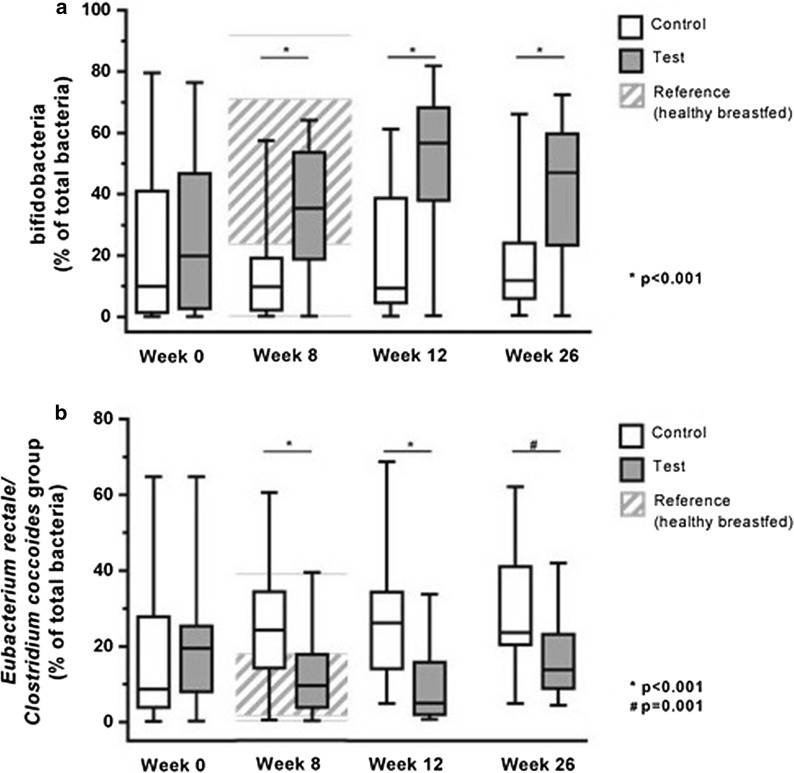
Subjects were randomized to receive test product (AAF including fructo-oligosaccharides and M-16V) or control product (AAF) for 8 weeks, after which infants could continue study product until 26 weeks. Fecal percentages of bifidobacteria and / group () were assessed at 0, 8, 12, and 26 weeks. Additional endpoints included stool markers of gut immune status, clinical symptoms, and safety assessments including adverse events and medication use.
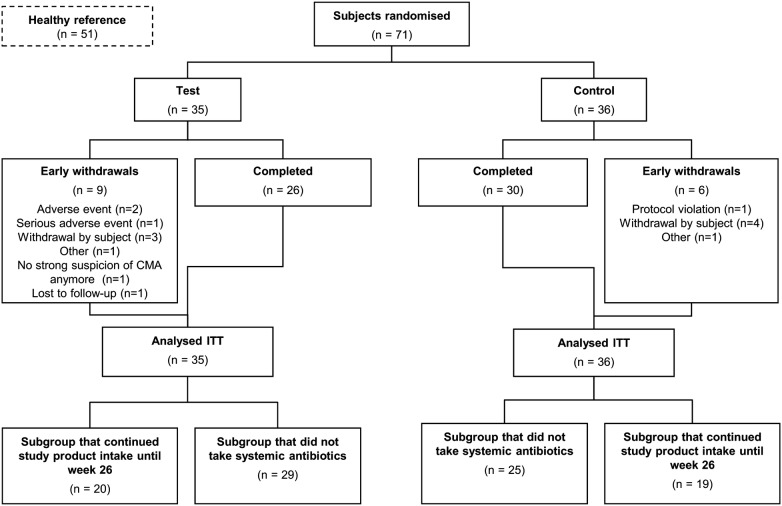
The trial included 35 test subjects, 36 controls, and 51 in the healthy reference group. Study product was continued by 86% and 92% of test and control subjects between week 8-12, and by 71% and 80%, respectively until week 26. At week 26 median percentages of bifidobacteria were significantly higher in test than control [47.0% vs. 11.8% ( < 0.001)], whereas percentages of were significantly lower [(13.7% vs. 23.6% ( = 0.003)]. Safety parameters were similar between groups. Interestingly use of dermatological medication and reported ear infections were lower in test versus control, = 0.019 and 0.011, respectively. Baseline clinical symptoms and stool markers were mild (but persistent) and low, respectively. Symptoms reduced towards lowest score in both groups.
Beneficial effects of this AAF including specific synbiotics on microbiota composition were observed over 26 weeks, and shown suitable for dietary management of infants with non-IgE-mediated CMA. NTR3979.
在此我们报告一项双盲、随机、对照多中心试验的随访数据,该试验研究了一种含合生元的新型氨基酸配方奶粉(AAF)对非免疫球蛋白E(IgE)介导的牛奶过敏(CMA)婴儿粪便微生物群变化的影响。
将受试者随机分为两组,分别接受试验产品(含低聚果糖和M-16V的AAF)或对照产品(AAF),为期8周,之后婴儿可继续使用研究产品至26周。在第0、8、12和26周评估粪便中双歧杆菌和/组()的百分比。其他终点包括肠道免疫状态的粪便标志物、临床症状以及包括不良事件和药物使用情况在内的安全性评估。
该试验纳入了35名试验对象、36名对照对象以及51名健康参照组对象。在第8至12周期间,分别有86%的试验对象和92%的对照对象继续使用研究产品;至第26周时,这一比例分别为71%和80%。在第26周时,试验组中双歧杆菌的中位百分比显著高于对照组[47.0%对11.8%(<0.001)],而的百分比则显著更低[(13.7%对23.6%(=0.003)]。两组之间的安全性参数相似。有趣的是,试验组使用皮肤科药物和报告耳部感染的情况低于对照组,分别为=0.019和0.011。基线临床症状和粪便标志物分别较轻(但持续存在)和较低。两组症状均降至最低评分。
在26周内观察到这种含特定合生元的AAF对微生物群组成具有有益作用,并表明其适用于非IgE介导的CMA婴儿的饮食管理。NTR3979。