Department of Molecular Biology and Genetics, Aarhus University, 8830, Tjele, Denmark.
Department of Molecular Biology and Genetics, Aarhus University, 8000, Aarhus, Denmark.
BMC Evol Biol. 2019 Jan 17;19(1):27. doi: 10.1186/s12862-019-1353-z.
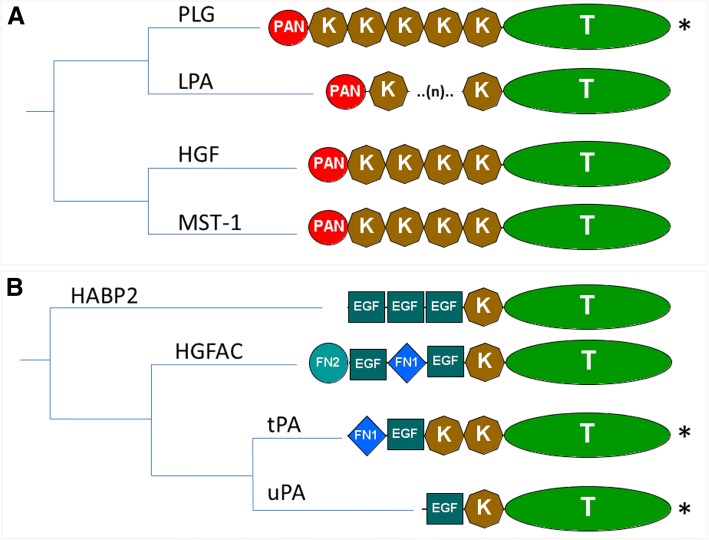
The plasminogen (PLG) activation system is composed by a series of serine proteases, inhibitors and several binding proteins, which together control the temporal and spatial generation of the active serine protease plasmin. As this proteolytic system plays a central role in human physiology and pathophysiology it has been extensively studied in mammals. The serine proteases of this system are believed to originate from an ancestral gene by gene duplications followed by domain gains and deletions. However, the identification of ancestral forms in primitive chordates supporting these theories remains elusive. In addition, evolutionary studies of the non-proteolytic members of this system are scarce.
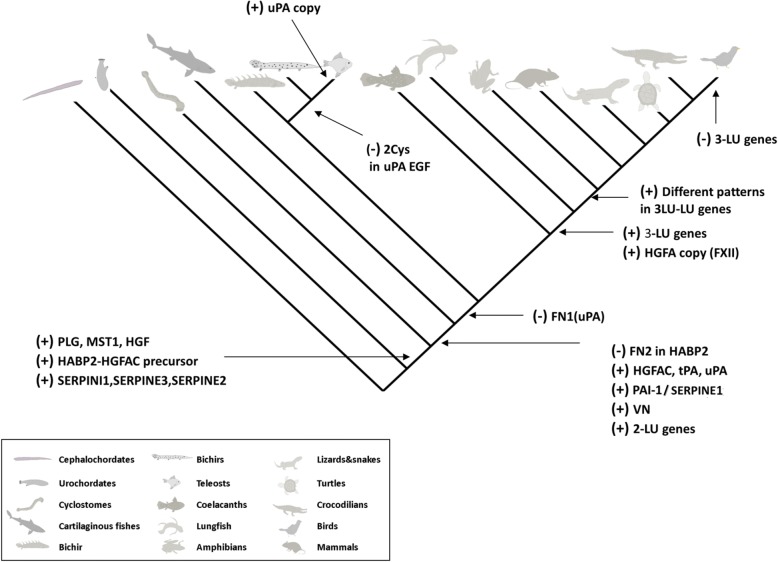
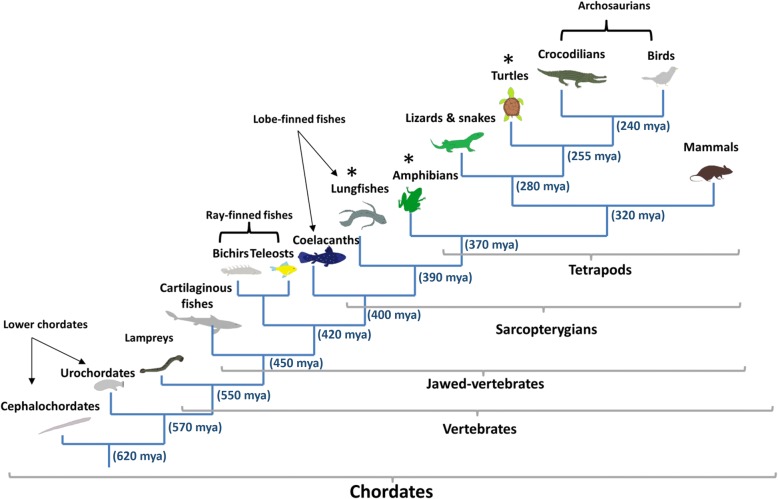
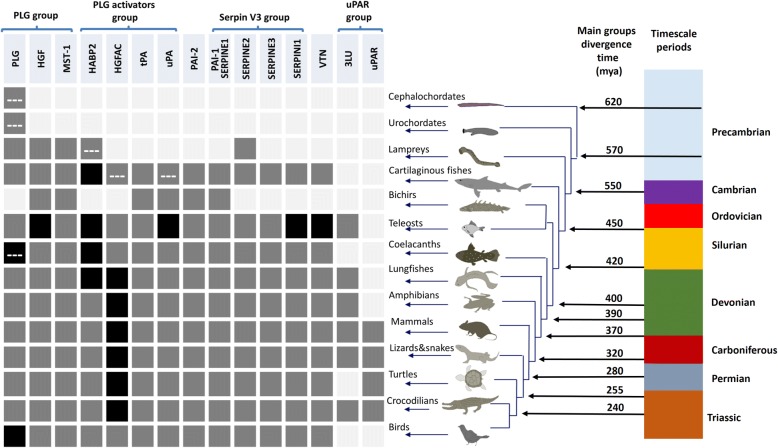
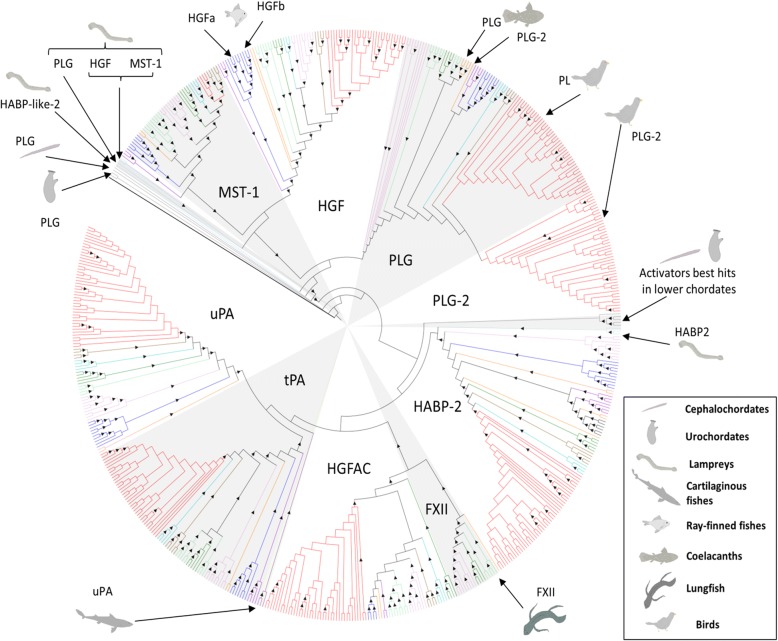
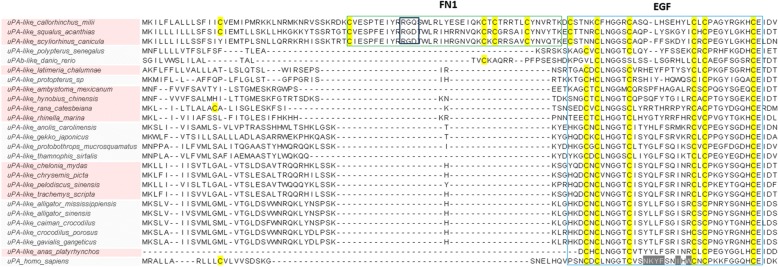
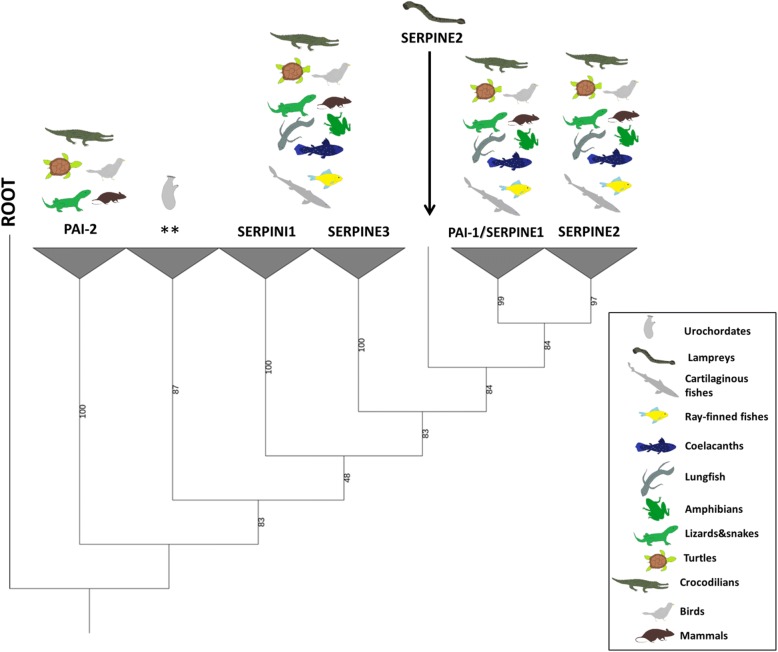
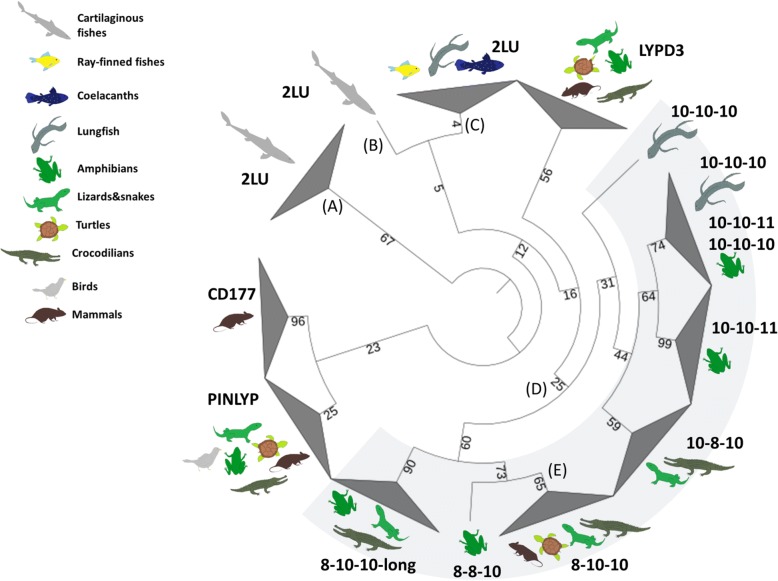
Our phylogenetic analyses place lamprey PLG at the root of the vertebrate PLG-group, while lamprey PLG-related growth factors represent the ancestral forms of the jawed-vertebrate orthologues. Furthermore, we find that the earliest putative orthologue of the PLG activator group is the hyaluronan binding protein 2 (HABP2) gene found in lampreys. The prime plasminogen activators (tissue- and urokinase-type plasminogen activator, tPA and uPA) first occur in cartilaginous fish and phylogenetic analyses confirm that all orthologues identified compose monophyletic groups to their mammalian counterparts. Cartilaginous fishes exhibit the most ancient vitronectin of all vertebrates, while plasminogen activator inhibitor 1 (PAI-1) appears for the first time in cartilaginous fishes and is conserved in the rest of jawed vertebrate clades. PAI-2 appears for the first time in the common ancestor of reptiles and mammals, and represents the latest appearing plasminogen activator inhibitor. Finally, we noted that the urokinase-type plasminogen activator receptor (uPAR)-and three-LU domain containing genes in general-occurred later in evolution and was first detectable after coelacanths.
This study identifies several primitive orthologues of the mammalian plasminogen activation system. These ancestral forms provide clues to the origin and diversification of this enzyme system. Further, the discovery of several members-hitherto unknown in mammals-provide new perspectives on the evolution of this important enzyme system.
纤溶酶原(PLG)激活系统由一系列丝氨酸蛋白酶、抑制剂和几种结合蛋白组成,它们共同控制活性丝氨酸蛋白酶纤溶酶的时空产生。由于该蛋白水解系统在人类生理和病理生理学中起着核心作用,因此在哺乳动物中进行了广泛的研究。该系统的丝氨酸蛋白酶被认为是由基因复制产生的,随后是结构域的获得和缺失。然而,在原始脊索动物中识别支持这些理论的祖先形式仍然难以捉摸。此外,该系统中非蛋白水解成员的进化研究也很少。
我们的系统发育分析将七鳃鳗 PLG 置于脊椎动物 PLG 组的根部,而七鳃鳗 PLG 相关生长因子代表了有颌脊椎动物同源物的祖先形式。此外,我们发现最早的 PLG 激活物组的假定同源物是在七鳃鳗中发现的透明质酸结合蛋白 2(HABP2)基因。最初的纤溶酶原激活物(组织型和尿激酶型纤溶酶原激活物,tPA 和 uPA)首先出现在软骨鱼类中,系统发育分析证实,所有鉴定的同源物与哺乳动物的同源物组成单系群。软骨鱼类具有所有脊椎动物中最古老的 vitronectin,而纤溶酶原激活物抑制剂 1(PAI-1)首次出现在软骨鱼类中,并在其余有颌脊椎动物进化枝中保守。PAI-2 首次出现在爬行动物和哺乳动物的共同祖先中,是出现最晚的纤溶酶原激活物抑制剂。最后,我们注意到,尿激酶型纤溶酶原激活物受体(uPAR)和三个 LU 结构域基因一般在进化中出现较晚,在腔棘鱼之后才首次检测到。
本研究鉴定了哺乳动物纤溶酶原激活系统的几个原始同源物。这些祖先形式为该酶系统的起源和多样化提供了线索。此外,发现了几个以前在哺乳动物中未知的成员,为这个重要的酶系统的进化提供了新的视角。