NICM Health Research Institute, Western Sydney University, Sydney, Australia.
School of Science and Health, The MARCS Institute, Western Sydney University, Sydney, Australia.
BMC Complement Altern Med. 2019 Jan 17;19(1):22. doi: 10.1186/s12906-019-2433-8.
Menstrual pain is very common amongst young women. Despite the significant impact that menstrual pain has on academic attendance and performance, social activities and quality of life, most young women do not seek medical treatment but prefer to use self-care; commonly OTC analgesic medications and rest. Many women do not get significant pain relief from these methods, therefore other low cost, easy to learn self-care methods may be a valuable approach to management. This review and meta-analysis examines the evidence for participant lead self-care techniques.
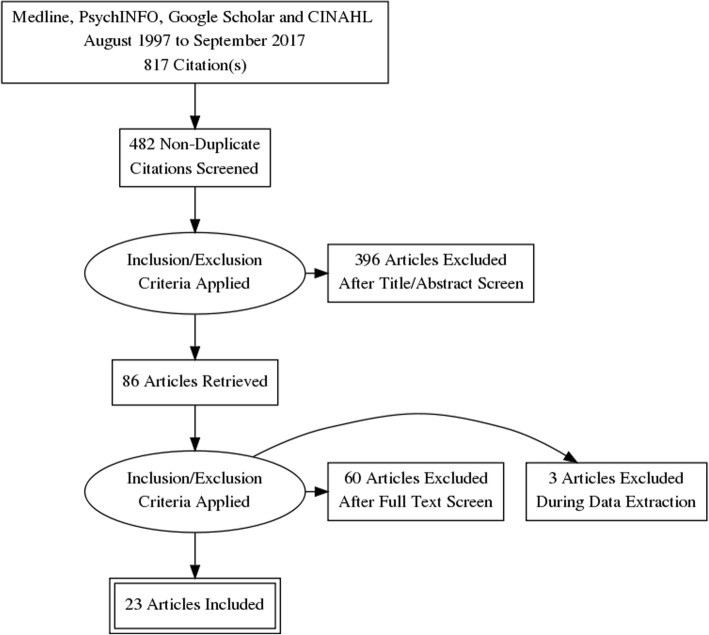
A search of Medline, PsychINFO, Google Scholar and CINAHL was carried out in September 2017.
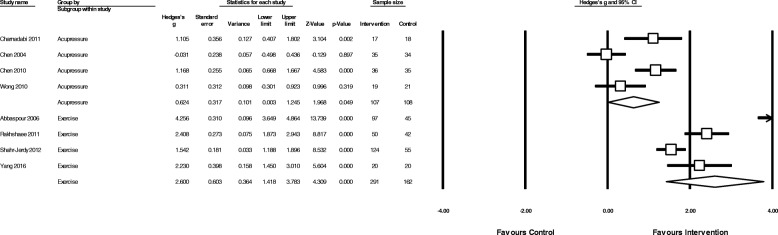
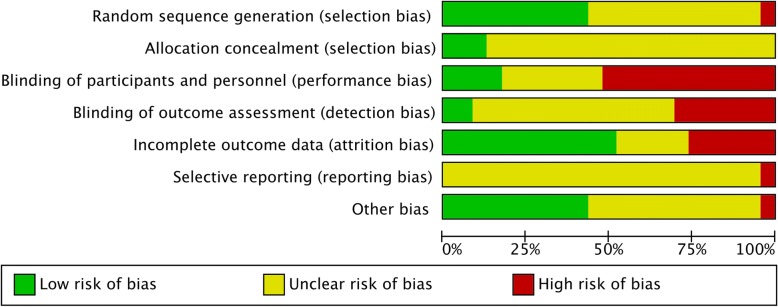
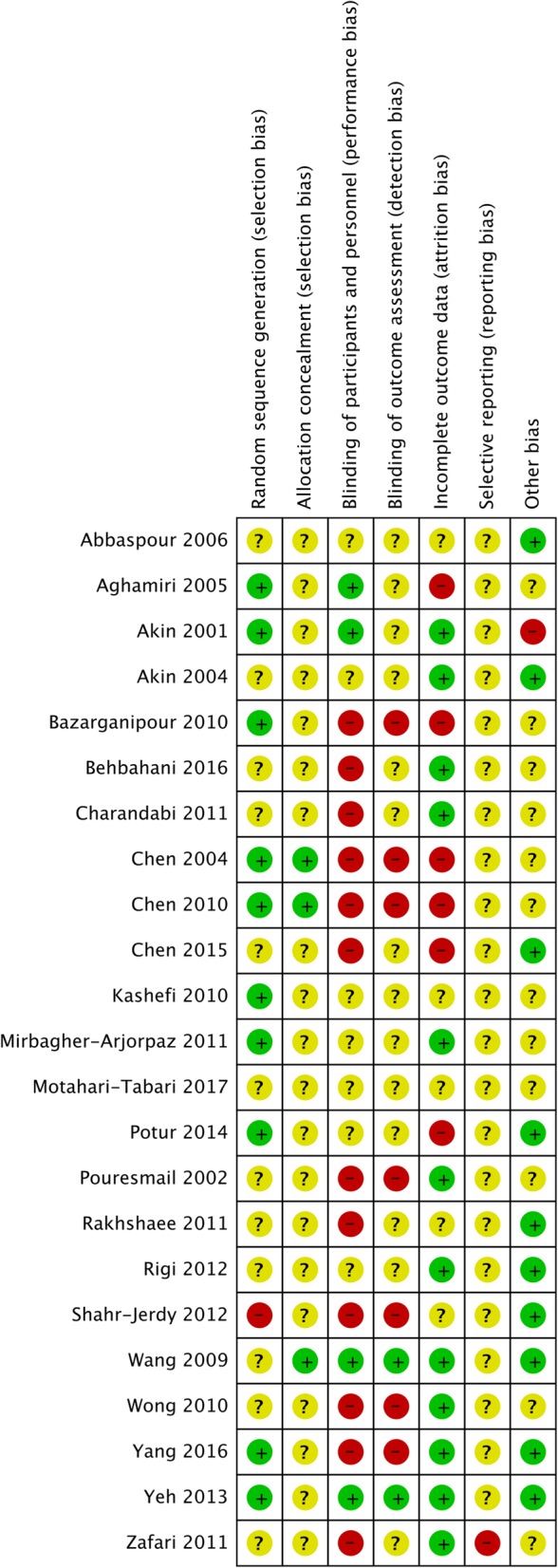
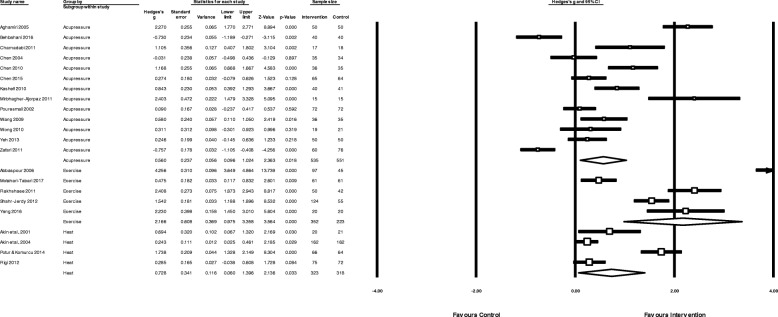
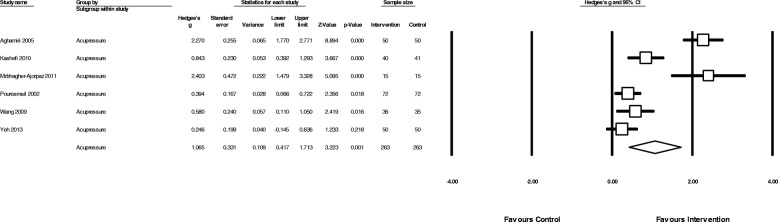
Twenty-three trials including 2302 women were eligible and included in the meta-analysis. Studies examined self-delivered acupressure, exercise and heat as interventions. Risk of bias was unclear for many domains. All interventions showed a reduction in menstrual pain symptoms; exercise (g = 2.16, 95% CI 0.97 to 3.35) showed the largest effect size, with heat (g = 0.73, 95% CI 0.06 to 1.40) and acupressure (g = 0.56, 95% CI 0.10 to 1.03) showing more moderate effect sizes. Exercise (g = 0.48, 95% CI 0.12 to 0.83) and heat (g = 0.48, 95% CI 0.10 to 0.87), were more effective than analgesics in reducing pain intensity, whereas acupressure was significantly less effective (g = - 0.76, 95% CI -1.37 to - 0.15).
Exercise showed large effects, while acupressure and heat showed moderate effects in reducing menstrual pain compared to no treatment. Both exercise and heat are potential alternatives to analgesic medication. However, difficulties in controlling for non-specific effects, along with potential for bias, may influence study findings.
经期疼痛在年轻女性中非常普遍。尽管经期疼痛对学业出勤率和表现、社交活动和生活质量有重大影响,但大多数年轻女性并不寻求医疗治疗,而是选择自我护理;通常是使用 OTC 止痛药物和休息。许多女性使用这些方法无法获得显著的疼痛缓解,因此,其他低成本、易于学习的自我护理方法可能是一种有价值的管理方法。本综述和荟萃分析检查了参与者主导的自我护理技术的证据。
我们于 2017 年 9 月在 Medline、PsychINFO、Google Scholar 和 CINAHL 上进行了搜索。
23 项试验(共 2302 名女性)符合条件并纳入荟萃分析。研究检查了自我实施的穴位按压、运动和热疗作为干预措施。许多领域的偏倚风险不明确。所有干预措施均显示出经期疼痛症状减轻;运动(g=2.16,95%CI 0.97 至 3.35)的效果最大,热疗(g=0.73,95%CI 0.06 至 1.40)和穴位按压(g=0.56,95%CI 0.10 至 1.03)的效果稍小。运动(g=0.48,95%CI 0.12 至 0.83)和热疗(g=0.48,95%CI 0.10 至 0.87)在降低疼痛强度方面比镇痛药更有效,而穴位按压则明显效果较差(g= -0.76,95%CI -1.37 至 -0.15)。
与不治疗相比,运动在减轻经期疼痛方面显示出较大的效果,而穴位按压和热疗则显示出中等的效果。运动和热疗都是替代镇痛药的潜在选择。然而,控制非特异性影响的困难以及潜在的偏倚可能会影响研究结果。