Department of Pediatric Gastroenterology, Hepatology and Nutrition, University of Groningen, University Medical Center Groningen, Groningen, The Netherlands.
Department of Laboratory Medicine, University of Groningen, University Medical Center Groningen, Groningen, The Netherlands.
Arch Dis Child. 2020 Oct;105(10):996-998. doi: 10.1136/archdischild-2018-316584. Epub 2019 Jan 17.
Treatment decisions in children with inflammatory bowel disease (IBD) are increasingly based on longitudinal tracking of faecal calprotectin concentrations, but there is little known about the stability of this protein in stool.
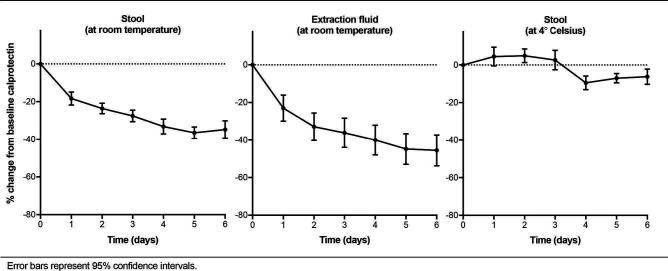
We stored aliquots of homogenised stool at room temperature and at 4°C, and measured the calprotectin concentration for 6 consecutive days with three different assays. In addition, we assessed calprotectin stability in assay-specific extraction buffers kept at room temperature.
After 6 days of storage at room temperature, mean percentage change from baseline calprotectin concentrations in stool and extraction buffer was 35% and 46%, respectively. The stability of calprotectin was significantly better preserved in samples stored at 4°C (p=0.0066 and 0.0011, respectively).
Calprotectin is not stable at room temperature. Children with IBD and their caretakers may be falsely reassured by low calprotectin values. The best advisable standard for preanalytical calprotectin handling is refrigeration of the stool sample until delivery at the hospital laboratory.
儿童炎症性肠病(IBD)的治疗决策越来越基于粪便钙卫蛋白浓度的纵向跟踪,但对该蛋白在粪便中的稳定性知之甚少。
我们将匀浆粪便的等分试样分别在室温下和 4°C 下储存,并使用三种不同的检测方法连续 6 天测量钙卫蛋白浓度。此外,我们还评估了在室温下保存的特定检测提取缓冲液中钙卫蛋白的稳定性。
在室温下储存 6 天后,粪便和提取缓冲液中基线钙卫蛋白浓度的平均百分比变化分别为 35%和 46%。与室温相比,钙卫蛋白在 4°C 下的稳定性显著更好(p=0.0066 和 0.0011,分别)。
钙卫蛋白在室温下不稳定。IBD 患儿及其照顾者可能会被低钙卫蛋白值错误地安抚。在分析前处理钙卫蛋白时,最佳的标准建议是将粪便样本冷藏,直到送到医院实验室。