Creative Research Initiatives Center for Molecular Biology of Translation, Korea University, Seoul 02841, Republic of Korea.
Division of Life Sciences, Korea University, Seoul 02841, Republic of Korea.
RNA. 2019 Apr;25(4):407-422. doi: 10.1261/rna.070136.118. Epub 2019 Jan 17.
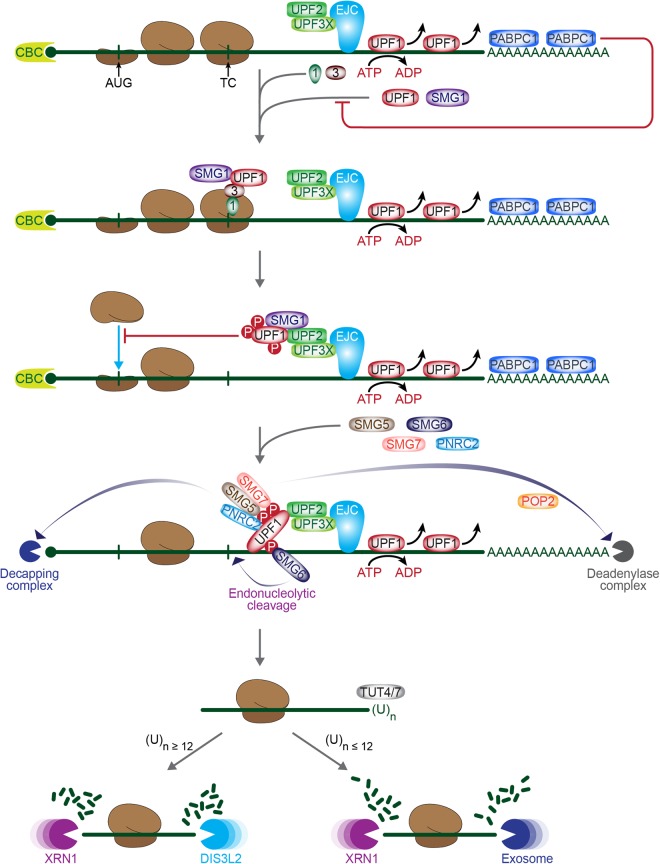
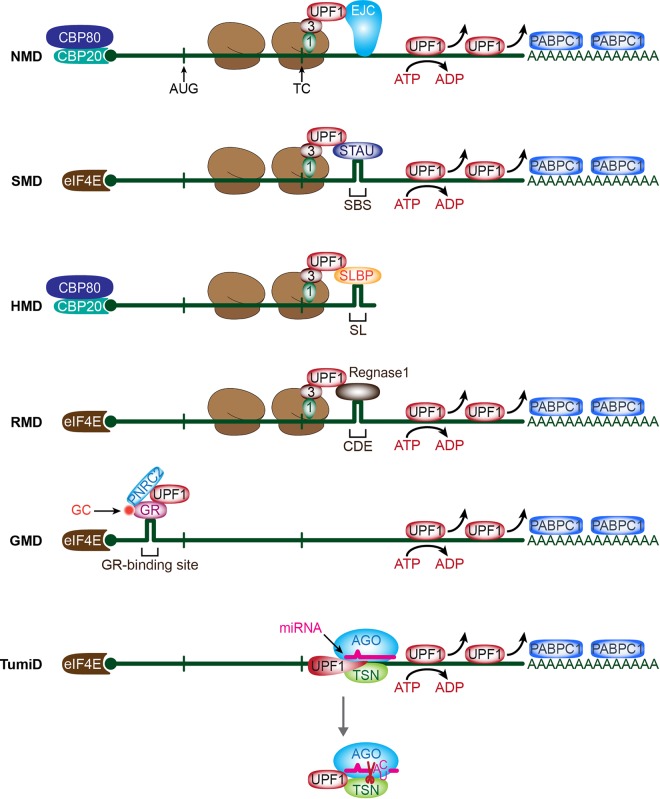
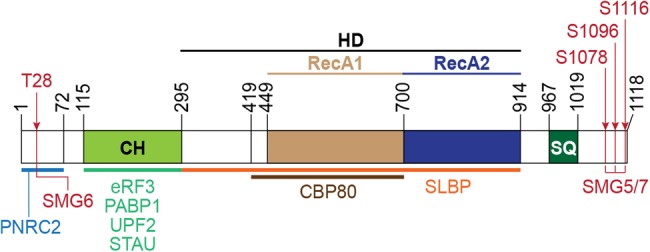
Nonsense-mediated mRNA decay (NMD), which is arguably the best-characterized translation-dependent regulatory pathway in mammals, selectively degrades mRNAs as a means of post-transcriptional gene control. Control can be for the purpose of ensuring the quality of gene expression. Alternatively, control can facilitate the adaptation of cells to changes in their environment. The key to NMD, no matter what its purpose, is the ATP-dependent RNA helicase upstream frameshift 1 (UPF1), without which NMD fails to occur. However, UPF1 does much more than regulate NMD. As examples, UPF1 is engaged in functionally diverse mRNA decay pathways mediated by a variety of RNA-binding proteins that include staufen, stem-loop-binding protein, glucocorticoid receptor, and regnase 1. Moreover, UPF1 promotes tudor-staphylococcal/micrococcal-like nuclease-mediated microRNA decay. In this review, we first focus on how the NMD machinery recognizes an NMD target and triggers mRNA degradation. Next, we compare and contrast the mechanisms by which UPF1 functions in the decay of other mRNAs and also in microRNA decay. UPF1, as a protein polymath, engenders cells with the ability to shape their transcriptome in response to diverse biological and physiological needs.
无意义介导的 mRNA 降解(NMD),可以说是哺乳动物中转录后基因调控中研究最透彻的翻译依赖型调控途径,它通过降解 mRNA 来选择性地调控基因表达。其调控目的可以是确保基因表达的质量,也可以是帮助细胞适应环境变化。无论其目的是什么,NMD 的关键都是 ATP 依赖性 RNA 解旋酶 1(UPF1),没有 UPF1,NMD 就无法发生。然而,UPF1 的功能远不止调控 NMD。例如,UPF1 参与多种 RNA 结合蛋白介导的功能多样的 mRNA 降解途径,这些 RNA 结合蛋白包括 Staufen、茎环结合蛋白、糖皮质激素受体和 1 型 Regnase。此外,UPF1 还能促进 Tudor-葡萄球菌/微球菌样核酸酶介导的 microRNA 降解。在这篇综述中,我们首先重点介绍 NMD 机制如何识别 NMD 靶标并触发 mRNA 降解。接下来,我们比较和对比了 UPF1 在其他 mRNA 降解和 microRNA 降解中的作用机制。作为一种蛋白多效酶,UPF1 使细胞能够根据不同的生物学和生理学需求来塑造其转录组。