Su Wenjuan, Kochen Rossi Juan, Nuevo-Tapioles Cristina, Chen Ting, Kawaler Emily, Branco Cristina, Wong Kwok-Kin, Simeone Diane M, Gardner Lawrence B, Philips Mark R
Perlmutter Cancer Center, New York University Grossman School of Medicine, New York, NY 10016.
Moores Cancer Center, University of California, San Diego, CA 92037.
Proc Natl Acad Sci U S A. 2024 Aug 13;121(33):e2401996121. doi: 10.1073/pnas.2401996121. Epub 2024 Aug 6.
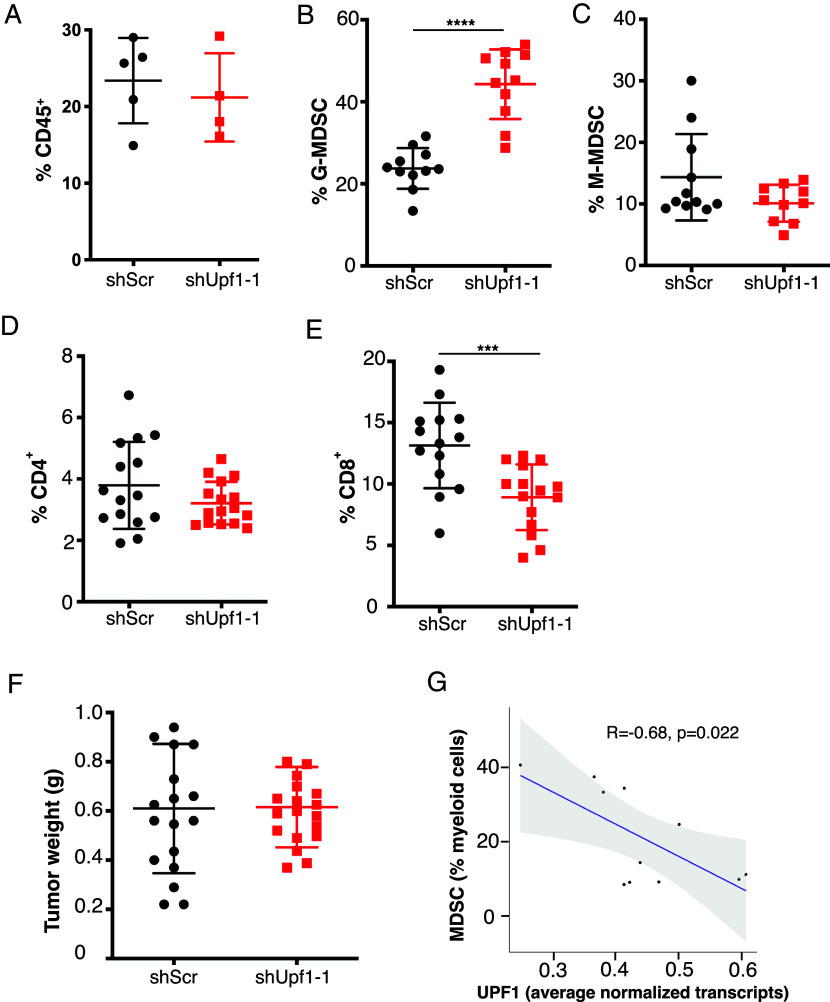
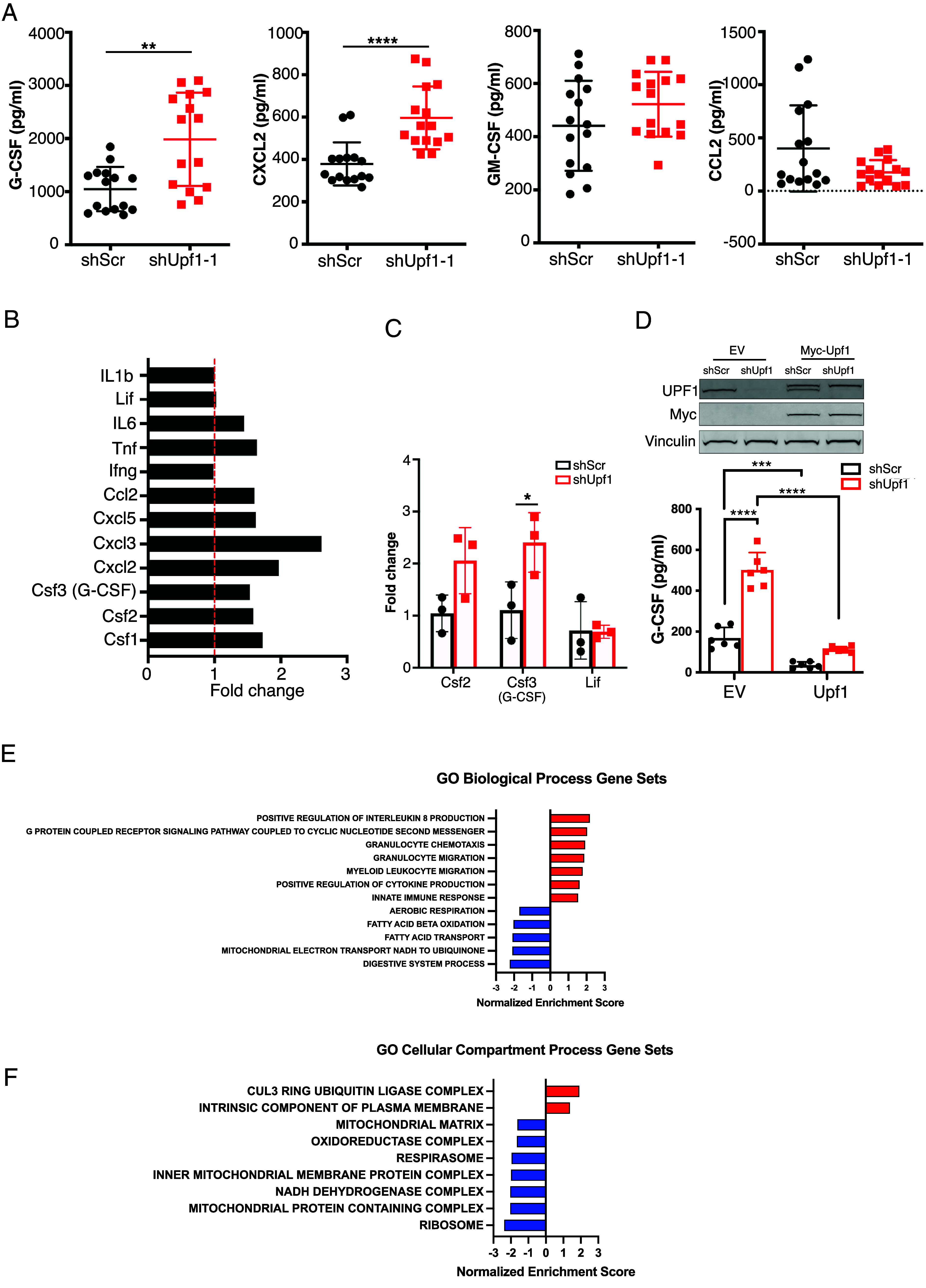
Upstream frameshift 1 (UPF1) is an RNA helicase involved in a number of mRNA regulatory processes including nonsense-mediated decay. Mutations in the locus that reduce its expression have been associated with adenosquamous carcinoma of the pancreas, a particularly aggressive form of the disease. To determine the effect of suppression in a murine model of pancreatic adenocarcinoma, we silenced with shRNA in cells derived from an autochthonous tumor in an LSL-Kras; Trp53; Pdx-1 mouse (KPC) and orthotopically implanted these cells in the pancreas of C57BL/6 mice. Tumors derived from Upf1-deficient cells were markedly larger than those derived from control cells, a difference observed only in immunocompetent mice. The immune infiltrate of Upf1-deficient tumors was enriched in myeloid-derived suppressor cells (MDSCs) and depleted of CD8 cells compared to control KPC tumors. Upf1-deficient KPC cells secreted inflammatory cytokines including G-CSF and CXCL2, known to recruit MDSCs. Cytokine secretion from Upf1-deficient KPC cells was induced by increased levels of mitochondrial reactive oxygen species (ROS), which in turn were due to an increase in complex I activity in the electron transport chain. Thus, Upf1 helicase deficiency leads to increased mitochondrial complex I activity which produces ROS that signals for cytokine release that drives immune suppression and enhanced tumor growth.
上游移码蛋白1(UPF1)是一种RNA解旋酶,参与包括无义介导的衰变在内的多种mRNA调节过程。该基因座中降低其表达的突变与胰腺腺鳞癌相关,这是一种侵袭性特别强的疾病形式。为了确定在胰腺腺癌小鼠模型中抑制UPF1的作用,我们在源自LSL-Kras;Trp53;Pdx-1小鼠(KPC)的原位肿瘤细胞中用shRNA沉默UPF1,并将这些细胞原位植入C57BL/6小鼠的胰腺中。源自UPF1缺陷细胞的肿瘤明显大于源自对照细胞的肿瘤,这种差异仅在免疫健全的小鼠中观察到。与对照KPC肿瘤相比,UPF1缺陷肿瘤的免疫浸润富含髓源性抑制细胞(MDSC),而CD8细胞减少。UPF1缺陷的KPC细胞分泌包括G-CSF和CXCL2在内的炎性细胞因子,已知这些细胞因子可募集MDSC。UPF1缺陷的KPC细胞的细胞因子分泌是由线粒体活性氧(ROS)水平升高诱导的,而这又是由于电子传递链中复合物I活性增加所致。因此,UPF1解旋酶缺陷导致线粒体复合物I活性增加,产生ROS,发出细胞因子释放信号,从而驱动免疫抑制和肿瘤生长增强。