Jimbo Shunsuke, Terashima Yoshinori, Teramoto Atsushi, Takebayashi Tsuneo, Ogon Izaya, Watanabe Kota, Sato Tatsuya, Ichise Nobutoshi, Tohse Noritsugu, Yamashita Toshihiko
Department of Orthopaedic surgery, Sapporo Medical University School of Medicine, Sapporo 060-8556, Japan,
Department of Cellular Physiology and Signal Transduction, Sapporo Medical University School of Medicine, Sapporo 060-8556, Japan.
J Pain Res. 2019 Jan 3;12:191-200. doi: 10.2147/JPR.S186413. eCollection 2019.
Ankle osteoarthritis (OA) causes significant pain and debilitation; yet, its underlying mechanisms remain unclear. Clinically, hyaluronic acid (HA) is widely used to treat OA. The present study aimed to investigate the roles of HA in pain-related behavior, joint function, swelling, and pathological changes in cartilage in a rat model of monoiodoacetate (MIA)-induced ankle OA.
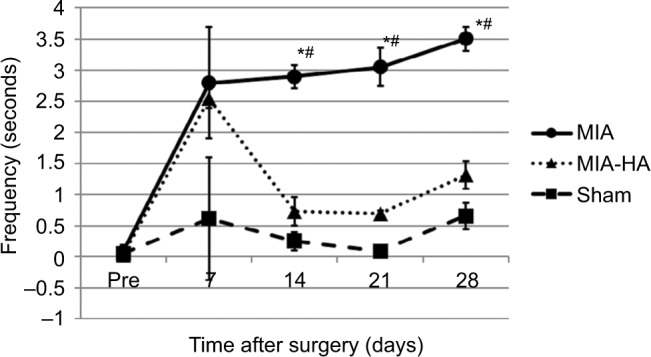
Male Sprague Dawley rats were assigned to three experimental groups as follows: 1) MIA rats injected with 1 mg MIA in the right tibiotarsal joint for two consecutive days; 2) sham rats injected with saline instead of MIA; and 3) MIA-HA rats injected with HA in the tibiotarsal joint at 7, 14, and 21 days after MIA injection. Joint swelling, range of motion (ROM), and pain-related behavior were evaluated 1 day before and on the 7th, 14th, 21st, and 28th day after MIA or saline injection. Pathological changes in the ankle joint were assessed 28 days after MIA or saline injection.
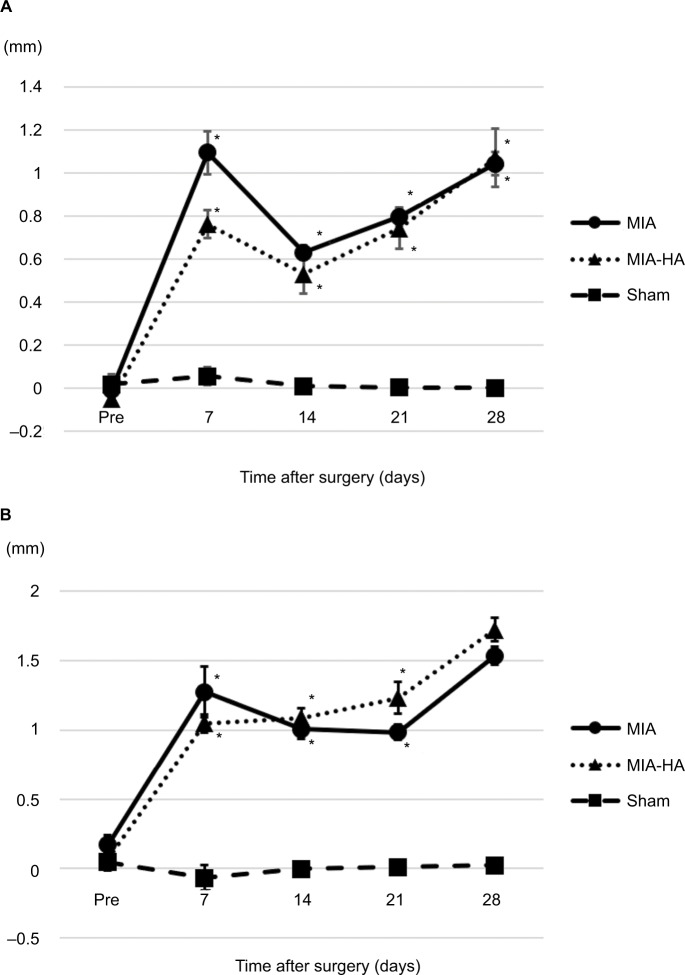
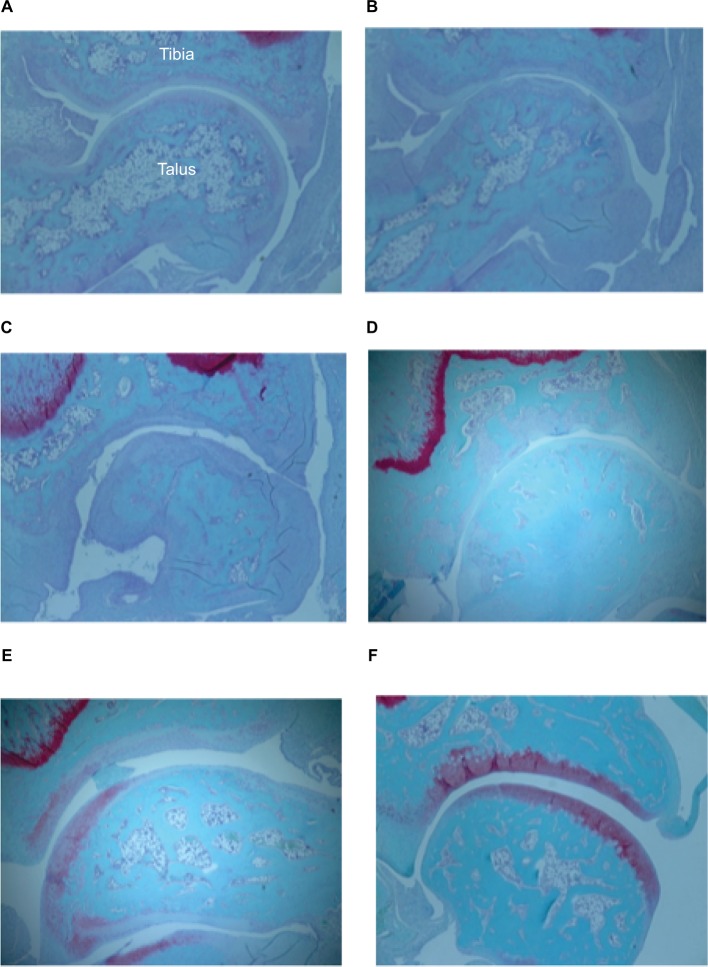
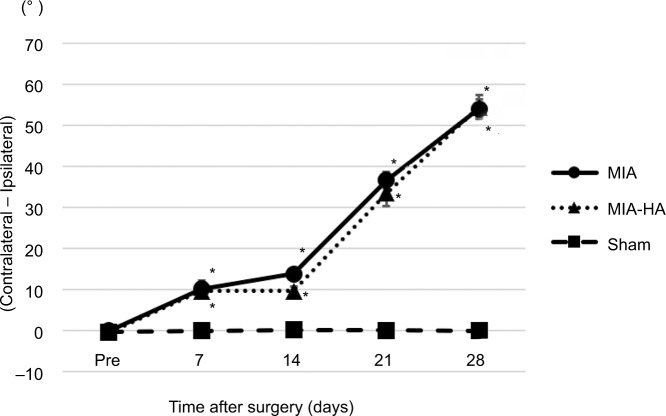
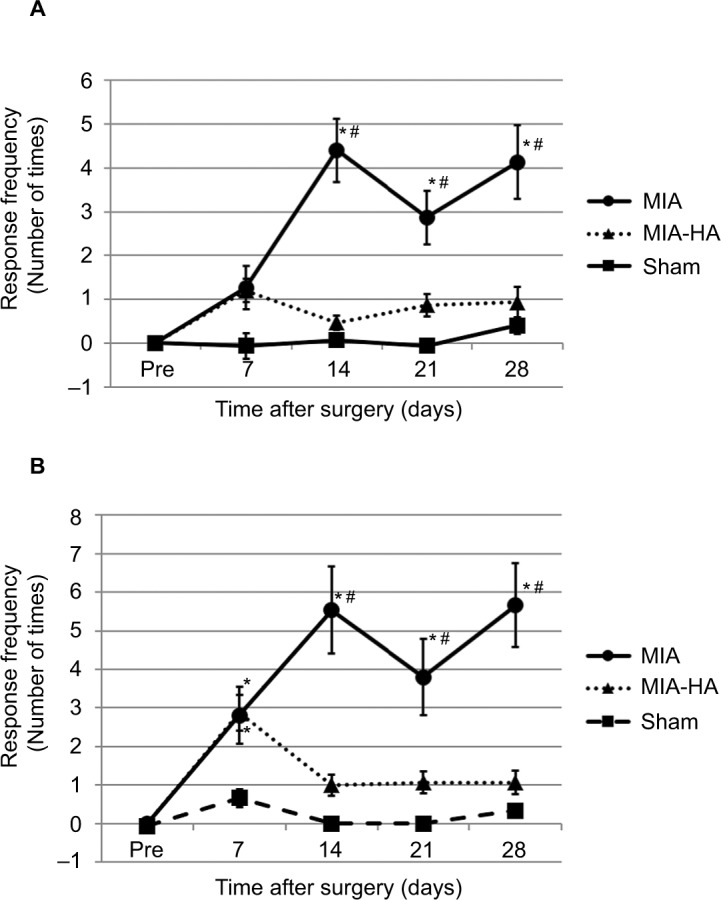
No significant difference in the degree of ankle swelling or ROM reduction was observed between MIA rats and MIA-HA rats. However, compared with those in MIA rats, mechanical and thermal hypersensitivity was significantly reduced and stride length significantly improved in MIA-HA rats. Histologic analysis revealed that cartilage degeneration was significantly suppressed in MIA-HA rats compared with that in MIA rats, reflecting the chondroprotective effects of HA.
HA improved pain-related behavior and stride length and suppressed MIA-induced cartilage degeneration. HA may thus inhibit OA progression and suppress peripheral and/or central sensitization.
踝关节骨关节炎(OA)会导致严重疼痛和功能障碍,但其潜在机制仍不清楚。临床上,透明质酸(HA)被广泛用于治疗OA。本研究旨在探讨HA在单碘乙酸盐(MIA)诱导的大鼠踝关节OA模型中与疼痛相关行为、关节功能、肿胀及软骨病理变化中的作用。
将雄性Sprague Dawley大鼠分为三个实验组,如下:1)连续两天在右胫跗关节注射1mg MIA的MIA大鼠;2)注射生理盐水而非MIA的假手术大鼠;3)在MIA注射后第7、14和21天在胫跗关节注射HA的MIA-HA大鼠。在MIA或生理盐水注射前1天以及注射后第7、14、21和28天评估关节肿胀、活动范围(ROM)和疼痛相关行为。在MIA或生理盐水注射后28天评估踝关节的病理变化。
MIA大鼠和MIA-HA大鼠在踝关节肿胀程度或ROM降低方面未观察到显著差异。然而,与MIA大鼠相比,MIA-HA大鼠的机械性和热超敏反应显著降低,步幅显著改善。组织学分析显示,与MIA大鼠相比,MIA-HA大鼠的软骨退变得到显著抑制,这反映了HA的软骨保护作用。
HA改善了疼痛相关行为和步幅,并抑制了MIA诱导的软骨退变。因此,HA可能抑制OA进展并抑制外周和/或中枢敏化。