Yoneda Masakazu, Imamura Ryuji, Nitta Hidetoshi, Taniguchi Keisuke, Saito Fumitaka, Kikuchi Ken, Ogi Hidenao, Tanaka Takuya, Katabuchi Hidetaka, Nakayama Hideki, Imamura Takahisa
Department of Molecular Pathology, Faculty of Life Sciences, Kumamoto University, Kumamoto 860-8556, Japan.
Department of Oral and Maxillofacial Surgery, Faculty of Life Sciences, Kumamoto University, Kumamoto 860-8556, Japan.
Oncol Lett. 2019 Jan;17(1):913-920. doi: 10.3892/ol.2018.9715. Epub 2018 Nov 16.
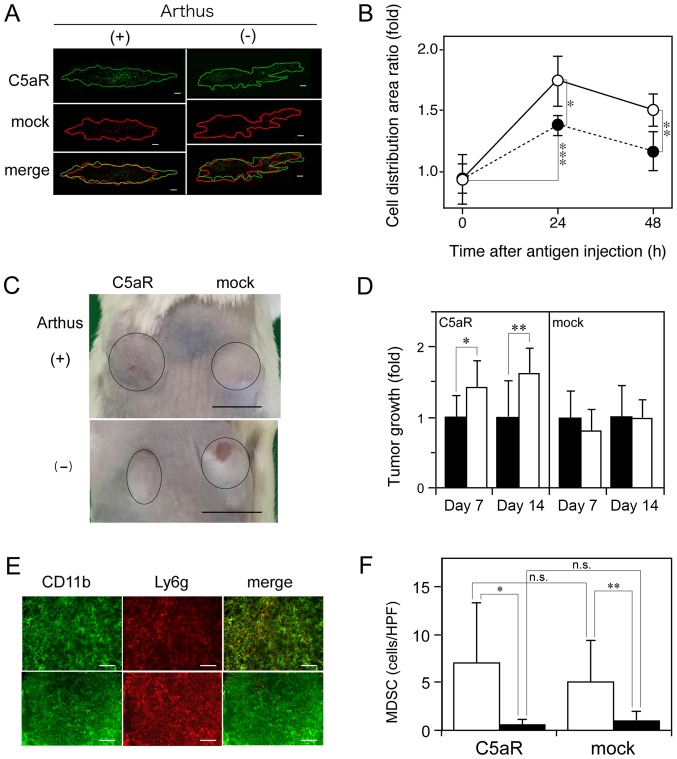
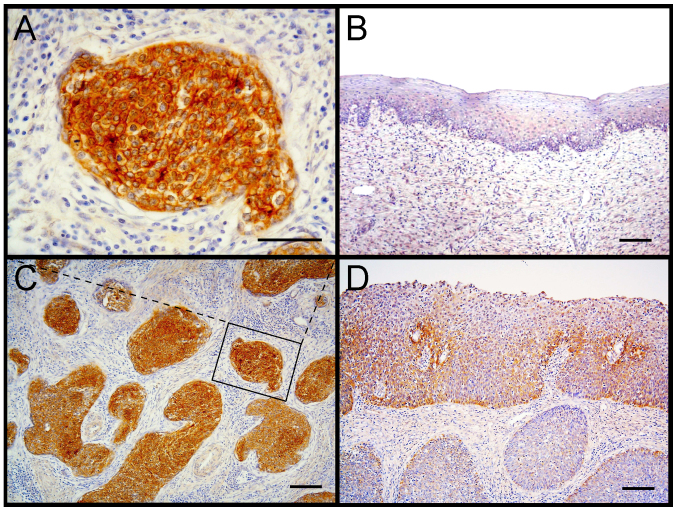
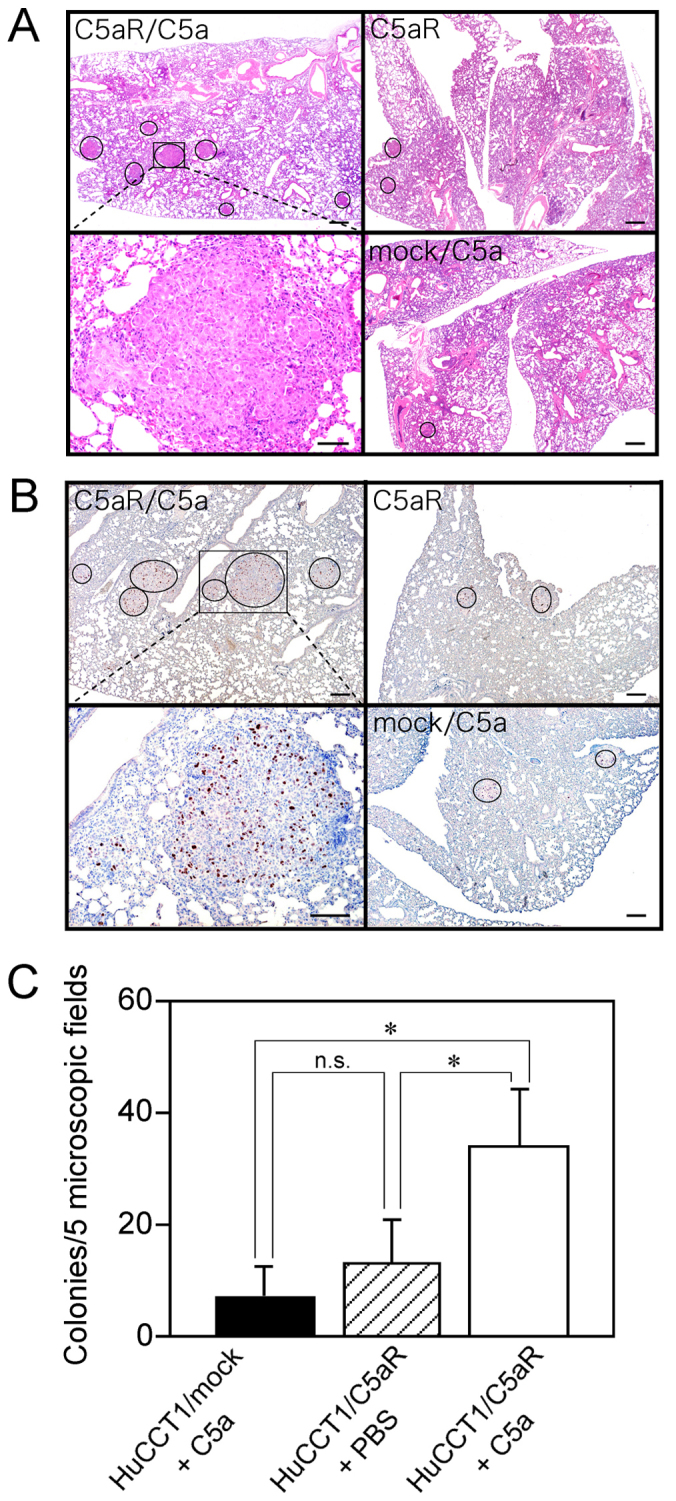
Autoimmune diseases are caused by immune complex-induced activation of the complement system and subsequent inflammation. Recent studies have revealed an association between autoimmune diseases and worse survival in patients with cancer; however, the underlying mechanism is still unknown. The C5a-C5a receptor (C5aR) system has been shown to enhance cancer activity and recruit myeloid-derived suppressor cells (MDSCs) that suppress the anti-tumor immune response. The Arthus reaction is inflammation caused by complement system activation by the immune complex and thus is a model of autoimmune diseases. To explore the effect of the Arthus reaction on cancer progression, mouse cancer cells were inoculated in syngeneic mouse skin, where the Arthus reaction was induced simultaneously. The Arthus reaction enhanced invasion and tumor growth of C5aR-positive cancer cells, but not control cells, and induced MDSC recruitment. Intravenous injection of C5a-stimulated C5aR-positive cancer cells into nude mice resulted in more lung nodules than injection of nontreated C5aR-positive cells and C5a-stimulated C5aR-negative cells, supporting C5a-C5aR-mediated enhancement of cancer growth. C5aR expression in uterine cervical carcinoma stage I cells, which invade into the deeper tissues, was significantly higher than that in CIN3 cells, which remain in the epithelium. These results indicate that cancer promotion by the C5a-C5aR system may underlie poor prognosis in cancer patients with autoimmune diseases, particularly in patients with C5aR-positive cancer, and may be associated with cervical cancer invasion. The enhancement of cancer cell invasion and growth by the C5a-C5aR system suggests that this system is a possible target of cancer therapy.
自身免疫性疾病是由免疫复合物诱导补体系统激活及随后的炎症反应所引起。最近的研究揭示了自身免疫性疾病与癌症患者较差的生存率之间存在关联;然而,其潜在机制仍不清楚。C5a - C5a受体(C5aR)系统已被证明可增强癌症活性并募集髓源性抑制细胞(MDSC),而髓源性抑制细胞会抑制抗肿瘤免疫反应。阿瑟斯反应是由免疫复合物激活补体系统引起的炎症,因此是自身免疫性疾病的一种模型。为了探究阿瑟斯反应对癌症进展的影响,将小鼠癌细胞接种于同基因小鼠皮肤中,同时在该部位诱导阿瑟斯反应。阿瑟斯反应增强了C5aR阳性癌细胞的侵袭和肿瘤生长,但对对照细胞没有影响,并且诱导了MDSC募集。将经C5a刺激的C5aR阳性癌细胞静脉注射到裸鼠体内,比注射未处理的C5aR阳性细胞和经C5a刺激的C5aR阴性细胞产生了更多的肺结节,这支持了C5a - C5aR介导的癌症生长增强作用。侵袭到更深组织的子宫颈癌I期细胞中的C5aR表达明显高于仍处于上皮层的CIN3细胞中的C5aR表达。这些结果表明,C5a - C5aR系统促进癌症可能是自身免疫性疾病癌症患者,特别是C5aR阳性癌症患者预后不良的原因,并且可能与宫颈癌侵袭有关。C5a - C5aR系统对癌细胞侵袭和生长的增强作用表明该系统可能是癌症治疗的一个潜在靶点。