Institute of Infection, Immunity and Inflammation, University of Glasgow, Glasgow, UK.
Department of Internal and Agricultural Medicine, Jagiellonian University Medical College, Krakow, Poland.
Br J Pharmacol. 2019 Jun;176(12):1951-1965. doi: 10.1111/bph.14583. Epub 2019 Mar 14.
Hypertension is a multifactorial disease, manifested by vascular dysfunction, increased superoxide production, and perivascular inflammation. In this study, we have hypothesized that 1,2,3,4,6-penta-O-galloyl-β-d-glucose (PGG) would inhibit vascular inflammation and protect from vascular dysfunction in an experimental model of hypertension.
PGG was administered to mice every 2 days at a dose of 10 mg·kg i.p during 14 days of Ang II infusion. It was used at a final concentration of 20 μM for in vitro studies in cultured cells.
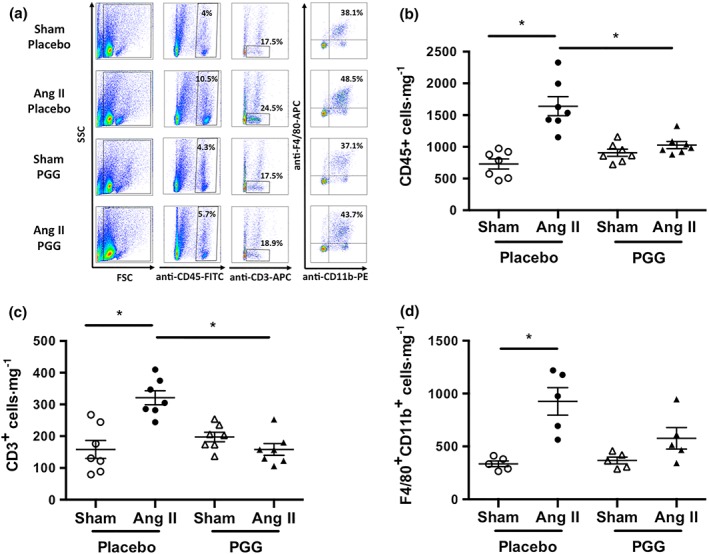
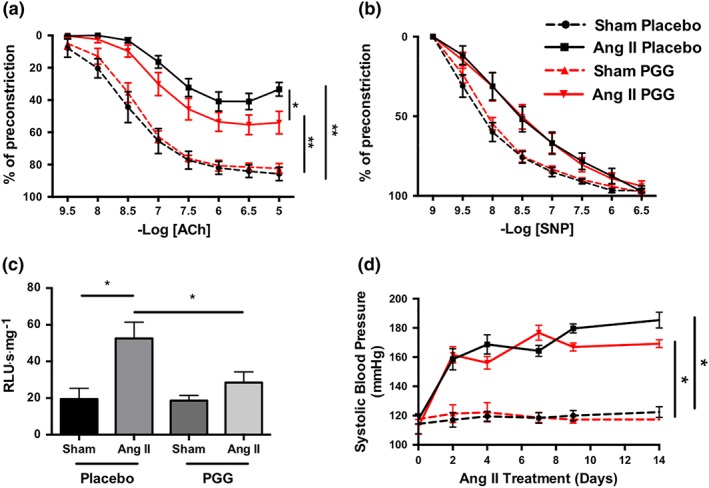
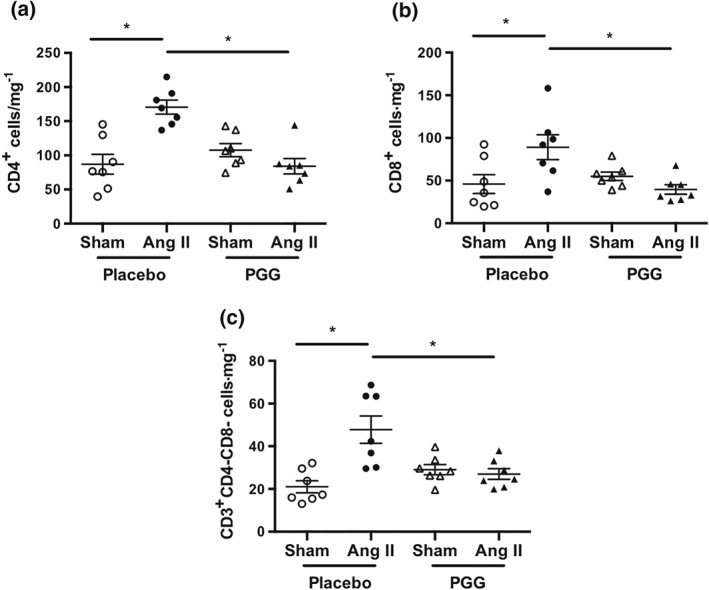
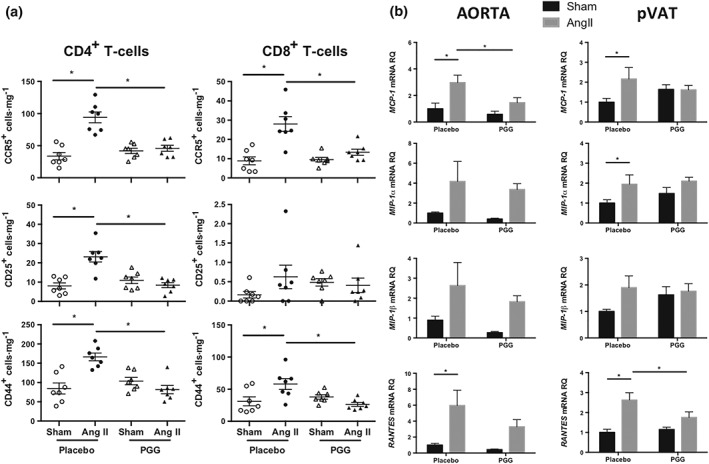
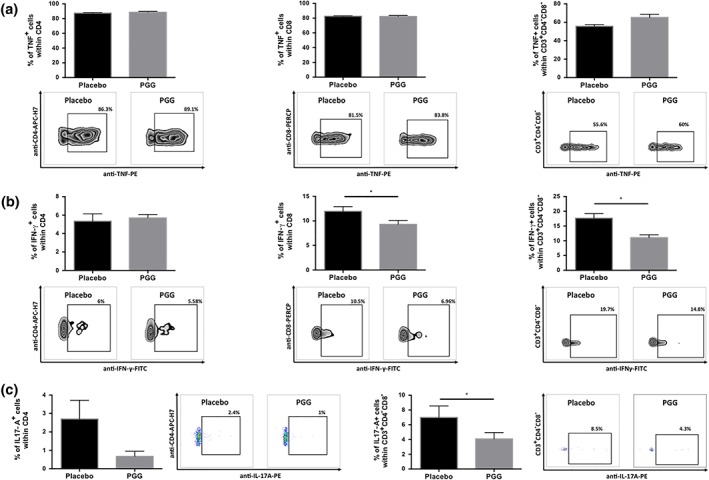
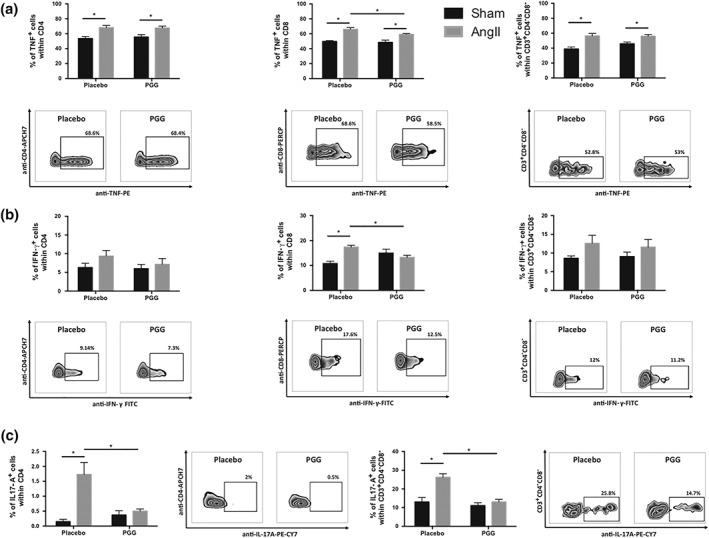
Ang II administration increased leukocyte and T-cell content in perivascular adipose tissue (pVAT), and administration of PGG significantly decreased total leukocyte and T-cell infiltration in pVAT. This effect was observed in relation to all T-cell subsets. PGG also decreased the content of T-cells bearing CD25, CCR5, and CD44 receptors and the expression of both monocyte chemoattractant protein 1 (CCL2) in aorta and RANTES (CCL5) in pVAT. PGG administration decreased the content of TNF and IFN-γ CD8 T-cells and IL-17A CD4 and CD3 CD4 CD8 cells. Importantly, these effects of PGG were associated with improved vascular function and decreased ROS production in the aortas of Ang II-infused animals independently of the BP increase. Mechanistically, PGG (20 μM) directly inhibited CD25 and CCR5 expression in cultured T-cells. It also decreased the content of IFN-γ CD8 and CD3 CD4 CD8 cells and IL-17A CD3 CD4 CD8 cells.
PGG may constitute an interesting immunomodulating strategy in the regulation of vascular dysfunction and hypertension.
This article is part of a themed section on Immune Targets in Hypertension. To view the other articles in this section visit http://onlinelibrary.wiley.com/doi/10.1111/bph.v176.12/issuetoc.
高血压是一种多因素疾病,表现为血管功能障碍、超氧化物产生增加和血管周围炎症。在这项研究中,我们假设 1,2,3,4,6-五-O-没食子酰基-β-d-葡萄糖(PGG)会抑制血管炎症,并在高血压的实验模型中保护血管功能障碍。
在血管紧张素 II 输注的 14 天内,每 2 天给小鼠腹腔注射 PGG 一次,剂量为 10mg·kg。在体外培养细胞中,它被用于终浓度为 20μM 的实验。
血管紧张素 II 给药增加了血管周围脂肪组织(pVAT)中的白细胞和 T 细胞含量,而 PGG 的给药显著减少了 pVAT 中的总白细胞和 T 细胞浸润。这种作用与所有 T 细胞亚群有关。PGG 还降低了携带 CD25、CCR5 和 CD44 受体的 T 细胞含量,以及主动脉中单核细胞趋化蛋白 1(CCL2)和 pVAT 中 RANTES(CCL5)的表达。PGG 给药减少了 TNF 和 IFN-γ CD8 T 细胞和 IL-17A CD4 和 CD3 CD4 CD8 细胞的含量。重要的是,PGG 的这些作用与血管紧张素 II 输注动物的血管功能改善和 ROS 产生减少有关,而与血压升高无关。在机制上,PGG(20μM)直接抑制了培养 T 细胞中的 CD25 和 CCR5 表达。它还降低了 IFN-γ CD8 和 CD3 CD4 CD8 细胞和 IL-17A CD3 CD4 CD8 细胞的含量。
PGG 可能构成一种有趣的免疫调节策略,用于调节血管功能障碍和高血压。
本文是免疫靶点在高血压专题的一部分。要查看该部分中的其他文章,请访问 http://onlinelibrary.wiley.com/doi/10.1111/bph.v176.12/issuetoc.