Division of Nephrology, Department of Medicine, University of Tennessee Health Science Center, Memphis, TN, United States; Nephrology Center, Toranomon Hospital, Tokyo, Japan; Department of Nephrology, Faculty of Medicine, University of Tsukuba, Ibaraki, Japan.
Division of Nephrology, Department of Medicine, University of Tennessee Health Science Center, Memphis, TN, United States; Department of Transplantation and Surgery, Semmelweis University, Budapest, Hungary; Methodist University Hospital Transplant Institute, Memphis, TN, United States; Department of Surgery, University of Tennessee Health Science Center, Memphis, TN, United States.
Atherosclerosis. 2019 Feb;281:114-120. doi: 10.1016/j.atherosclerosis.2018.12.021. Epub 2018 Dec 23.
Constipation is one of the most frequent symptoms encountered in daily clinical practice and is implicated in the development of atherosclerosis, potentially through altered gut microbiota. However, little is known about its association with incident cardiovascular events.
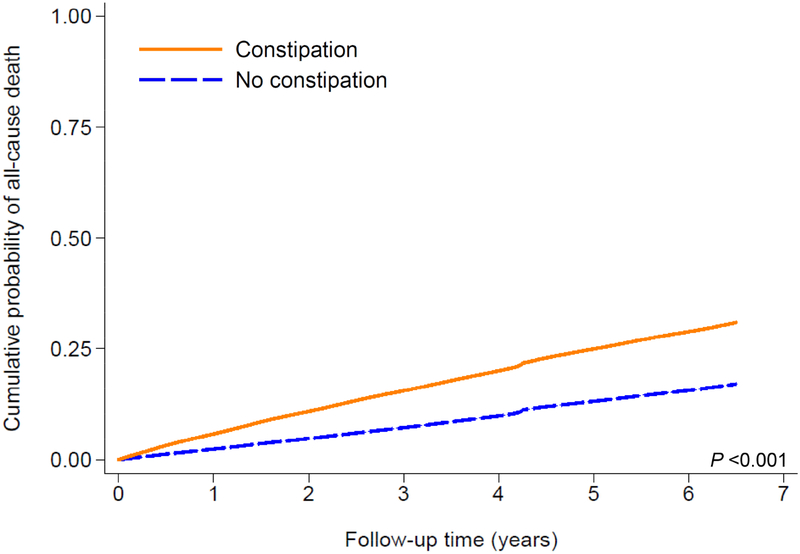
In a nationally representative cohort of 3,359,653 US veterans with an estimated glomerular filtration rate (eGFR) ≥60 mL/min/1.73 m between October 1, 2004 and September 30, 2006 (baseline period), with follow-up through 2013, we examined the association of constipation status (absence or presence; defined using diagnostic codes and laxative use) and laxative use (none, one, or ≥2 types of laxatives) with all-cause mortality, incident coronary heart disease (CHD), and incident ischemic stroke.
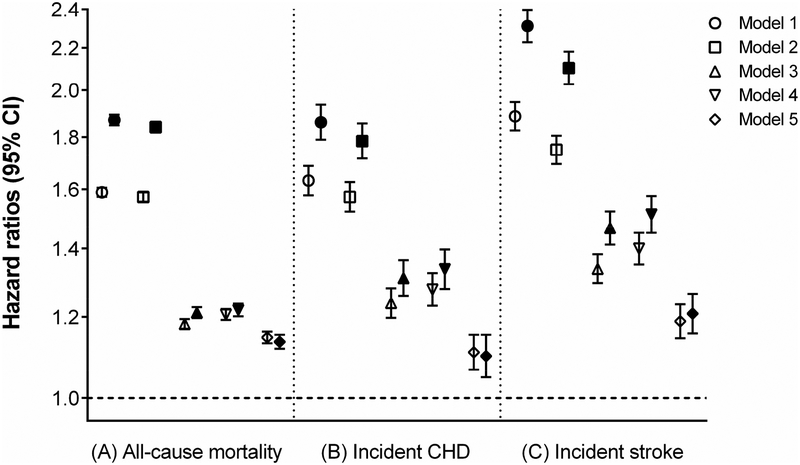
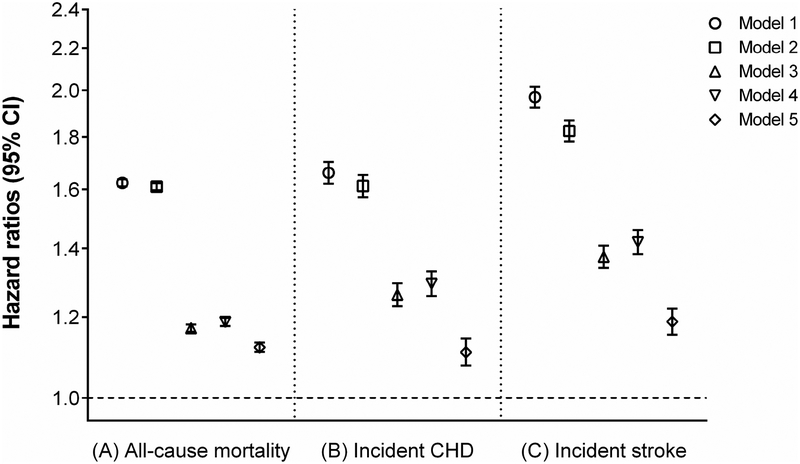
Among 3,359,653 patients, 237,855 (7.1%) were identified as having constipation. After multivariable adjustments for demographics, prevalent comorbidities, medications, and socioeconomic status, patients with (versus without) constipation had 12% higher all-cause mortality (hazard ratio [HR], 1.12; 95% CI, 1.11-1.13), 11% higher incidence of CHD (HR, 1.11; 95% CI, 1.08-1.14), and 19% higher incidence of ischemic stroke (HR, 1.19; 95% CI, 1.15-1.22). Patients with one and ≥2 (versus none) types of laxatives experienced a similarly higher risk of all-cause mortality (HRs [95% CI], 1.15 [1.13-1.16] and 1.14 [1.12-1.15], respectively), incident CHD (HRs [95% CI], 1.11 [1.07-1.15] and 1.10 [1.05-1.15], respectively) and incident ischemic stroke (HRs [95% CI], 1.19 [1.14-1.23] and 1.21 [1.16-1.26], respectively).
Constipation status and laxative use are independently associated with higher risk of all-cause mortality and incident CHD and ischemic stroke.
便秘是日常临床实践中最常见的症状之一,与动脉粥样硬化的发生有关,可能通过改变肠道微生物群来实现。然而,关于其与心血管事件发生的关系知之甚少。
在 2004 年 10 月 1 日至 2006 年 9 月 30 日期间(基线期),我们对 3359653 名美国退伍军人进行了一项全国代表性队列研究,这些退伍军人的肾小球滤过率(eGFR)估计值≥60mL/min/1.73m,通过 2013 年的随访,我们研究了便秘状态(存在或不存在;使用诊断代码和泻药使用来定义)和泻药使用(无、一种或≥2 种泻药)与全因死亡率、冠心病(CHD)和缺血性卒中发生率之间的关联。
在 3359653 名患者中,有 237855 名(7.1%)被确定为便秘。在调整了人口统计学、现患合并症、药物和社会经济状况等因素后,与无便秘的患者相比,便秘患者的全因死亡率(风险比 [HR],1.12;95%CI,1.11-1.13)增加 12%,冠心病(HR,1.11;95%CI,1.08-1.14)发生率增加 11%,缺血性卒中(HR,1.19;95%CI,1.15-1.22)发生率增加 19%。使用一种和≥2 种(与无)类型泻药的患者全因死亡率风险也显著升高(HRs[95%CI],1.15[1.13-1.16]和 1.14[1.12-1.15]),冠心病(HRs[95%CI],1.11[1.07-1.15]和 1.10[1.05-1.15])和缺血性卒中(HRs[95%CI],1.19[1.14-1.23]和 1.21[1.16-1.26])的发生率也显著升高。
便秘状态和泻药的使用与全因死亡率和冠心病及缺血性卒中等事件发生的风险增加独立相关。