Department of Epidemiology, Harvard T.H. Chan School of Public Health, Boston, MA 02115, USA.
Department of Nutrition, Harvard T.H. Chan School of Public Health, Boston, MA 02115, USA.
Sci Rep. 2016 Sep 6;6:33005. doi: 10.1038/srep33005.
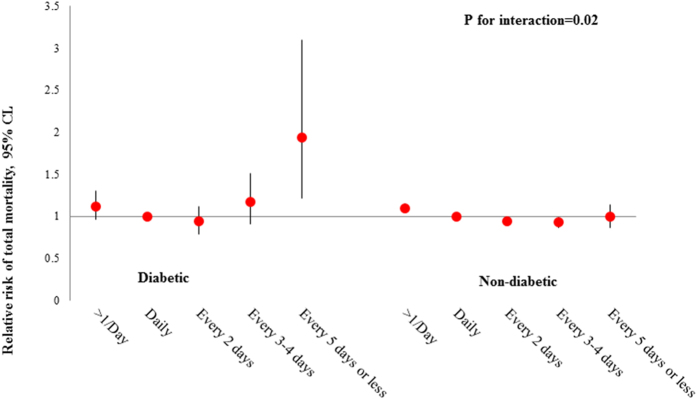
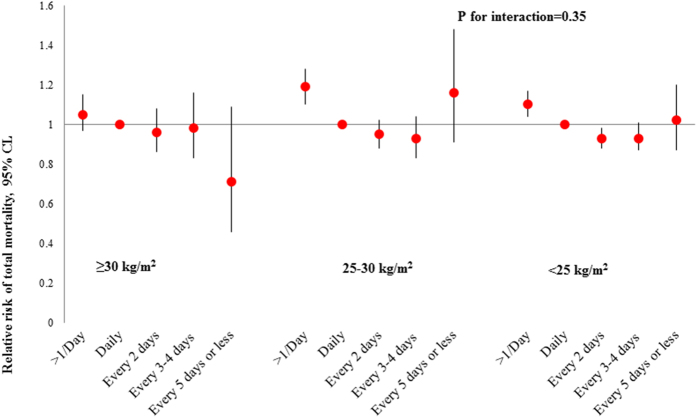
Emerging evidence suggests a potential impact of gastrointestinal function on cardiometabolic risk. Abnormal bowel movements have been related to various cardiovascular risk factors such as dyslipidemia, hypertension, diabetes, and altered metabolism of bile acids and gut microbiota. However, little is known about whether bowel movement frequency affects risk of cardiovascular disease (CVD) and mortality. In the Nurses' Health Study, bowel movement frequency was self-reported in 1982 by 86,289 women free from CVD and cancer. During up to 30 years of follow-up, we documented 7,628 incident CVD cases and 21,084 deaths. After adjustment for dietary intake, lifestyle, medication use, and other risk factors, as compared with women with daily bowel movement, having bowel movements more than once daily was significantly associated with increased risk of CVD (hazard ratio [HR]: 1.13; 95% confidence interval [CI]: 1.05-1.21), total mortality (HR: 1.17; 95% CI: 1.12-1.22), and cardiovascular mortality (HR: 1.17; 95% CI: 1.07-1.28). With further adjustment for body mass index and diabetes status, the association with total mortality remained significant (HR: 1.10; 95% CI: 1.06-1.15), whereas the associations with incident CVD and cardiovascular mortality were no longer significant. Our results suggest increased bowel movement frequency is a potential risk factor for premature mortality.
越来越多的证据表明,胃肠道功能可能对心血管代谢风险产生影响。异常的排便习惯与多种心血管危险因素有关,如血脂异常、高血压、糖尿病以及胆汁酸和肠道微生物群代谢改变。然而,人们对于排便频率是否会影响心血管疾病(CVD)风险和死亡率知之甚少。在“护士健康研究”中,1982 年有 86289 名无 CVD 和癌症的女性自我报告了排便频率。在长达 30 年的随访期间,我们记录了 7628 例新发 CVD 病例和 21084 例死亡。在调整饮食摄入、生活方式、用药情况和其他危险因素后,与每日排便一次的女性相比,每日排便次数多于一次的女性 CVD 风险显著增加(风险比 [HR]:1.13;95%置信区间 [CI]:1.05-1.21)、全因死亡率(HR:1.17;95% CI:1.12-1.22)和心血管死亡率(HR:1.17;95% CI:1.07-1.28)。进一步调整体重指数和糖尿病状态后,与全因死亡率的关联仍然显著(HR:1.10;95% CI:1.06-1.15),而与新发 CVD 和心血管死亡率的关联不再显著。我们的研究结果表明,排便频率增加可能是导致过早死亡的一个潜在危险因素。