Liu Yao-Hua, Yeh I-Jeng, Lai Ming-Derg, Liu Kuan-Ting, Kuo Po-Lin, Yen Meng-Chi
Department of Emergency Medicine, Kaohsiung Medical University Hospital, Kaohsiung Medical University, Kaohsiung 807, Taiwan.
Department of Biochemistry and Molecular Biology, College of Medicine, National Cheng Kung University, Tainan 701, Taiwan.
Cancers (Basel). 2019 Jan 17;11(1):108. doi: 10.3390/cancers11010108.
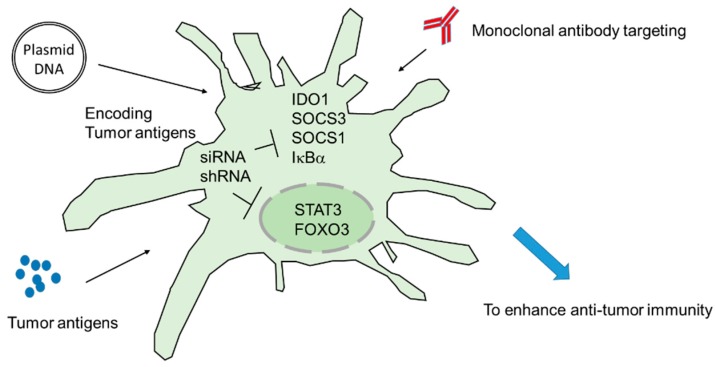
Dendritic cells (DCs) are capable of activating adaptive immune responses, or inducing immune suppression or tolerance. In the tumor microenvironment, the function of DCs is polarized into immune suppression that attenuates the effect of T cells, promoting differentiation of regulatory T cells and supporting tumor progression. Therefore, blocking negative immune regulators in DCs is considered a strategy of cancer immunotherapy. Antibodies can target molecules on the cell surface, but not intracellular molecules of DCs. The delivery of short-hairpin RNAs (shRNA) and small-interfering RNAs (siRNA) should be a strategy to silence specific intracellular targets in DCs. This review provides an overview of the known negative immune regulators of DCs. Moreover, a combination of shRNA/siRNA and DC vaccines, DNA vaccines in animal models, and clinical trials are also discussed.
树突状细胞(DCs)能够激活适应性免疫反应,或诱导免疫抑制或耐受。在肿瘤微环境中,DCs的功能偏向于免疫抑制,从而减弱T细胞的作用,促进调节性T细胞的分化并支持肿瘤进展。因此,阻断DCs中的负性免疫调节因子被认为是癌症免疫治疗的一种策略。抗体可以靶向细胞表面的分子,但不能靶向DCs的细胞内分子。短发夹RNA(shRNA)和小干扰RNA(siRNA)的递送应该是使DCs中特定细胞内靶点沉默的一种策略。本综述概述了已知的DCs负性免疫调节因子。此外,还讨论了shRNA/siRNA与DC疫苗、动物模型中的DNA疫苗以及临床试验的联合应用。