Department of Psychiatry, College of Health Sciences, Addis Ababa University, Addis Ababa, Ethiopia.
Department of Psychology, University of Gondar, Gondar, Ethiopia.
BMJ Open. 2019 Jan 17;9(1):e021142. doi: 10.1136/bmjopen-2017-021142.
This study aimed at testing the significance of mediating and moderating roles of sense of coherence, adaptive coping styles and social support in the relationship between exposure to trauma and psychological symptoms in a refugee population in sub-Saharan Africa.
A cross-sectional survey design was employed to collect data. The study was carried out in Mai Aini refugee camp in Ethiopia. A total of 562 adult Eritrean refugees aged 18-74 years were selected randomly to screen for depression and post-traumatic stress disorder (PTSD) symptoms and to examine associated factors. Data were collected using the premigration and postmigration living difficulties checklist, Center for Epidemiologic Studies Depression (CES-D) scale, Primary Care PTSD Screener, coping style scale, Sense of Coherence scale and Oslo Social Support scale. Path modelling was used to test the mediation and moderation effects of prespecified factors.
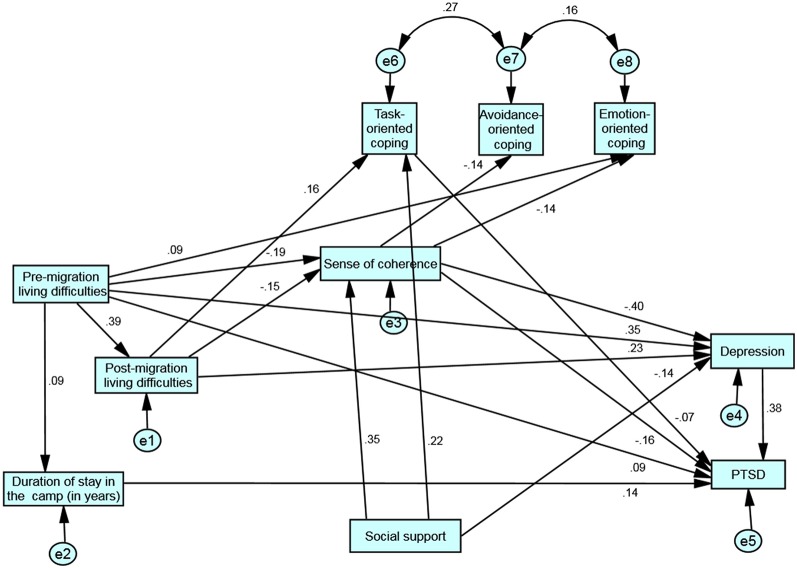
Premigration living difficulties were associated directly with symptoms of PTSD (β=0.09, p<0.05), and associated indirectly with PTSD symptoms in paths through duration of stay in the camp, sense of coherence, postmigration living difficulties, task-oriented coping style and depressive symptoms (β=0.26, p<0.01). Premigration and postmigration living difficulties were associated directly with depressive symptoms with standardised estimate of β=0.35(p<0.001) and β=0.23(p<0.05), respectively. Postmigration living difficulties were associated indirectly with PTSD through paths of sense of coherence, task-oriented coping style and depressive symptoms (β=0.13; p<0.01). Social support moderated the effect of postmigration living difficulties on depressive symptoms (p<0.05). Emotion-oriented coping style moderated the effect of premigration threat for abuse on PTSD (β=-0.18, p<0.001) and depressive (β=-0.12, p<0.01) symptoms, as well as moderating threat to life on PTSD symptoms (β=-0.13, p<0.001).
Sense of coherence and task-oriented coping style showed a partial mediating effect on the association between exposure to trauma and symptoms of PTSD. An emotion-oriented coping style and social support moderated the effect of premigration and postmigration living difficulties, respectively. Fostering social support, task-oriented and emotion-oriented coping styles may be beneficial for these refugees.
本研究旨在检验在撒哈拉以南非洲的难民群体中,创伤暴露与心理症状之间的关系中,作为中介和调节作用的感知连贯、适应性应对方式和社会支持的意义。
采用横断面调查设计收集数据。该研究在埃塞俄比亚的迈阿尼难民营进行。共随机选择 562 名 18-74 岁的成年厄立特里亚难民,筛查抑郁和创伤后应激障碍(PTSD)症状,并检查相关因素。使用移民前和移民后生活困难清单、流行病学研究中心抑郁量表(CES-D)、初级保健 PTSD 筛查器、应对方式量表、感知连贯量表和奥斯陆社会支持量表收集数据。路径模型用于检验预设因素的中介和调节效应。
移民前的生活困难与 PTSD 症状直接相关(β=0.09,p<0.05),并通过在难民营停留时间、感知连贯、移民后生活困难、任务导向应对方式和抑郁症状的路径间接与 PTSD 症状相关(β=0.26,p<0.01)。移民前和移民后生活困难与抑郁症状直接相关,标准化估计值分别为β=0.35(p<0.001)和β=0.23(p<0.05)。移民后生活困难通过感知连贯、任务导向应对方式和抑郁症状的路径间接与 PTSD 相关(β=0.13;p<0.01)。社会支持调节了移民后生活困难对抑郁症状的影响(p<0.05)。情绪导向应对方式调节了移民前受虐待威胁对 PTSD(β=-0.18,p<0.001)和抑郁(β=-0.12,p<0.01)症状以及对生命威胁对 PTSD 症状的影响(β=-0.13,p<0.001)。
感知连贯和任务导向应对方式对创伤暴露与 PTSD 症状之间的关联具有部分中介作用。情绪导向应对方式和社会支持分别调节移民前和移民后生活困难的影响。培养社会支持、任务导向和情绪导向应对方式可能对这些难民有益。