MRC Integrative Epidemiology Unit at the University of Bristol, Oakfield House, Oakfield Grove, Bristol, BS8 2BN, UK.
Population Health Science, Bristol Medical School, University of Bristol, Bristol, UK.
BMC Med. 2019 Jan 21;17(1):15. doi: 10.1186/s12916-018-1248-7.
Pregnancy is associated with widespread change in metabolism, which may be more marked in obese women. Whether lifestyle interventions in obese pregnant women improve pregnancy metabolic profiles remains unknown. Our objectives were to determine the magnitude of change in metabolic measures during obese pregnancy, to indirectly compare these to similar profiles in a general pregnant population, and to determine the impact of a lifestyle intervention on change in metabolic measures in obese pregnant women.
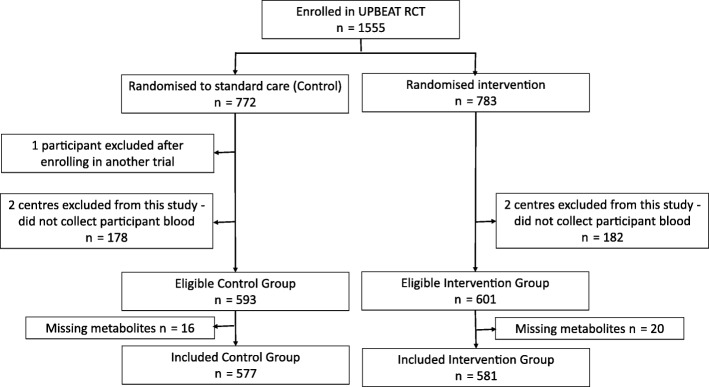
Data from a randomised controlled trial of 1158 obese (BMI ≥ 30 kg/m) pregnant women recruited from six UK inner-city obstetric departments were used. Women were randomised to either the UPBEAT intervention, a tailored complex lifestyle intervention focused on improving diet and physical activity, or standard antenatal care (control group). UPBEAT has been shown to improve diet and physical activity during pregnancy and up to 6-months postnatally in obese women and to reduce offspring adiposity at 6-months; it did not affect risk of gestational diabetes (the primary outcome). Change in the concentrations of 158 metabolic measures (129 lipids, 9 glycerides and phospholipids, and 20 low-molecular weight metabolites), quantified three times during pregnancy, were compared using multilevel models. The role of chance was assessed with a false discovery rate of 5% adjusted p values.
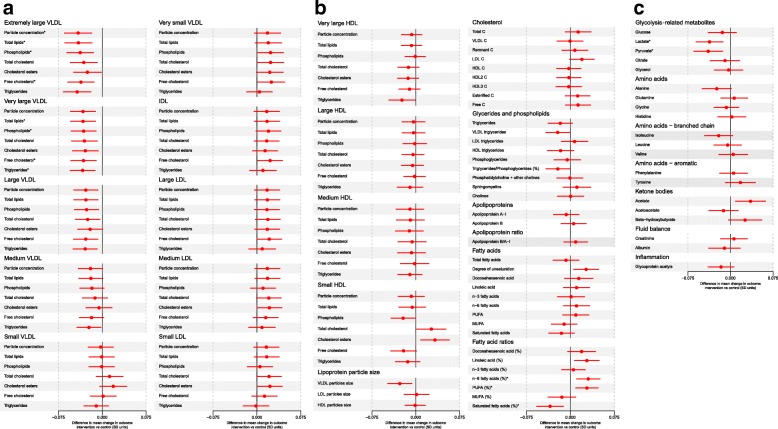
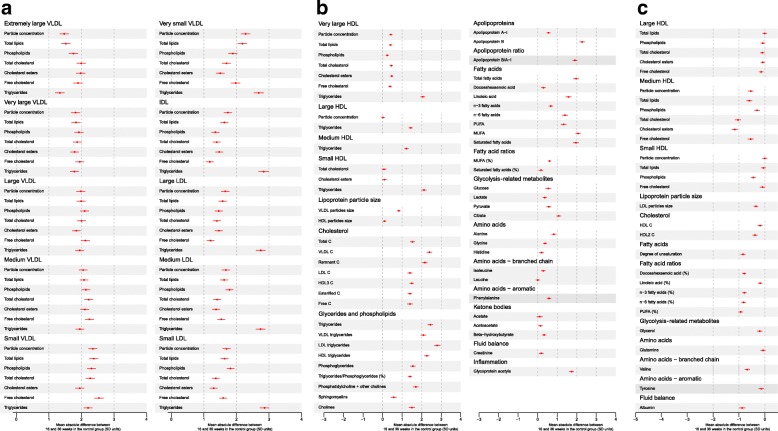
All very low-density lipoprotein (VLDL) particles increased by 1.5-3 standard deviation units (SD) whereas intermediate density lipoprotein and specific (large, medium and small) LDL particles increased by 1-2 SD, between 16 and 36 weeks' gestation. Triglycerides increased by 2-3 SD, with more modest changes in other metabolites. Indirect comparisons suggest that the magnitudes of change across pregnancy in these obese women were 2- to 3-fold larger than in unselected women (n = 4260 in cross-sectional and 583 in longitudinal analyses) from an independent, previously published, study. The intervention reduced the rate of increase in extremely large, very large, large and medium VLDL particles, particularly those containing triglycerides.
There are marked changes in lipids and lipoproteins and more modest changes in other metabolites across pregnancy in obese women, with some evidence that this is more marked than in unselected pregnant women. The UPBEAT lifestyle intervention may contribute to a healthier metabolic profile in obese pregnant women, but our results require replication.
UPBEAT was registered with Current Controlled Trials, ISRCTN89971375 , on July 23, 2008 (prior to recruitment).
妊娠伴随着代谢的广泛变化,而肥胖女性的代谢变化可能更为显著。肥胖孕妇的生活方式干预是否能改善妊娠代谢特征仍不清楚。我们的目的是确定肥胖孕妇妊娠期间代谢指标的变化幅度,间接将其与一般孕妇的类似特征进行比较,并确定生活方式干预对肥胖孕妇代谢指标变化的影响。
我们使用了一项随机对照试验的数据,该试验共纳入了来自英国六家市区产科的 1158 名肥胖(BMI≥30kg/m)孕妇,这些孕妇均随机分配到 UPBEAT 干预组或标准产前护理对照组。UPBEAT 是一种针对改善饮食和体育活动的个性化综合生活方式干预措施,已被证明可以改善肥胖孕妇妊娠期间和产后 6 个月的饮食和体育活动,并降低 6 个月时后代的肥胖程度;但它对妊娠期糖尿病的风险没有影响(主要结局)。使用多水平模型比较了妊娠期间三次测量的 158 种代谢指标(129 种脂质、9 种甘油三酯和磷脂以及 20 种低分子量代谢物)的浓度变化。使用虚假发现率为 5%调整后的 p 值评估了机会的作用。
所有极低密度脂蛋白(VLDL)颗粒增加了 1.5-3 个标准差单位(SD),而中间密度脂蛋白和特定(大、中、小)低密度脂蛋白颗粒增加了 1-2 个 SD,在 16-36 周妊娠期间。甘油三酯增加了 2-3 个 SD,其他代谢物的变化幅度较小。间接比较表明,与来自先前发表的独立研究中的未选择妇女(横断面分析中 n=4260,纵向分析中 n=583)相比,这些肥胖孕妇妊娠期间的变化幅度大 2-3 倍。该干预措施降低了特大、超大、大、中 VLDL 颗粒的增加速度,尤其是含有甘油三酯的 VLDL 颗粒。
肥胖孕妇妊娠期间的脂质和脂蛋白发生了明显变化,其他代谢物也发生了适度变化,有证据表明,这些变化比未选择的孕妇更为明显。UPBEAT 生活方式干预可能有助于肥胖孕妇形成更健康的代谢特征,但我们的结果需要进一步验证。
UPBEAT 于 2008 年 7 月 23 日在 Current Controlled Trials(ISRCTN89971375)上注册,早于招募阶段。